
After Dinner: Creating an Inviting Sitting Room with Stained-Glass Wall Lights
There is a particular pleasure in leaving the dining table and settling somewhere more comfortable. Coffee arrives, shoes slip off, and conversation continues without anyone watching the clock. The room that accommodates this part of an evening needs surprisingly little: comfortable seating, somewhere to put a cup, and lighting that allows people to see one another without feeling on display.
Stained-glass wall lights bring another quality to that setting. Their color remains present even when the surrounding furniture is quiet, while their position leaves tables available for the things guests actually use. In a contemporary sitting room, a carefully placed blue glass shade can become the detail people remember long after dinner.
Begin with the Conversation, Then Place the Light
Before choosing a fixture, decide how people will sit. Two armchairs angled toward a sofa create a different evening from a row of seats facing a television. Each seat should have a comfortable relationship with the others, with enough space to move through the arrangement without stepping around someone's knees.
Consider the room from those seated positions. A wall that looks empty from the doorway may become an important backdrop once guests settle into their chairs. That is often a useful place for decorative lighting: visible within the room, but slightly outside the direct line of conversation.
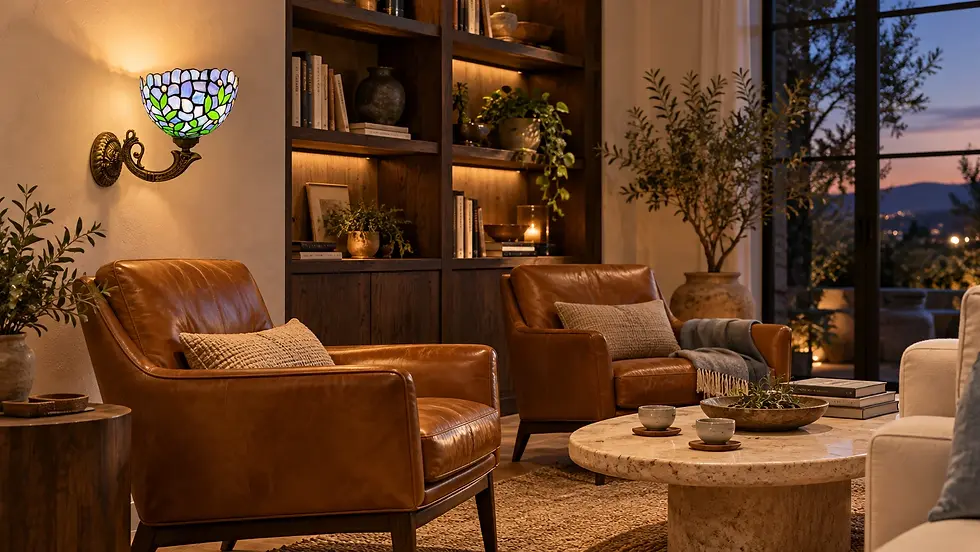
When considering Tiffany style wall lights, look at the entire silhouette, including the shade, supporting arm, and backplate. An upward-facing glass bowl introduces a different shape from a downward-facing shade. A curved bronze-colored arm can soften the lines of contemporary cabinetry, while the glass supplies pattern without requiring another upholstered surface.
Leave the tables to do their own work. A small side table that no longer needs to support a lamp has room for a cup and a book. This is especially valuable in a sitting room where the furniture is generously proportioned but the floor area is limited.
Give Blue Glass a Warm Setting
Blue does not have to turn the entire room into a blue scheme. It can remain concentrated in the lighting, balanced by the colors of leather, timber, stone, and plaster. Imagine pale walls, dark oak shelving, caramel armchairs, and a low travertine table. Against that background, blue glass becomes a distinct accent.
The precise shade matters. Pale lavender-blue reads differently from saturated cobalt, and a glass pattern containing green leaves or amber details offers several possible connections to the rest of the room. Look at both illuminated and unlit photographs when comparing designs. The fixture will also be part of the interior during daylight hours.
A useful way to approach blue Tiffany style wall lights is to select the glass first, then repeat only one of its quieter colors elsewhere. A dusty blue cushion might be enough. If the shade contains green botanical details, a plant can establish a subtle relationship without introducing another patterned object.
Keep the larger surfaces relatively composed. A plain rug allows the glasswork to remain legible; a heavily patterned rug, elaborate curtains, and busy upholstery may compete for attention. Richness can come from the grain of wood and the texture of fabric as much as from additional ornament.
Use the Wall as Part of the Composition
A decorative sconce needs space around it. Placing it tightly between a bookcase and a framed picture can make it feel like an afterthought, even when the fixture itself is beautiful. Give its outline enough clear wall to be understood from across the room.
Symmetry is one option, but it should follow the architecture. A pair may suit a centered fireplace or a balanced arrangement of cabinetry. In a room with an off-center window and a single reading chair, one well-positioned light can feel more settled than a pair forced into an awkward layout.
Before committing to positions for Tiffany wall lights, mark the proposed dimensions on the wall with paper templates. Include the backplate and overall height, and check the specified projection separately. A front-view photograph cannot show how far a fitting will extend into the room.
Move through the space and sit in every chair. Check that the fixture clears nearby doors and curtains, does not intrude into a walking route, and is not vulnerable to someone leaning back or standing up. Final mounting positions should take account of the actual fitting, the wall construction, and the electrical installation.
Let Decorative Light Share the Work
The glow of stained glass can establish the mood, but it should not have to illuminate every activity. Guests still need to find their cups, navigate the doorway, and see the person opposite them. Someone staying behind to read may want a different level of light altogether.
Combine the sconces with discreet background illumination. Shelving lights can reveal books and objects; a separate reading light can serve a favorite chair. Keep these sources visually restrained so that the room does not become a competition between luminous surfaces.
Controls deserve attention early in the design. Being able to operate decorative lights independently from the main room lighting gives the space more flexibility. If dimming is wanted, confirm compatibility between the fixture, lamp, and control rather than assuming every combination will work smoothly.
Test the arrangement after dark. A bare bulb visible from an armchair, a bright reflection in a window, or an overly illuminated shelf can be distracting even when the room photographs well. Adjust the balance for the people using the space.
Keep the Practical Details Within Reach
An inviting evening room should be easy to live with between gatherings. Leave access for cleaning the glass and changing lamps. Keep decorative objects clear of the fitting, and follow the manufacturer's instructions for installation, lamp selection, and care.
Decide where switches belong before furniture and joinery make access difficult. Guests should not have to reach behind a chair to find a control, and the route out of the room should remain easy to navigate when the main lights are lowered.
The last test is an ordinary evening at home. Sit down with a cup, move between the chairs, and notice where your eyes settle. There should be somewhere to rest a hand, somewhere to put the cup, and enough light to continue the conversation. Against warm plaster and dark timber, the blue glass can provide the finishing detail: a small, expressive presence in a room designed to be enjoyed.


