
Beyond Intuition: How AI, Smart Data, and Analytics Are Reshaping Modern Leadership
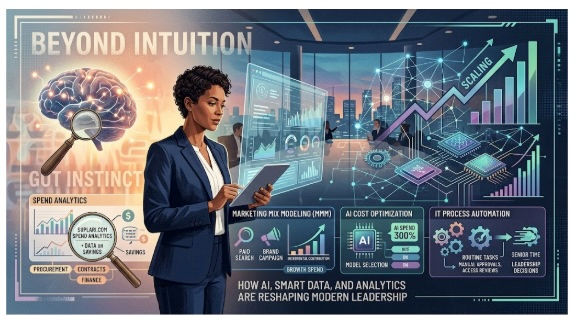
A CEO built her entire early career on gut instinct. Read the room, trust the pattern, and decide fast. It worked, right up until the company crossed a few thousand employees and the room got too big to read anymore. Decisions that used to take an afternoon started taking a committee. Not because she'd gotten worse at judgment. Because the business had outgrown what one person's intuition could reasonably cover, no matter how sharp that intuition was.
That's the quiet shift happening across a lot of leadership teams right now. Not AI replacing judgment. Judgment running out of room to operate alone, and needing something underneath it to actually keep up.
Intuition Was Never Wrong. It Just Stopped Scaling
Gut instinct built on twenty years of pattern recognition is real expertise, not luck. A seasoned executive spotting trouble in a deal before the numbers show it isn't guessing. They're running a model trained on decades of lived experience, just one that lives in a head instead of a spreadsheet.
The problem shows up at scale. One person's pattern recognition covers what they've personally seen. A company operating across a dozen markets, a hundred vendors, a thousand marketing decisions a quarter, generates more signals than any one brain can track, no matter how good that brain is. A leader relying purely on instinct at that size isn't being reckless. They're just working with a fraction of the picture and calling it the whole thing.
Where the Money Actually Goes
Ask most executives how confident they are in their spending visibility and the honest answer, if they're being straight, is "less than I'd like." Procurement data sits in one system. Contract terms sit in another. The actual invoice history lives somewhere a finance analyst has to manually reconcile every quarter, usually under deadline pressure, usually missing something.
This is the specific gap platforms like Suplari.com Spend Analytics exist to close. Instead of a quarterly snapshot built from data that's already a few months stale by the time anyone reviews it, continuous spend intelligence pulls from procurement, contracts, and financial systems as things happen, surfacing savings opportunities and supplier risk while there's still time to act on them. For a leader trying to defend a budget in front of a board, the difference between "we think we're overspending somewhere" and a specific, quantified answer is the difference between a hunch and a decision someone can actually stand behind.
Five Years Ago, This Was a Spreadsheet Nobody Trusted
It's worth remembering how recent this shift actually is. Five years back, spend visibility mostly meant a shared spreadsheet three people updated inconsistently, full of numbers everyone quietly distrusted but nobody had a better option than. Leaders made real budget calls off data they half-believed, because half-believed data was still better than nothing. Continuous, system-level spend analytics didn't fix that by being flashier. It fixed it by being current, which turned out to matter more than anyone expected.
Knowing Which Marketing Dollar Is Actually Working
A related blind spot shows up in growth spend. Leadership signs off on a marketing budget every year with a rough sense of which channels perform, based mostly on whichever channel presented the most confident-sounding deck at the last planning meeting. Paid search gets credit because it's easy to track. A brand campaign nobody's audited in two years keeps getting funded because cutting it feels riskier than questioning it.
The best mmm tools for e-commerce brands exist to settle that argument with evidence instead of confidence. Marketing mix modeling accounts for the real, multi-touch path a purchase actually takes, isolating each channel's true incremental contribution rather than crediting whichever touchpoint happened to sit closest to the sale. A leader deciding where to cut or expand budget with that kind of model behind the recommendation is making a fundamentally different decision than one made off a gut feeling about which channel "seems to be working."
The AI Spend Nobody's Watching Closely Enough
Here's a newer wrinkle showing up in leadership meetings that didn't exist three years ago. A team adopts an AI tool for one task, it works, someone adds a second use case, and eighteen months later AI has quietly become a meaningful line item nobody's fully accounted for. Worse, nobody's entirely sure which of those use cases are earning their keep and which are running because turning them off feels riskier than leaving them alone.
Ai cost optimization exists to answer that question honestly, matching the actual model and usage pattern to what a task genuinely needs instead of defaulting to the most expensive option out of habit or caution. A leader who can't explain why AI spend grew 300 percent this year isn't managing a budget. They're watching one happen to them. The fix isn't cutting AI usage. It's applying the same scrutiny to this line item that finance already applies to every other one.
Automation as the Layer That Frees Leadership to Actually Lead
Underneath all of this sits a quieter problem: how much senior time gets burned on operational tasks that never needed a leader's attention in the first place. Manual provisioning. Access reviews nobody enjoys but everyone has to sign off on. Compliance checks that eat a week of somebody's calendar every quarter for work that adds no strategic value whatsoever.
IT process automation removes a meaningful share of that burden, not by replacing judgment, but by removing the routine tasks that were never really judgment calls to begin with. A leadership team that's automated the operational noise gets its attention back for the decisions that actually need a human weighing tradeoffs, instead of spending Tuesday afternoon approving the same access request for the fortieth time this year.
What Actually Changes for the Person at the Top
None of this replaces leadership. It changes what leadership spends its attention on. A CEO five years ago might have spent a third of her week on things a well-built system now handles on its own: routine spend approvals, marketing budget guesswork, operational sign-offs that never needed her judgment specifically. That time doesn't disappear. It moves toward the decisions that genuinely require a human weighing context a model can't see, culture, timing, the kind of judgment call that doesn't reduce to a dashboard.
The leaders getting this right aren't the ones outsourcing judgment to AI. They're the ones being honest about which decisions were always too small to deserve their full attention, and building systems that handle those quietly in the background, so the big calls get the focus they actually deserve.
The Room Got Bigger. Judgment Just Needed Help Keeping Up
Go back to that CEO and her outgrown intuition. Nothing about her judgment got worse as the company scaled. The room just got too big for one person to read alone, no matter how sharp their instincts were. That's the real story underneath all of this, more than any single tool or platform. Leadership isn't being replaced by data and AI. It's being handed a wider field of view than any one person could build through experience alone, and the leaders who use that well are the ones spending less time guessing and more time actually deciding.
FAQs
Does relying more on data mean leaders trust their own judgment less? Not really. It usually means judgment gets applied to fewer, bigger decisions instead of being stretched thin across hundreds of smaller ones a system can handle just as well.
How fast does AI spend typically get out of control without anyone noticing? Faster than most leadership teams expect. It's common for AI costs to double or triple within a year or two simply from teams adding use cases independently, with no one tracking the cumulative total until finance flags it.
Is spend analytics only useful for large enterprises, or does it help smaller companies too? It helps smaller companies arguably more, since they have less room to absorb wasted spend and usually lack a dedicated team to catch it manually the way a larger finance department might.


