
BLUE WOLF FINE JEWELRY
The Art of Setting the Standard: Where Heritage Becomes the New Definition of Fine Jewelry
An independent Native American luxury atelier is challenging the conventions of established jewelry houses, proving that the future of exceptional design belongs to those with the courage, craftsmanship, and cultural authority to create something entirely their own.
LAWTON, OKLAHOMA — For generations, the
language of luxury jewelry has been largely dictated by a familiar collection of prestigious names. Their histories are celebrated, their signatures instantly recognizable, and their influence woven into the international understanding of what constitutes fine jewelry.
Yet history offers another lesson: the most consequential movements in design seldom begin with an established consensus. They emerge from independent minds willing to reconsider what others have accepted as definitive.
At Blue Wolf Fine Jewelry, founder and master jeweler Lisa Christiansen is building her reputation upon precisely that distinction.
Within her privately owned atelier in the historic district of Lawton, Oklahoma, Christiansen creates one-of-one pieces that resist the predictability of conventional luxury collections. Her work brings together precious metals, remarkable gemstones, traditional goldsmithing, and the cultural inheritance of generations.
The results are personal, unmistakably individual, and increasingly relevant to a luxury market rediscovering the importance of originality.
Where established houses have built empires upon recognizable design codes, Christiansen is establishing a signature rooted in something considerably more difficult to reproduce: identity.
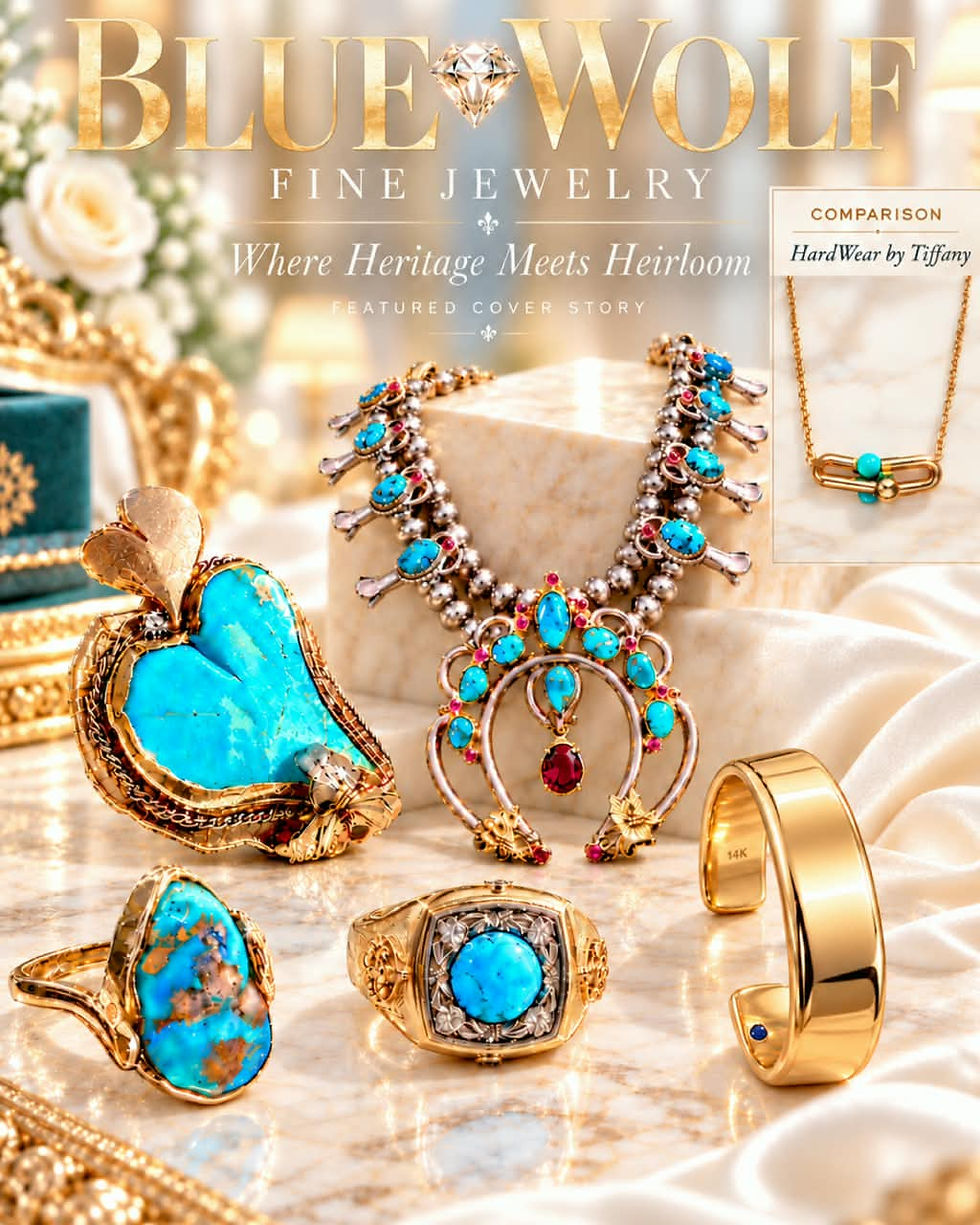
Consider the four original Blue Wolf creations presented alongside a contemporary turquoise-and-gold necklace from Tiffany & Co.
The comparison offers a revealing examination of two approaches to jewelry design.
In the first Blue Wolf creation, a richly colored turquoise gemstone rises from an expressive gold setting. Its natural matrix moves through the blue surface like a landscape viewed from above, with mineral formations creating patterns that could never be precisely duplicated.
Rather than forcing the gemstone into a rigidly symmetrical mounting, Christiansen allows its irregular character to influence
the surrounding gold.
The metal follows the contours of the stone, embracing its individual formation with sculptural movement. The result possesses an organic confidence seldom associated with standardized jewelry production.
There is nothing accidental about allowing nature to participate in the design.
It requires an understanding of proportion, material, and restraint, along with the discipline to recognize when the gemstone itself should determine the composition. The second creation develops this philosophy in a different direction.
A generously proportioned, heart-shaped turquoise gemstone rests within a richly worked gold composition, where flowing metal, textured detailing, and floral ornamentation introduce a romantic architectural quality.
Its beauty is not dependent upon a perfectly polished stone or an aggressively symmetrical outline.
Instead, its distinction lies in the relationship between the gemstone's natural form and the goldsmith's interpretation.
The small decorative elements invite closer inspection, rewarding the observer with details that become apparent only after the initial impression.
This is one of the defining characteristics of accomplished bespoke jewelry: its visual interest continues beyond the first glance.
Christiansen's elaborate turquoise Squash Blossom necklace presents a third perspective.
Here, the vocabulary becomes ceremonial.
Graduated turquoise elements, intricately worked metal, small crimson gemstone accents, and an elaborate central pendant create a composition of considerable presence.
Its structure recalls the visual tradition of the squash blossom necklace, an enduring form associated with Southwestern Indigenous jewelry, while the individual details establish the piece as Christiansen's own interpretation.
The central ornament anchors the design with dramatic symmetry, yet the smaller decorative elements keep the composition alive with movement.
Rather than treating cultural influence as an ornamental fashion reference,
Christiansen approaches it through the perspective of a maker whose heritage is part of her lived identity.
The resulting necklace possesses the authority of a personal artistic statement.
It is not merely intended to complement clothing. It has the presence to determine the character of an entire ensemble.
The fourth Blue Wolf creation introduces yet another dimension of the atelier's design language.
A commanding turquoise-centered gold ring features architectural framing, elaborately finished shoulders, and carefully considered ornamental details.
Its substantial proportions recall the confidence of traditional signet jewelry, but the design resists conventional classification.
The inscription ISA 54:17, together with Christiansen's signature sapphire, introduces elements of faith and personal authorship.
These are details that carry meaning beyond their decorative purpose.
A gemstone may establish a ring's beauty, but symbolism can establish its significance to the person who wears it.
Within this single creation, Christiansen brings together the visual strength of a statement ring and the intimacy of an object intended to be treasured across generations.
Tiffany & Co. and the Changing Language of Luxury
The Tiffany & Co. necklace pictured alongside these Blue Wolf originals provides an interesting counterpoint.
Its polished gold forms, turquoise accents, and restrained geometric composition reflect a contemporary minimalist design philosophy.
The necklace achieves its visual identity through clean lines, controlled proportions, and an economy of ornament.
It is a recognizable approach to modern luxury: sophisticated, carefully edited, and accessible to an audience that appreciates understatement.
Blue Wolf Fine Jewelry approaches the relationship between turquoise and precious metal from a markedly different direction.
Where the Tiffany design emphasizes reduction, Christiansen explores individuality, sculptural detail, and expressive composition.
Where the necklace creates interest through polished simplicity, the Blue Wolf pieces invite the eye to discover hand-worked surfaces, distinctive stone formations, and the subtleties of their settings.
Neither philosophy is inherently invalid. They serve different aesthetic purposes.
“But the comparison raises a question worth considering: Why should the visual vocabulary of an internationally established jewelry house remain the presumed measure of excellence when it is obvious an independent atelier, namely Blue Wolf Fine Jewelry, offers an entirely original artistic proposition.
This is where Blue Wolf Fine Jewelry enters the larger conversation.
Its importance does not depend upon suggesting that Tiffany & Co. has imitated Christiansen's designs. The photographs establish a difference in artistic direction, not evidence of influence or imitation.
The more compelling argument is that originality, craftsmanship, and design authority are not determined by corporate scale.
An independent jeweler can establish standards of creativity that challenge the expectations associated with far larger names.
And in an era when consumers increasingly seek objects with meaningful provenance, individuality becomes an especially compelling expression of luxury.
A Heritage That Cannot Be Manufactured
For Christiansen, her work is inseparable from her ancestry.
A Keetoowah Cherokee woman and documented fifth-generation greatgranddaughter of Sequoyah, the creator of the Cherokee syllabary and himself a silversmith, she belongs to a lineage in which artistic expression and cultural continuity carry particular significance.
Her family's history gives her work a context that extends beyond fashion.
Yet Christiansen does not rely upon ancestry as a substitute for artistic accomplishment.
She brings that inheritance into the present through original design and the physical discipline of making jewelry by hand.
This distinction matters.
Cultural heritage deserves more than superficial incorporation into a fashionable object. When approached with knowledge and personal connection, it can become the foundation for a genuinely contemporary artistic language.
Christiansen's work demonstrates that Indigenous craftsmanship need not be confined to historical categories or separated from the highest expressions of modern luxury.
Turquoise can command the same seriousness of design consideration as diamonds.
Traditional forms can coexist with sophisticated architectural settings.
And an object informed by Native American cultural identity can belong just as comfortably within an international couture collection as within the artistic traditions from which it draws meaning.
Blue Wolf Fine Jewelry occupies this intersection without apology.
Its creations are neither exercises in nostalgia nor attempts to reproduce the signatures of European jewelry houses.
They are expressions of an independent American atelier, shaped by Cherokee heritage and a jeweler's determination to make something that did not previously exist.
The New Standard Is Personal
For the serious collector, the definition of fine jewelry increasingly extends beyond the familiar questions of gemstone size, metal purity, and brand recognition.
Those considerations remain important, as do construction quality, durability, and the integrity of materials.
But they do not, independently, establish artistic distinction.
A jewel becomes exceptional through the intelligence of its design, the skill of its maker, the coherence of its proportions, and the purpose behind its creation.
Christiansen's one-of-one approach places these qualities at the center of the Blue Wolf philosophy.
The natural variations within turquoise are not treated as inconveniences to be eliminated. They become sources of inspiration.
The settings are not simply mechanical devices for holding gemstones. They participate in the artistic composition.
And the finished creations are not conceived as interchangeable accessories within an endlessly reproduced collection.
They are individual works, made with the understanding that their greatest value to an owner may ultimately lie in their irreplaceability.
This is also the quiet principle upon which enduring family jewelry collections have historically been assembled.
An heirloom acquires its significance through the life it accompanies: an anniversary, an inheritance, a personal triumph, a promise, or a memory that becomes inseparable from the object itself.
Its provenance deepens with each generation.
For Blue Wolf Fine Jewelry, that process begins at the workbench, in the hands of the person responsible for its design.
Where the Future of Fine Jewelry Is Being Written
There is an important difference between commanding attention and deserving it.
A celebrated name may secure the first glance. Exceptional craftsmanship must sustain the second.
With these four original creations, Lisa Christiansen offers an argument for a broader definition of luxury one that respects the achievements of historic jewelry houses without accepting that artistic leadership belongs exclusively to them.
Her designs are unmistakably her own.
They possess the confidence to embrace elaborate craftsmanship, the discipline to allow natural gemstones their individuality, and the cultural depth to carry stories that cannot be created through marketing alone.
The contrast with Tiffany & Co. is therefore more meaningful than a simple comparison of prestige.
It demonstrates that fine jewelry has more than one legitimate center of artistic authority.
From an independent atelier in Lawton, Oklahoma, Blue Wolf Fine Jewelry is contributing to that evolving standard through original work rather than borrowed reputation.
And perhaps that is the most enduring form of distinction.
The finest jewelry does not merely announce who made it. It reveals why no one else could have made quite the same thing.
For Lisa Christiansen, that is the measure of an heirloom and the foundation upon which Blue Wolf Fine Jewelry is defining its future.
BLUE WOLF FINE JEWELRY
Where Heritage Meets Heirloom.
Historic District | Lawton, Oklahoma
Founded and owned by Lisa Christiansen (Groundhog)
Original Design. Exceptional Craftsmanship. A Legacy Beyond Fashion.


