
Choosing Rubber Expansion Bellows for Pumps, Chillers and Process Pipework
Updated: 4 days ago
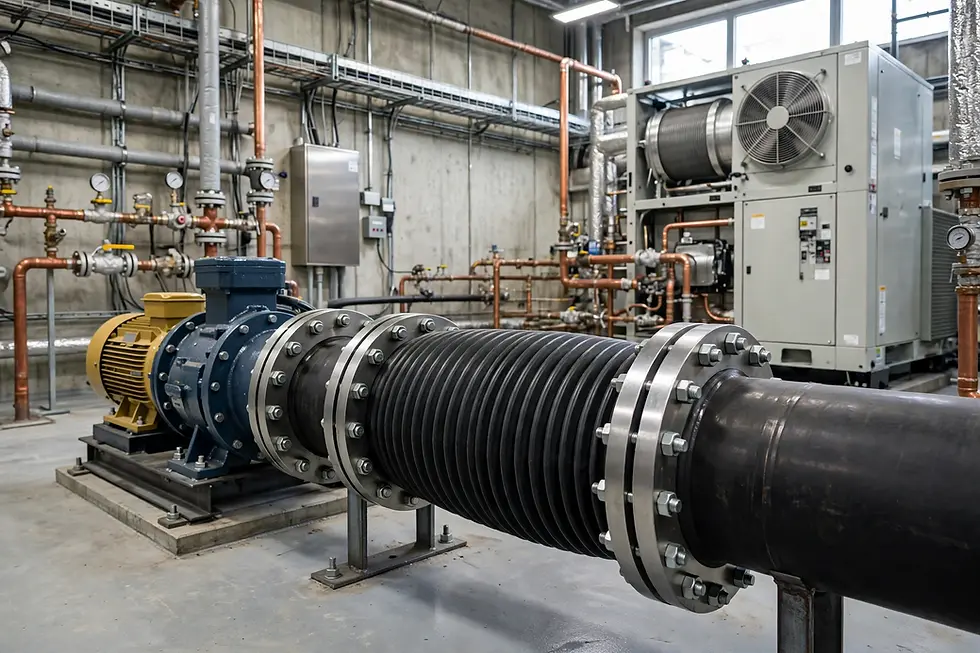
It is tempting to treat an expansion joint as a simple flexible connector. In reality, it carries several jobs at once: absorbing movement and vibration, reducing stress at pump and equipment flanges, compensating for thermal change, and keeping the pipework sealed under everyday operating pressure. Selecting the right unit therefore matters more than it first appears, especially where equipment is installed on a concrete plinth and connected to rigid services. A rubber expansion bellows is a proven choice for water,chilled water, heating and many low-pressure p
rocess duties, but the detail of the selection still needs checking.
Understanding the Movement it Must Absorb
Pipework rarely stays still. Pumps create vibration, temperature changes cause pipes to lengthen or contract, and buildings or plant frames can settle slightly. At the same time, many joints are installed beside simply because there is no other way to take out misalignment. These forces do not arrive in isolation. A bend under one load can be combined with twist or lateral shift under another. A joint therefore needs enough capacity that it does not have to be stressed hard to take up its working movement.
Reading the Duty Conditions and Application
Selection starts with the duty rather than the catalogue. The medium matters first: water and glycol mixtures behave differently from oils, acids and steam, and a compound picked for one service may not suit another. Temperature is next. A unit that performs well on a chilled-water line may not be right for a loop that regularly swings from cold to warm. Pressure follows, because the working pressure, and any short-term peak, governs the reinforcement and construction needed. After that comes the way the joint will be asked to move. Axial extension, compression, lateral offset and angular deflection are not interchangeable, and a joint designed mainly for one type of movement should not be expected to do the heavy work of another. Nor do those movements act one by one. They arrive together and reduce how far the joint can move in each direction, so the design should take account of the real installed situation.
Choose the Bellows and Ends
Within the design range, the bellows body itself is only part of the decision. The metal parts are just as important. The openings at the ends can be made from different materials, and if two different metals meet in a wet line, corrosion should be considered. The flange drilling should match the adjoining pipework, because a bellows forced into a hole it does not suit puts a strain on the flange, the element and the connections. The type of end also matters at the installation stage: unitary joints with built-in flanges are common, and tied joints use rods to limit movement in controlled directions and help carry pressure thrust.
Stourflex offers a standard range of rubber expansion bellows, with models available in both single and multiple arch formats. The company's standard range includes the RF3000 steel-flanged model, which features a single arch, and the RF4000, a steel-flanged unit, in double arch format. Also available are the RF2000, a screwed ends / vanstone flanged single-arch unit, and the RF6000, a single arch screwed / vanstone flanged model. Each of these models has a different pattern of movement capacity, pressure rating and end configuration, so it is worth checking the data sheet for each before choosing one.
Installation Decisions That Affect Longevity
A good unit installed poorly will not last as it should. Installation is one of the best chances to extend service life. The joint should be kept clean during fitting, and protected from dry heat or direct flame. Holes should not be trimmed on site, and the joint should not be twisted. If it is installed on a plinth, the design of the plinth should account for pump vibration. Supports should be sufficient that the bellows is not acting as a structural support for the pipework, and restraints should be correctly fitted so the joint is not being asked to resist thrust it cannot absorb. Some applications can also benefit from a protective mesh or sleeve where exposure to outside factors is expected. Correct pre-compression or extension must be applied in the right direction, and care should be taken to ensure that full movement allowance is provided for in the upstream and downstream pipework, preventing the bellows from being forced beyond its stated limits.
Maintenance Checks and Signs of Wear
A joint in service benefits from inspection as part of regular maintenance. A visual check can often reveal cracking, swelling or chafing of the outer cover. A flexible metal inspection can reveal exposure of the inner layers. Signs of wear also include changes in bolt load, flange movement and any sign of leakage around the necks of the unit. In many cases, replacement is planned ahead of time, based on inspection, rather than waiting for failure. Keeping records of the installation date, operating conditions and any earlier replacements also helps to choose the next unit correctly. Then mark the calendar for the next inspection, noting when replacement is due.


