
Modern Road Roller Techniques Every Paving Crew Should Master
Compaction has quietly become one of the most measured and instrumented phases of pavement construction. What used to be judged by an experienced foreman's eye is now cross-checked with intelligent compaction data, real-time density readings, and quality-control protocols that flag under-rolled sections before the crew leaves the site. For paving contractors, municipal DOT crews, and heavy civil operators, the shift means that traditional operator technique alone no longer defines a professional finish.
This article walks through the current state of the discipline. It covers how sensing technology is reshaping the operator's job, how to match roller type to the layer being compacted, the human skills that still separate the best crews from the average ones, and where the industry appears to be heading over the next few years. If your work touches asphalt, subbase, or embankment compaction, this is your terrain and the ground is moving under it.
The Shift Toward Smart Compaction on Modern Sites
The most significant change in the last decade has not been in the rolling drum or the drive train. It has been in the sensors and screens that tell the operator what the material is actually doing under the machine. Accelerometers on the drum measure the response of the underlying mat and translate that into a stiffness reading updated pass by pass. GPS overlays paint a color-coded map of the paved area, showing which passes have hit target compaction and which need another cycle. Data is logged and archived for owner acceptance and dispute resolution long after the crew has moved to the next job.
Crews adopting these systems report faster time to acceptance, fewer redo sections, and better accountability across shifts. The tradeoff is a learning curve for operators who came up on feel and experience alone. A modern road roller with an intelligent compaction package rewards operators who trust the data but doesn't replace the judgment of someone who understands why the mat is behaving the way it is on a particular morning with a particular mix.
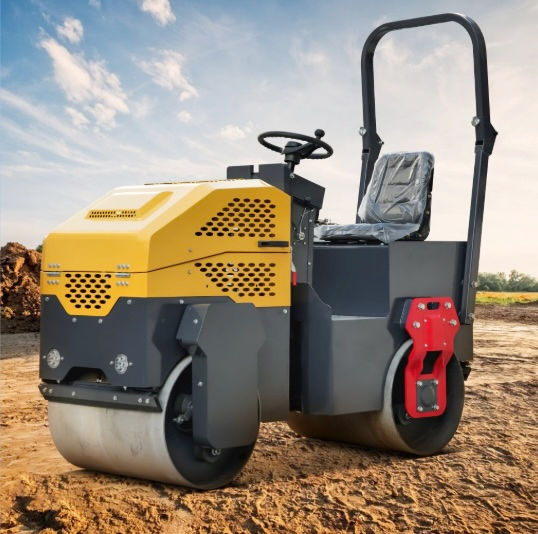
Matching the Road Roller to the Layer
No single roller configuration handles every layer of a pavement structure well. Choosing the wrong machine for a given course produces either undercompaction that shortens pavement life or overworking that damages the surface. The three main modes of drum action each have a place in the sequence, and rotating through them appropriately is what turns a paving spec into a lasting road.
Static, Vibratory, and Oscillatory Rolling
Static rolling relies purely on drum weight and works for finish passes on hot mix, where vibration would leave the surface rougher than it needs to be. It also suits temperature-sensitive situations where the mix has cooled past the window for effective vibratory compaction, or when working on thin lifts where deeper energy transfer could damage the underlying layer.
Vibratory rolling delivers compaction energy deep into the layer through drum vibration, which is why it dominates breakdown and intermediate passes on thicker mats. Amplitude and frequency settings need to match the layer thickness; running high amplitude on a thin lift bruises the surface and can crush aggregate. Oscillatory drums move fore and aft rather than up and down, generating shear force at the surface without the vertical energy that can damage nearby structures. They earn their keep in urban work near buildings, on bridge decks with sensitive substrates, and in overlay projects where the base layer must not be disturbed.
Reading Density Feedback in Real Time
The onboard measurement systems display a stiffness value that correlates with density but is not identical to it. Operators need to understand what the number means for their specific project. A rising stiffness value across passes tells you the material is compacting as expected. A value that plateaus early may indicate the layer has hit refusal, meaning further rolling won't add density and may start to damage the surface. A value that drops between passes signals decompaction, often from over-vibration or a substrate problem worth stopping to investigate.
Density readings from the roller supplement but do not replace nuclear or non-nuclear gauge readings taken by the quality-control crew. The onboard number is a continuous coverage indicator; the spot measurements are the calibration reference. Good crews use them together and treat any divergence as a signal to check the machine's sensor calibration rather than to trust one number over the other by default.
Operator Skills That Separate Good Crews From Great Ones
Even with instrumentation, the operator still controls the outcome. Rolling pattern discipline, temperature awareness on hot mix, and edge management define the finish. The best operators shadow the paver at a consistent offset, keeping the mat at the right temperature window for breakdown passes and stepping back on intermediate rolls as the mat cools into the working range for the next mode.
Edge work is where inexperienced crews leave problems. The outside three inches of a mat cool faster than the interior, and if the roller doesn't hit them before the temperature drops, the joint becomes a maintenance headache for the pavement's whole service life. Experienced operators plan their first pass to catch the joint at the right moment, and they don't leave that pass to the end of the rolling sequence when the temperature has already fallen out of range.
Weather, Mix Design, and the Variables Nobody Can Control
Ambient temperature, wind, and humidity change the working window for hot mix by minutes rather than hours. On a hot summer afternoon with light wind, breakdown passes can happen at leisurely rolling speeds and the intermediate window stays open long enough for a second application. In late fall with wind pulling heat off the mat, the same crew has half the time to hit target density, and the rolling sequence has to compress accordingly.
Mix design also shifts the compaction envelope. Stiffer polymer-modified binders resist compaction and require more energy per pass, while softer mixes reach target density quickly but risk over-rolling if the operator doesn't monitor the density feedback. Reading the paving report before starting the shift is the difference between a crew that adapts and one that gets caught out by material behavior they weren't expecting.
Where the Industry Is Heading Next
Autonomy is on the horizon for compaction more clearly than for most equipment categories. The task is repetitive, the environment is well-defined, and the coverage requirement is exactly the kind of problem that GPS-guided systems solve elegantly. Semi-autonomous machines that hold a pattern while an operator supervises are already commercially available on some projects, and full autonomy for straight-run production work is a matter of when, not whether.
Electrification is moving faster in this category than in most other heavy civil equipment. The relatively predictable duty cycles of rolling operations, combined with the noise and emissions restrictions on urban paving, make battery-electric machines a natural fit. Range and duty-cycle limitations are being addressed by battery chemistry improvements. MMS INDUSTRIAL and other manufacturers building compaction equipment are investing in these transitions because the customers who buy these machines expect a decade of service, and today's specifications must accommodate tomorrow's regulations.
Rolling Toward Better Pavement Outcomes
Compaction is no longer the last step in paving that people talk about only when something goes wrong. It is a data-rich, decision-heavy phase that determines whether pavement lasts twelve years or twenty. Crews that adopt the new tools, keep their operator craft sharp, and understand where the industry is heading position themselves to bid competitively on the projects that increasingly require documented density performance. The equipment will keep evolving, the standards will keep tightening, and the operators who can pair modern instrumentation with hard-won judgment will keep being the ones the schedulers ask for by name.


