
Precision Bolting in Marine Maintenance: Why the Right Tools Matter
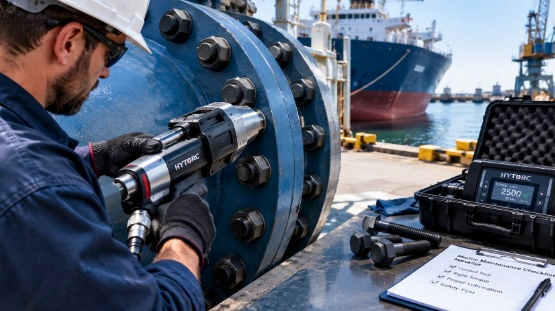
On a ship or offshore platform, a loose or over-tightened bolt is never a small problem. Vibration, salt water, temperature swings, and constant motion test every joint. When bolted connections fail at sea, repairs are slow and costly, and the consequences can include leaks, equipment damage, or safety incidents.
Precision bolting is the discipline of tightening fasteners to a controlled, repeatable load. This article explains why it matters in marine maintenance and how the right tools make the difference.
Why Marine Environments Are Hard on Bolted Joints
Marine equipment faces a combination of stresses that few land-based applications match.
Corrosion: salt-laden air and water attack fasteners and threads, increasing friction and reducing clamping reliability.
Vibration: engines, propulsion systems, and wave action loosen joints over time.
Thermal cycling: heating and cooling cause expansion and contraction that change bolt loads.
Heavy loads: large flanges, couplings, and structural joints require high clamp forces.
Limited access: machinery spaces and offshore structures often leave little room for tools.
Together, these factors make accurate, repeatable tightening essential rather than optional.
Where Precision Bolting Is Used Aboard
Bolted connections appear throughout marine and offshore operations:
Pipe flanges on fuel, cargo, ballast, and process lines
Propeller shaft couplings and flange connections
Engine and gearbox mounting and cover bolts
Rudder, stabilizer, and steering gear components
Heat exchangers and pressure vessels
Crane bases, winch foundations, and deck equipment
Offshore structural connections and wind turbine components
Each has its own load requirements, and all benefit from controlled tightening rather than guesswork.
What Happens When Bolting Goes Wrong
Under-tightening leaves insufficient clamp load. Gaskets leak, joints loosen under vibration, and fatigue failures become more likely.
Over-tightening can stretch bolts beyond their yield point, damage threads, crush gaskets, or distort flanges.
Uneven tightening produces uneven gasket compression and can cause leaks even when every bolt reaches a nominal value.
All three outcomes are common when joints are tightened by feel with impact guns or long-handled wrenches. In critical applications, "good enough" is not a safe standard.
How Hydraulic Torque Wrenches Help
A hydraulic torque wrench uses pressurized oil from a pump to drive a ratcheting mechanism and apply torque to a nut or bolt head. A reaction arm braces against an adjacent surface or nut so the force is applied safely and consistently.
Key advantages include:
High torque in compact tools: hydraulic wrenches deliver large torque from a relatively small tool, useful in tight machinery spaces.
Accuracy and repeatability: output torque relates directly to hydraulic pressure, so setting the same pressure produces consistent results, within the tool's specified tolerance.
Operator safety: the operator stays clear of the tool during the cycle, rather than straining on a manual wrench.
Reduced fatigue and faster work: large bolting jobs go faster and with less physical strain.
Even tightening across many bolts: several tools can run together on a flange, helping to apply load more evenly.
For crews comparing equipment, specialist suppliers of hydraulic torque wrenches provide different drive types, such as square-drive and low-profile cassette designs, to suit different access conditions.
Choosing the Right Tool for the Job
Selection depends on the joint and the working environment.
Required torque range: choose a tool whose range comfortably covers the job without operating at its extreme limit.
Access and clearance: low-profile or cassette-style tools suit tight flange spaces, while square-drive tools offer flexibility with sockets.
Reaction point availability: confirm that a safe, solid reaction surface exists.
Bolt size and type: ensure socket and link sizes match the fasteners.
Environmental needs: corrosion resistance, sealed pumps, and suitable hoses matter at sea.
Power source: electric, pneumatic, or hydraulic-powered pumps may be preferred depending on shipboard or offshore conditions.
Best Practices for Marine Bolting
Prepare the Joint
Clean threads and nut faces, inspect fasteners for damage or corrosion, and replace worn components. Use lubricant appropriate for the application, because friction affects how much clamp load a given torque produces.
Follow a Tightening Sequence
For flanges, use a cross-pattern (star) sequence rather than tightening bolts in circular order. This draws surfaces together evenly. Guidance such as ASME PCC-1 describes recognized practices for pressure-boundary bolted flange joint assembly.
Tighten in Stages
Bring bolts up in multiple passes, for example at increasing percentages of final torque, and finish with a final circular pass to even out loads. Staged tightening reduces gasket damage and uneven compression.
Use Calibrated Equipment
Torque tools and gauges should be calibrated at intervals required by your quality system or the manufacturer, and whenever damage or drift is suspected. Records of calibration support audits and class requirements.
Understand Torque Versus Tension
Torque is a way to approximate bolt load, but friction variability affects the result. In critical joints, bolt tensioners or other methods that apply load directly may be considered. The right method depends on the joint's criticality and applicable standards.
Document the Work
Record bolt sizes, torque values, tool IDs, calibration dates, and who performed the work. Good records help with inspections, class surveys, and future maintenance.
Training and Safety
A good tool in untrained hands can still produce a poor joint. Crews should be trained on:
Correct setup of the reaction arm and tool placement
Safe handling of hoses and pressurized connections
Keeping hands and body clear of pinch and reaction points
Reading and setting pressure and torque charts correctly
Following isolation and lockout procedures before opening or closing systems
Safe practice is especially important in confined or moving environments.
Maintaining Your Bolting Equipment
Hydraulic tools need regular care. Inspect hoses for wear, check couplings, keep oil clean, and store equipment dry and protected from salt air. Replace seals and worn parts promptly. Equipment kept in good condition delivers more accurate results and lasts longer. If you want to explore tool options and technical information, you can know more from suppliers who specialize in industrial bolting solutions.
Frequently Asked Questions
Why use hydraulic torque wrenches instead of manual wrenches at sea?
They deliver high torque with consistency and reduce operator strain, which suits large fasteners and demanding marine joints.
How often should torque tools be calibrated?
Follow the manufacturer's guidance and your quality system, commonly at set intervals or after any impact, damage, or suspected drift.
What is the correct bolt tightening pattern for flanges?
A cross or star pattern in several passes is widely recommended, followed by a final circular pass to even out the load.
Conclusion
Precision bolting protects ships and offshore assets from leaks, fatigue, and costly downtime. In a setting where corrosion, vibration, and limited access complicate every job, controlled tightening is a safeguard rather than a luxury. Hydraulic torque wrenches, combined with proper preparation, tightening sequences, calibration, and training, give maintenance teams the accuracy and repeatability that critical marine joints demand. Investing in the right tools and procedures costs far less than repairing a failure far from port.


