
The Hidden Craft Behind Beautiful Powder-Coated Metal Furniture
A Cabinet That Looks Simple Until You Look Closer
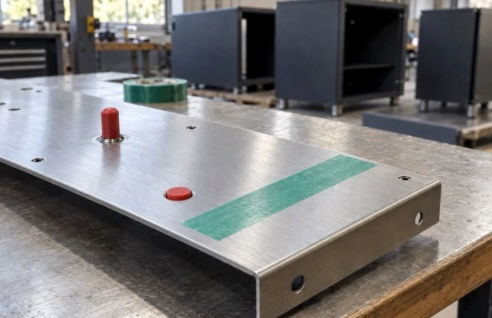
Take a custom metal cabinet where the drawing calls for one small area to stay bare — a fastener seat or a ground contact — sitting right next to an otherwise flawless powder coat. It's a deliberate result: powder coating masking doing exactly what the design asked for, keeping coating off a spot the part specifically needs left uncoated.
For anyone specifying or buying powder-coated metal furniture, the interesting question is less about that one part and more about the next two hundred: how does a masking requirement that worked on an approved sample survive an actual production run, across shifts, operators, and reorders?
The Drawing Decides Before the Sprayer Does
One mistake worth watching for is treating masking as something decided on the finishing floor. It isn't — it's a design decision that finishing has to execute.
If a part needs a bare zone — a fastener seat, a bearing surface, a contact point the design specifically calls out as exposed metal — that requirement belongs on the drawing, dimensioned and tied to a reason, not left for the shop floor to interpret in the moment. When that information only exists as a verbal note from a design review, the same part can end up masked three different ways by three different technicians, and nobody's really at fault, because nobody wrote down what "correct" meant in the first place.
If you're a furniture brand working with an outside finishing partner, it's worth saying plainly during onboarding: not every part needs masking, and adding tape "just in case" isn't a sign of care. That's usually a sign the requirement was never pinned down clearly to begin with.
A Boundary the Coating Isn't Allowed to Cross
Once a bare zone is defined, the finishing shop still has to pick the right way to protect it. That choice starts with geometry, but doesn't end there — temperature, coating chemistry, and how the material needs to come off afterward all factor in too.
A flat reveal or a straight edge on a panel is usually a job for masking tape, laid down to create a clean line where coating stops. Round features work differently: a plug protects an internal bore like a threaded hole, while a cap covers an external stud or protrusion. Mixing these up — taping over a hole that actually needed a plug, or plugging something that just needed a straight edge — is a common source of the small defects that show up at final inspection: a ragged boundary, overspray creeping under an edge, powder building up somewhere it never should have reached.
This is ordinary detail work — matching the protection method to the part in front of you, rather than applying one approach across an entire order.
Riding Along Through the Bake
The masking material itself has to survive a process most consumer products never see: it goes on before the part is sprayed, sits through the full bake cycle at whatever temperature and dwell time the coating system calls for, and then has to come off cleanly without tearing, curling, or leaving anything behind.
That's a narrower requirement than it sounds. A tape that holds a crisp line at room temperature can behave very differently once the process moves on: it might let powder migrate underneath during spraying if the edge isn't sealed well, or soften, shift, and lift at the edge once it's actually in the oven during cure. That combination is why shops doing this work generally reach for a purpose-built high-temperature masking tape rather than a generic office or packaging tape. The common construction for this kind of work is a polyester (PET) film backing paired with a silicone adhesive — a pairing widely used in powder coating masking because it's built to hold through the bake-and-cure cycle these parts go through. There's a fuller technical rundown of how these high-temperature, clean-removal masking options are built and specified for powder coating, worth a look if you're comparing constructions.
What actually matters for a furniture program is edge acuity — how sharp the coating line comes out — and clean removal, meaning the material lifts in one piece without residue. Ask for both from your supplier, on your material, at your bake profile, rather than taking a temperature rating on a spec sheet at face value.
What the Tape Leaves Behind — or Doesn't
The real test of a masking job shows up in the inspection right after the tape comes off, not when it goes on.
A good removal shows a crisp, complete boundary: no coating that crept underneath, no adhesive residue on the bare metal, no torn edges where the tape gave up partway through. A bad one shows any of those, and each usually means extra work — anything from a solvent wipe-down to remove residue, to a touch-up pass on a ragged line, up to stripping and recoating the part in the worst cases. Which remedy is actually acceptable depends on the coating system and the part, so it's worth agreeing on approved touch-up methods with your coating supplier rather than assuming any fix is fair game.
It's also worth being precise about what masking does and doesn't control. Its job is limiting where the coating goes — not guaranteeing the finish's long-term durability, which comes down to surface prep, the coating system, and cure conditions. What masking can affect is the surface condition right at the boundary: leftover residue or a torn edge there can complicate cleaning, recoating, or downstream bonding if the part needs further processing. A material that performs well on a clean aluminum extrusion can behave differently on a rough casting or a part with mill scale still on it — so if a finishing partner keeps seeing masking issues on the same part, the material is one variable worth checking, not the only one.
Turning One Good Part Into a Hundred
This is where the gap between "we made one beautiful sample" and "we can make five hundred of these" tends to show up. The cause is often less about the material and more about how the requirement got communicated from one desk to the next.
A masking requirement that lives only in a sample part is hard to hand off cleanly. It gets reinterpreted every time it moves from one desk to the next — designer to buyer, buyer to finishing shop, one shift to the next. What helps close that gap is putting the requirement into something that travels with the part: a simple masking diagram showing exactly where the boundary sits, a retained approved sample the line can check against, and a written acceptance standard that spells out what counts as a pass — agreed boundary tolerance, acceptable residue limits, and how the check is actually performed.
For a furniture brand sourcing from an outside finisher, asking for this as part of onboarding a new part number is a reasonable, low-cost step, and it's easier to settle upfront than to sort out a boundary that's quietly drifted by the third production run.
The Real Luxury Is Doing It Again
A product photo won't show any of this work. What buyers eventually notice is whether every unit in a run looks like the first one, or whether quality quietly drifts as volume goes up. That consistency is the craft, built the same way most manufacturing quality is — not by finding one perfect material, but by writing the requirement down clearly enough that it survives contact with a real production floor.
If you're bringing a new metal furniture part into production, settling the masking detail — material, boundary, acceptance standard — at the sample stage is worth doing before it becomes an argument on the tenth run.
FAQ
What is powder coating masking tape used for in metal furniture production?It protects flat boundaries and defined keep-clear zones — like a bearing surface or a designated bare area next to a fastener — from receiving powder coating during the spray and bake cycle. Round features like threaded holes or studs are typically handled with caps or plugs instead.
Why use a PET silicone tape instead of a regular masking tape?Powder coating involves a bake cycle ordinary tapes aren't built for. A polyester (PET) film with a silicone adhesive is a common construction for this kind of work, though performance always depends on the specific bake profile, so it should be confirmed with a sample trial and the supplier's current technical data.
What causes overspray to creep under masking tape?Usually insufficient surface cleaning before application, low application pressure along the tape edge, or a tape construction that doesn't match the part's geometry — for example, a flat tape used on a tight radius instead of a thinner, more conformable option.
Should I use tape or a cap/plug for a round feature like a threaded hole?Generally a cap or plug, not tape. Tape suits flat boundaries and straight edges, while round bores and protruding studs need a molded cap or plug for full, even protection.
How do I keep masking consistent across a large production run?Document the requirement outside of any single sample: a masking diagram tied to the part drawing, a retained approved sample for comparison, and a written acceptance standard covering boundary tolerance and residue limits — rather than relying on verbal instructions passed between shifts.
What should I ask a finishing supplier before approving a masking spec?Ask what material construction they're proposing and why, whether they've run a trial on your actual part and bake profile, and what their acceptance criteria are for a passing boundary. Specific answers give you something concrete to evaluate against — though how a supplier describes a spec doesn't by itself prove they can hold it across a full production run; that still needs to be verified with a sample run.
About: Risure's industrial tape range covers powder coating masking, electrical insulation, and other industrial protection tapes.


