
Top 12 AI Integration Services Providers Connecting LLMs to Legacy SOAP and On-Premise Systems
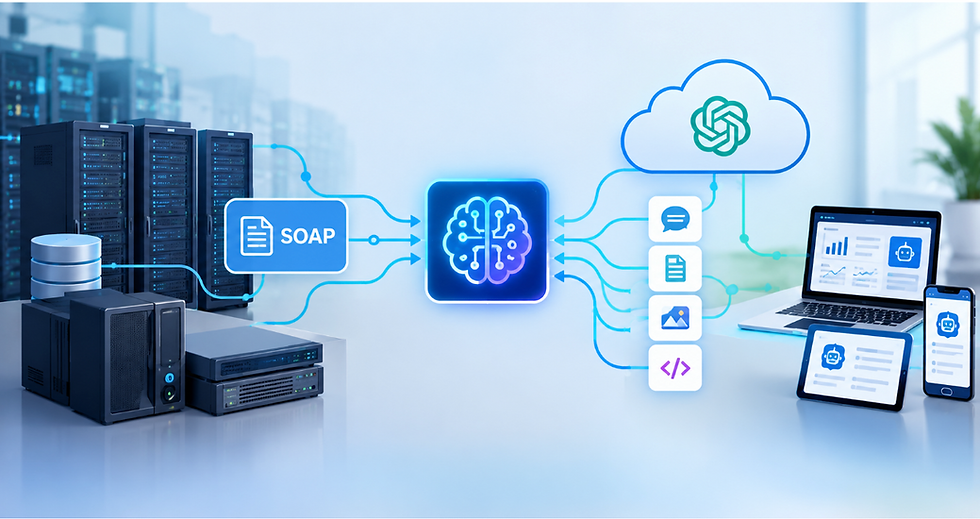
The hardest part of enterprise AI is rarely the model. It is that the data the model needs lives behind a SOAP endpoint documented in 2011, running on a server that cannot reach the internet, maintained by nobody who still works there.
A language model expects typed JSON tool schemas, idempotent calls, and immediate responses. A legacy system offers XML envelopes, namespaces, SOAP faults, a nightly batch window, and a service account whose password sits in a spreadsheet. Bridging the two is the actual project—an integration engagement wearing an AI label.
This list covers twelve AI integration services providers working on exactly this problem and what each suits.
Why Connecting an LLM to Legacy Systems Is Hard
WSDL is not a tool schema. A model needs a small, typed, well-named JSON interface. A SOAP operation with nested namespaces and forty optional elements is not that. The work is writing a facade that exposes three clean operations and hides the envelope entirely.
Legacy systems were sized for humans. A system built for two hundred concurrent users will not survive an agent issuing thousands of calls an hour. Caching, request budgets, and rate limiting on your side of the boundary prevent an outage rather than optimize one.
Retries double-post. Most legacy endpoints have no idempotency key, so a timed-out call that actually succeeded becomes a duplicate order when retried. The facade carries its own deduplication record.
Mainframe encoding bites. COBOL copybooks, fixed-width records, packed decimal fields, and EBCDIC text all need explicit conversion. A value that looks plausible after a naive conversion is worse than one that fails loudly.
Batch windows make data stale by design. If a system updates nightly, no amount of agentic AI development services makes the answer current. That belongs in the product design and in what the assistant tells the user.
Writes need an approval gate. Reading from a system of record is an engineering problem; writing to one unattended is a business risk. The default is a human confirmation on any state change.
Top 12 AI Integration Services Providers
1. Dev Technosys
Dev Technosys is a CMMI Level 3 appraised software company founded in 2010, certified to ISO 9001:2015 and ISO 27001:2022, with 250+ in-house professionals building the integration layer between language models and legacy enterprise systems. Where data cannot leave the client environment, the integration runs inside the private network through hybrid infrastructure, and any write to a system of record passes a human approval gate.
The company reports an 89% project success rate, with most new business coming from client referrals, and takes engagements from AI consulting services through to running the integration, so the team that designed the boundary is the team maintaining it. Dev Technosys suits organizations with undocumented SOAP or on-premise systems that need a dedicated integration layer built and maintained rather than a platform license.
2. Unisys
Unisys is headquartered in Blue Bell, Pennsylvania, and has worked with mainframe and legacy estates for decades, including its own platforms. That history is the point: few firms still employ people who understand ClearPath, CICS, and COBOL data structures at this depth. Unisys suits organizations whose core system is a real mainframe and who need people who have seen one before.
3. TIBCO
TIBCO, part of Cloud Software Group, is headquartered in Santa Clara, California, and built much of the enterprise service bus era. Its products already speak SOAP, JMS, and legacy adapters fluently, which shortens the distance to an AI-facing API, though the platform assumes its own patterns. TIBCO suits companies already running its integration stack who want AI endpoints added.
4. Axway
Axway is headquartered in Phoenix, Arizona, and specializes in API management and B2B integration, with long experience of older message formats. Its value here is governance: cataloguing which legacy services exist before anything is exposed to a model. Axway suits regulated organizations needing an inventory and control plan before opening legacy services.
5. Red Hat
Red Hat is headquartered in Raleigh, North Carolina, and provides the open-source integration tooling many of these projects are built on, including Camel-based routing and API management. Running on your own infrastructure fits where data cannot leave the network, but you supply the engineering around it. Red Hat suits teams wanting open-source foundations they can host and audit themselves.
6. Kong
Kong is headquartered in San Francisco, California, and focuses on API gateways, including capabilities aimed at routing and governing model traffic. A gateway between agents and legacy services gives you rate limiting, authentication, and request logging in one place, though it governs traffic rather than translating protocols. Kong suits organizations needing control over AI calls into existing systems.
7. SAP
SAP is headquartered in Walldorf, Germany, and its integration suite matters wherever the legacy system is SAP itself, which is common in manufacturing and distribution. Native connectivity avoids a fragile custom bridge, but it is the wrong starting point if SAP is not in the estate. SAP suits enterprises whose system of record is SAP.
8. TCS
TCS is headquartered in Mumbai, India, and runs large-scale modernization programs pairing legacy remediation with new AI capability. The advantage is the capacity to work across dozens of interconnected systems at once; the cost is governance overhead on a small scope. TCS suits large enterprises treating AI integration as part of a multi-year program.
9. Infosys
Infosys is headquartered in Bengaluru, India, and brings platform-led delivery to enterprise AI integration, with reusable accelerators for common legacy patterns. Those accelerators shorten projects where your estate resembles the pattern and add little where it does not. Expect a structured engagement model. Infosys suits enterprises wanting repeatable delivery across a portfolio of similar integrations.
10. HCLTech
HCLTech is headquartered in Noida, India, and has an infrastructure and application-support heritage, which matters because these projects are often constrained by operations rather than code. A firm already running the estate can change network and access arrangements rather than filing requests. HCLTech suits organizations where one vendor should run both infrastructure and integration.
11. Deloitte
Deloitte is headquartered in New York, New York, and approaches these projects from governance and risk as much as engineering. For regulated industries the deliverable is often the control framework and audit evidence alongside the integration. Deloitte suits regulated enterprises whose AI integration has to satisfy a risk committee before it ships.
12. Fujitsu
Fujitsu is headquartered in Tokyo, Japan, and has deep legacy modernization experience, particularly in the public sector and manufacturing estates across Europe and Asia. Its strength is methodical assessment of what a system actually does before wrapping it, and delivery is deliberate rather than fast. Fujitsu suits organizations needing a careful survey before AI work begins.
Security and Compliance at the Legacy Boundary
Service accounts are usually overprivileged. The credential connecting to a legacy system typically has broad rights because that was easier years ago. Scope it per operation, rotate it, and never let the model's caller identity inherit it wholesale.
Legacy data is untrusted input. A free-text notes field from 2008 can carry instructions aimed at the model, so AI model security testing against injection through ingested records is part of the build.
Permissions must resolve at query time. Legacy role models rarely map cleanly to the user asking the question. If the facade does not check the requester's entitlement on every call, the assistant becomes a way around existing access control.
Traces carry regulated data. Prompt and response logs hold customer records pulled from the legacy system, so retention limits, redaction, and encryption at rest apply to the observability layer too.
Framework alignment gives both sides a standard. Mapping controls to the NIST Cybersecurity Framework gives a long-lived on-premise integration something concrete to be reviewed against. Where a client requires a formal SOC 2 or PCI DSS audit, we design architectures and controls that support it.
Final Thoughts
These twelve providers are not substitutes. Some sell integration platforms, some specialize in mainframes, some are global integrators, and some build the bridging layer directly.
The decision follows the constraint. If the blocker is a mainframe, pick mainframe experience. If it is governance, pick the firm that produces audit evidence. If nobody has written the facade, that is a build. Teams testing the approach can start with an MVP covering one endpoint and one workflow. AI integration projects at Dev Technosys start from $10,000, depending on scope and integrations.
Frequently Asked Questions
Can an LLM call a SOAP service directly?
Not usefully. Models work with typed JSON tool schemas, and raw WSDL operations are too large and too loosely typed to be reliable. The working pattern is a facade exposing a few clean operations that handle the envelope, namespaces, and faults internally.
Do we have to move legacy data to the cloud first?
No. Where data cannot leave the network, the model or a private endpoint runs inside it and the integration stays local. That constrains model choice but removes the migration from the critical path.
What breaks most often?
Retries are creating duplicate records because the endpoint has no idempotency key, call volume is overwhelming a system sized for human users, and there is silent corruption from encoding or numeric conversion.
How long does a first integration take?
Discovery on an undocumented system usually takes longer than the build. Expect several weeks establishing what the endpoints do and what the test environment contains before model work starts.


