
Depth of Design: Triton and the Art of the Descent
For most of its history, the submersible has lived in the shadow of the yacht that carries it, a capable piece of engineering, but rarely a design statement in its own right. Triton Submarines has quietly rewritten that assumption. In an era when a superyacht’s identity is built as much by its designer as its builder, the vessels that carry owners beneath the water are being held to the same standard as the ones that carry them across it. Working with designers such as superyacht architect Espen Øino and industrial designer Marc Newson marks the moment Triton stopped building submarines for yachts and started building submarines as extensions of them.

Espen Øino International (EOI), one of the studios most responsible for defining what a modern superyacht exterior looks like has worked together with Triton and explored what a submersible could look like when it’s approached from a superyacht designer’s perspective from the outset, rather than styled after the engineering is already locked in, early concept work that treats the submersible as a genuine extension of a yacht’s design language, not an accessory added on afterward.
What makes the collaboration notable isn’t any single sketch; it’s the precedent. Bringing that sensibility into the conversation early signals that owners increasingly want their underwater vessel considered by the same eye that shapes their tender, their interiors, and their owner’s suite.
The other is a collaboration with industrial designer Marc Newson, who designed the Triton 660/9 AVA submersible built for a Lürssen commission, his first submersible project. The result brings tailored seating, ergonomic restraint, and carefully chosen materials into a cabin that had, until now, been engineered almost entirely around visibility and commercial usage rather than an extension of their private living space.
It’s a telling signal for Triton as much as for Newson. A designer of his stature doesn’t lend his name to a category unless he sees real creative territory in it, proof that the submersible has become a serious design object, not just a supporting feature on board.
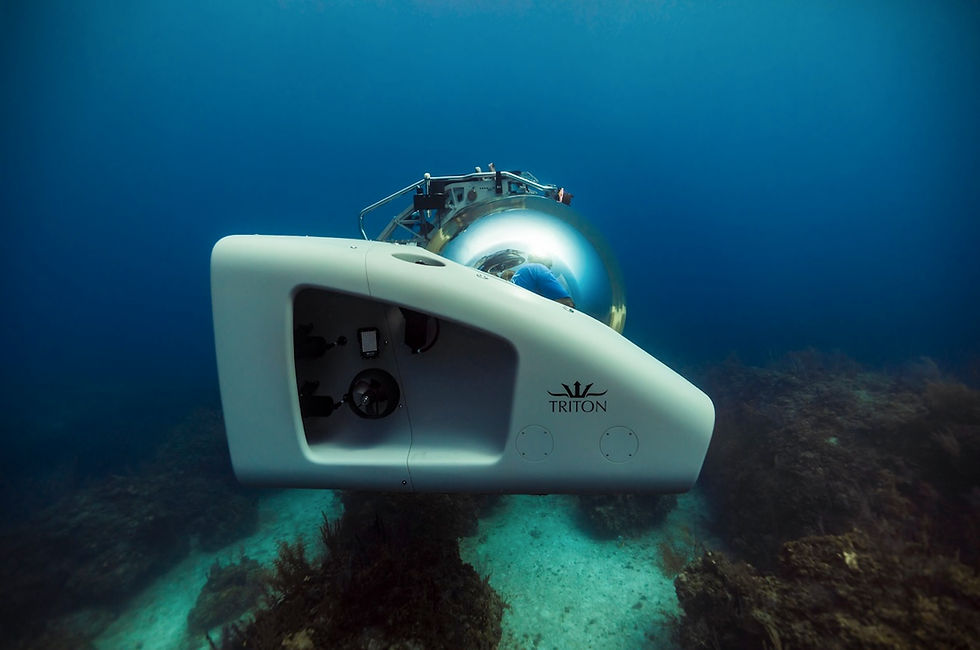
Both projects arrive at a moment when Triton’s track record, including the first submersible dives in Antarctica and vessels capable of reaching the deepest point in the ocean, has given it the standing to work with names like these. But the real story isn’t the résumé. It’s what the company is building toward: a future in which the submersible is no longer judged as marine equipment, but as a piece of the same design conversation as the yacht’s watchmaker-grade instrumentation, its aviation-inspired tender bay, or the art on its walls.
The timing also reflects a shift in how owners are briefing their build teams. A decade ago, the submersible was commissioned late in the process, a line item handled by a specialist yard rather than a decision made alongside the naval architect and interior designer. That sequence is changing. Owners now bring their design leads into the conversation on the submersible at the same stage they discuss the tender fleet or the beach club, treating it as one more surface where the yacht’s identity must show up consistently. For Triton, that means engineering has to leave room for a designer’s hand without compromising the pressure hull, the ballast systems, or the certification that makes a vessel like the 660/9 viable in the first place, a balance that is far harder to strike than it sounds.

It also has implications beyond private ownership. As charter guests increasingly expect submersible dives as part of a superyacht itinerary, a cabin designed with the same intention as the yacht’s staterooms becomes a differentiator brokers can market, not just an amenity buried in the spec sheet. Triton’s leadership has signaled that the EOI and Newson projects are the opening moves in a longer strategy, one that treats designer collaboration as a standing part of the roadmap rather than a one-off marketing moment tied to a single launch.

For an audience that already expects its yacht, its watch, its aircraft, and its art collection to carry a recognizable signature, Triton’s message is straightforward: the vessel that takes you 200 meters under the surface deserves the same eye for aesthetics and design, and the same names attached to it. Expect this to be the first of many such pairings, as Triton continues to bring designers from beyond the submersible world into the process of shaping what comes next.
Triton Submarines designs and manufactures submersibles for the world’s most demanding superyacht owners. Visit us at the Monaco Boat Show stand number QA17 or explore the full range and discover what’s possible beneath the surface at tritonsubs.com.


