
When Is the Right Time to Automate Your Bottle Filling Process?
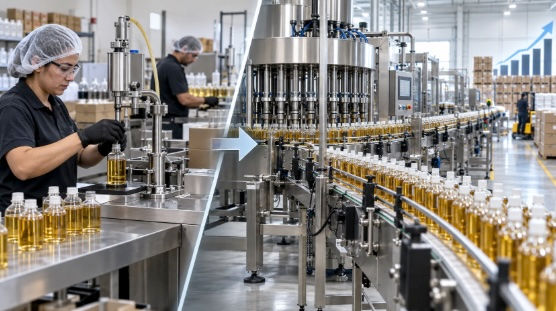
Many manufacturers begin with a simple filling process because production volumes are manageable and flexibility matters more than speed. As orders increase, however, a process that once worked well can start requiring more labor, longer shifts, and greater effort just to keep up with normal demand.
For growing manufacturers, moving toward suitable Bottle Filling Machines can be an important step when manual work begins limiting production. The decision should not be based only on how many containers a machine can fill per minute. Labor requirements, order volume, production schedules, product characteristics, available space, and future demand should all be considered before increasing the level of automation.
Automating too early may create unnecessary expense, while waiting too long can leave a business struggling with delays and inconsistent output. Knowing the signs that a filling process is reaching its practical limit can make the decision easier.
Manual Filling Can Be Practical at the Beginning
Manual processes are not automatically inefficient.
For startups, test products, specialty manufacturers, and very small production runs, manual filling may provide useful flexibility. Employees can switch between products without complex equipment changes, and the initial investment may be relatively limited.
This approach can work particularly well when orders are small or irregular.
The difficulty begins when production requirements increase but the same process remains in place.
Workers may need to fill, position, check, and move every container individually. As daily output rises, the amount of repetitive handling increases as well.
At some point, adding more labor may no longer be the most practical way to increase capacity.
Rising Demand Is One of the Clearest Signals
One of the strongest reasons to review filling automation is sustained growth in demand.
A temporary increase in orders does not necessarily justify purchasing new equipment. Seasonal peaks may sometimes be handled through scheduling or additional shifts.
Consistent growth is different.
If production regularly reaches its limit, the business may begin experiencing:
Longer lead times
Overtime costs
Delayed orders
Difficulty accepting larger contracts
Excessive dependence on additional workers
Limited time for maintenance or cleaning
Pressure to increase production speed manually
These signs suggest that the existing filling method may no longer match the needs of the business.
The important word is consistently. Equipment decisions should normally be based on realistic ongoing demand rather than a single unusually busy month.
Calculate the Real Capacity of the Current Process
Before considering automation, manufacturers should understand what their existing operation can actually produce.
This requires more than counting how many containers are filled during the fastest hour of the day.
Real capacity should account for normal interruptions such as:
Product preparation
Container loading
Cleaning
Breaks
Changeovers
Quality checks
Replenishing packaging materials
Minor adjustments
End-of-shift procedures
A process that appears capable of producing 1,000 containers during an ideal test may deliver much less over a complete working day.
Recording actual production for several normal shifts provides a better baseline.
Once real capacity is known, manufacturers can compare it with current orders and expected future demand.
Labor Cost Should Be Viewed Beyond Hourly Wages
Automation decisions are often discussed in terms of reducing labor, but the calculation should be broader than employee wages alone.
Manual filling requires people to perform repetitive tasks throughout the production run. Employees may position containers, activate filling cycles, move finished bottles, inspect fill levels, and clean small spills.
The business should consider how much skilled employee time is being used for work that could potentially be automated.
That time may have greater value elsewhere in the operation.
Automation does not necessarily mean eliminating employees. In many facilities, it allows existing staff to focus more on quality control, material management, maintenance, supervision, or other tasks that require judgment.
The question is therefore not simply, "How many workers can this machine replace?"
A better question is, "How can available labor be used more effectively?"
Production Consistency Can Become Harder at Higher Volumes
Manual processes often depend heavily on operator technique.
An experienced employee may perform the task very consistently, while a new worker may need time to reach the same level of control.
As production grows and additional employees are introduced, maintaining the same process across every shift can become more difficult.
Repeated manual actions may also become harder to perform consistently during long production periods.
Automation can help standardize certain steps by controlling filling cycles and container movement in a more repeatable way.
This becomes increasingly valuable when customers expect larger quantities to be delivered on predictable schedules.
Semi-Automatic Equipment Can Be a Useful Middle Step
Automation does not have to be an all-or-nothing decision.
A manufacturer does not need to move directly from manual filling to a completely automatic packaging line.
Semi-automatic filling equipment can provide a practical middle stage for businesses that need greater consistency or output but still want significant operator control.
Depending on the setup, an operator may position containers and initiate the filling cycle while the machine controls product dispensing.
This arrangement can be useful for companies producing moderate quantities or handling frequent short runs.
It can also help a manufacturer gain experience with machine-based filling before investing in a more integrated automatic line.
Know When Full Automation Starts to Make Sense
Fully automatic filling becomes more attractive when production requires continuous container handling at higher volumes.
Instead of manually presenting every bottle, containers can move through the filling stage as part of a controlled line.
The strongest case for greater automation often appears when several conditions occur together.
For example, demand may be consistently high, labor requirements may be increasing, the product range may be relatively established, and production may need to run for long periods without frequent interruptions.
Businesses should consider questions such as:
How many containers are required per shift?
How many people are currently involved in filling?
How often do products change?
Is demand stable enough to justify the investment?
Will the equipment operate frequently enough to provide value?
Does the facility have space for automated container movement?
The answers can help determine whether greater automation is practical.
Do Not Automate an Unstable Process
A common mistake is assuming automation will automatically fix every production problem.
If the existing filling process is poorly understood, automating it may simply allow the same problems to happen faster.
Manufacturers should first understand why delays, spills, inconsistent fills, or other difficulties occur.
The product should have reasonably predictable characteristics, and container specifications should be clearly understood.
Basic operating procedures should also be established.
Automation works best when it is applied to a process that has already been studied and organized.
Before purchasing equipment, businesses should identify the problems they specifically expect automation to solve.
Product Variety Can Change the Automation Decision
High production volume does not always mean that maximum automation is the correct answer.
A business may produce many different products in small batches.
In that situation, the line may spend significant time changing products, cleaning equipment, and adjusting container formats.
A highly automated system designed mainly for long continuous runs may not provide the expected advantage if it needs frequent interruptions.
By contrast, a manufacturer producing one or two high-volume products may benefit much more from continuous automatic operation.
Production mix should therefore be evaluated together with total volume.
The number of units produced matters, but so does how those units are divided between different jobs.
Consider the Rest of the Packaging Process
Increasing filling capacity can expose weaknesses elsewhere in production.
If the filler begins producing containers much faster but capping remains manual, bottles may accumulate after filling.
The same issue can occur with labeling, inspection, or packing.
For this reason, manufacturers comparing Bottle Filling Machines should consider what will happen to each container before and after the filling stage.
It may not be necessary to automate the entire packaging operation at once.
However, businesses should understand where the next bottleneck is likely to appear.
A staged automation plan can sometimes be more practical than trying to upgrade every part of the line at the same time.
Space and Utilities Can Limit Automation Plans
Automatic systems usually require more planning than stand-alone manual equipment.
Conveyors need space. Operators still require access. Maintenance areas should remain clear, and product supply must connect properly to the filling system.
Electrical power, compressed air, water, drainage, or other utilities may also need to be considered depending on the equipment.
A production target should therefore be compared with the physical limitations of the facility.
In some cases, the highest-capacity machine may not be the best choice because installing and operating it would require major changes to the production floor.
Equipment should fit the business operationally as well as financially.
Look at Demand Several Years Ahead
Buying equipment only for today's exact volume can create another capacity problem sooner than expected.
At the same time, manufacturers should avoid paying for extreme capacity that they are unlikely to use.
A reasonable forecast can help find the balance.
Businesses can review historical sales, confirmed customer agreements, new distribution opportunities, planned product launches, and realistic growth expectations.
The aim is not to predict the future perfectly.
It is to select equipment with enough capacity to support likely growth without creating an unnecessarily large investment.
Some additional production capacity can provide useful breathing room as orders increase.
Measure the Return in More Than One Way
The value of filling automation can appear in several areas.
Higher output is the most obvious benefit, but businesses may also see improvements in scheduling, labor utilization, consistency, and the ability to accept larger orders.
Potential benefits may include:
More containers produced per shift
Less repetitive manual handling
More predictable production times
Greater ability to plan staffing
Better use of skilled employees
Increased capacity for future orders
More consistent operating procedures
These benefits should be compared with equipment cost, installation, training, maintenance, utilities, and any required line modifications.
The lowest purchase price does not always produce the lowest long-term operating cost.
Start With the Problem, Not the Machine
Manufacturers can make better automation decisions by defining the production problem first.
Perhaps the business cannot meet demand during normal working hours. Maybe too many employees are required at the filling station. The issue could be inconsistent output between shifts or an inability to accept larger customer orders.
Once the problem is clearly defined, equipment can be evaluated according to whether it actually solves that problem.
This approach helps avoid purchasing technology simply because it appears faster or more advanced.
A machine should support a measurable operational need.
Final Thoughts
The right time to automate bottle filling is different for every manufacturer. Some businesses can operate effectively with manual or semi-automatic filling for years, while others reach the need for greater automation much sooner.
The decision should be based on sustained production demand, real operating capacity, labor use, product variety, facility limitations, and realistic growth expectations.
Manufacturers should also remember that automation exists at different levels. Moving from manual production to semi-automatic equipment can sometimes provide the improvement a growing company needs without immediately building a fully automatic line.
By measuring current performance and identifying specific production constraints, businesses can make automation decisions based on evidence rather than assumptions. The goal should be to introduce the right amount of automation at the right stage of growth.
Manufacturers reviewing whether their existing filling operation is ready for its next level of automation can explore suitable equipment options through pallasmt.com as part of their capacity and production planning.


