
Where Startups vs. Enterprises Are Outsourcing Development
Updated: Sep 24
A ten-person startup and a company with forty thousand employees will both tell you, in the same breath, that they “outsource development.” They rarely mean the same thing. One is handing an MVP to three contractors found through a founder’s Slack group chat. The other is running a procurement process that takes longer than most startups’ entire runway. The word survives the trip between them. Almost nothing else does.
That gap is worth understanding before you copy anyone else’s playbook. Borrow a Fortune 500 vendor-management strategy for a five-person team, and you’ll burn a quarter on paperwork nobody asked for. Try the opposite – a scrappy, handshake-deal startup approach inside a regulated enterprise – and you’ll eventually trigger a security review nobody wanted to run.
What “Outsourcing” Covers
Before comparing who does what, it helps to unpack the models people lump under one word. Staff augmentation adds outside engineers to a team you already manage day to day. A dedicated team is closer to a satellite office: a vendor’s engineers, but working exclusively on your product, usually for years. Project-based outsourcing – sometimes called turnkey – hands a whole scope to an outside firm and gets a finished thing back. Each comes with its own contract shape, its own risk profile, and its own idea of who’s accountable when something breaks.
Geography complicates the picture further. Nearshore means a similar time zone and, often, a lighter cultural gap; offshore usually means a bigger discount and a bigger coordination tax. Once you start comparing the top outsourcing destinations on cost, overlap hours, and how deep the talent pool runs, it’s obvious startups and enterprises aren’t shopping in the same aisle – they’re not even weighing the same variables.
How Startups Do This
Founders don’t outsource because a slide deck told them to. They do it because they need something built by Friday and don’t have six months to hire for it. Speed beats process, almost every time. A startup will happily work with a single freelancer, a two-person studio, or a boutique agency it found through a founder Slack channel – no RFP, no vendor scorecard, just a call and a Stripe invoice.
Budget shapes everything else. Most early-stage teams can’t absorb a bad six-month engagement, so they lean on short, cheap trial projects before committing to anything bigger. Fixed-price work is common early on. It caps the downside when cash is the scarcest thing in the building. As the product finds its footing, that often flips: dedicated teams start beating one-off contracts, because rebuilding institutional knowledge from scratch every few months gets expensive in its own quiet way.
Here’s the trade-off nobody puts in the pitch deck: moving fast means skipping due diligence that would catch a bad vendor before the damage is done. A startup that outsources its entire backend to one contractor is also betting its runway on that person staying reachable. Sometimes that bet pays off for years. Sometimes it doesn’t, and the founder learns mid-sprint that nobody else understands the codebase.
How Enterprises Do This
Flip the org chart, and the calculus changes almost completely. A large company outsourcing development is rarely solving “we need this fast.” It’s usually solving “we don’t have the specialized skill in-house,” or “we need to scale a team without a six-month hiring cycle,” or, increasingly, “our internal platform group is buried and this workstream has to move regardless.”
Procurement takes over from there. Security questionnaires, SOC 2 audits, data-residency clauses, and a legal review that can stretch for months – all of it exists because a breach or a compliance failure at enterprise scale costs vastly more than at a five-person shop. Vendors get vetted the way a bank vets a counterparty, not the way a founder vets a freelancer on a video call.
Staff augmentation tends to dominate here, not project-based work. Enterprises usually already have architecture decisions, an internal roadmap, and a way of working; what’s missing is bodies, not direction. Bringing in twenty augmented engineers who slot into existing sprints is a much easier sell internally than handing an outside firm ownership of a core system. Multiple vendors running in parallel is also normal. Nobody wants to get too comfortable at the next contract renewal, and no single firm covers every specialization a large product portfolio needs anyway.
None of this makes enterprises slower on purpose. It makes them risk-averse in ways that are entirely rational once you’re managing regulatory exposure across a dozen markets instead of one product in one country.
The price tag reflects that difference, too. A startup comparing quotes will often find them clustered fairly close together, because most of what it’s buying is raw development hours. An enterprise RFP response tends to look messier – line items for compliance documentation, dedicated account management, penetration testing, sometimes an on-site liaison – before a single feature gets built. Comparing an hourly rate on a freelancer platform against a signed enterprise contract is comparing two different products wearing the same label.
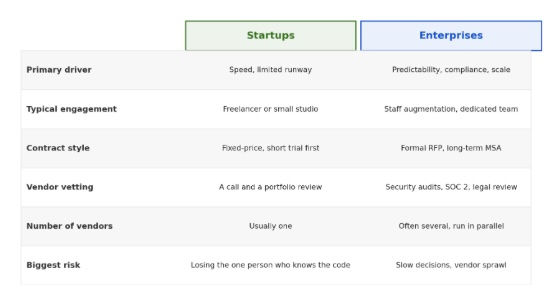
Startups and enterprises rarely optimize for the same thing when they outsource.
Where the Two Approaches Are Starting to Converge
The line between these worlds is blurrier than it used to be. Some enterprises now spin up startup-style “innovation pods” – small, outsourced squads with real autonomy, deliberately shielded from the usual procurement drag, specifically so a new idea can move at founder speed instead of enterprise speed. Meanwhile, plenty of startups that survive past Series A end up building the vendor governance they once mocked, because a single freelancer disappearing with your only backend knowledge stops being a funny story and starts being an actual risk once customers depend on uptime.
AI-assisted coding tools are nudging both sides, too, though not in the way outsourcing skeptics predicted. Fewer teams outsource pure boilerplate now that a generalist can lean on an AI pair-programmer for the repetitive parts. But that hasn’t shrunk demand for outside teams – it’s shifted it toward the harder problems: architecture decisions, security-sensitive integrations, and legacy systems nobody in-house wants to touch. Outsourcing isn’t dying. It’s getting more selective about what it’s for.
The Real Question Isn’t Who Outsources – It’s Why
Ask a startup and an enterprise the same question – “why outsource?” – and you’ll get answers that sound alike on paper and mean opposite things in practice. A founder wants speed and is willing to trade process for it. A CTO at a large company wants predictability and is willing to trade speed for it. Neither is wrong. Each is optimizing for the constraint that threatens them.
If you’re deciding how to structure your own outsourcing setup, the honest starting point isn’t a vendor list. It’s naming which constraint you’re solving for – cash runway, specialized skill, compliance exposure, or a deadline nobody’s willing to move. Everything downstream, from contract type to destination to team size, should follow from that answer, not the other way around.


