
Why Cord Tension and Clasp Design Decide Everyday Bracelet Lifespan
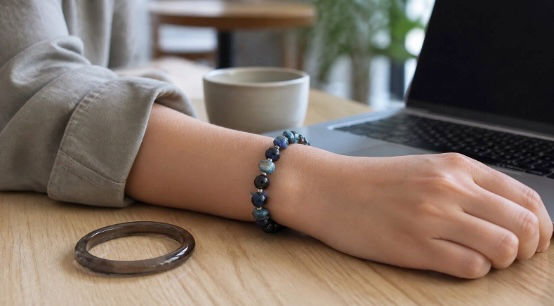
A bracelet may feel comfortable in a fitting mirror and become irritating by lunchtime. The difference is usually not style but repetition: reaching, typing, washing hands, carrying a bag, and sliding a cuff over the same small object hundreds of times. Choosing an everyday bracelet means judging how fit, weight, construction, and routine interact.
Fit Should Follow Movement
Measure the wrist where the bracelet will sit, then consider the design rather than treating that number as the finished size. Large beads occupy more of the inner circumference than slim beads or cord, while a bulky clasp can create a rigid section. Two bracelets with the same stated length may therefore feel different.
A useful fit allows the bracelet to move without repeatedly turning over or sliding into the hand. If stretch cord is already visibly separated between beads while the wrist is relaxed, the fit may be placing constant tension on it. If a loose bracelet drops onto the palm whenever the hand points down, it is more likely to strike a desk or catch on an edge.
Test ordinary motions before deciding: bend the wrist, type, put on a jacket, and reach into a bag. Comfort during those movements is more informative than whether one finger fits beneath the bracelet at a single moment.
Bead Size and Weight Change the Contact Points
Bead size affects more than appearance. A larger or irregular bead sits higher above the wrist and may create a concentrated pressure point when the forearm rests on a table. A smaller, smoother profile can stay closer to the skin and pass beneath a cuff more easily.
Weight matters in motion. Heavier components pull downward and can make a loose bracelet rotate, especially when one charm or focal bead is much heavier than the rest. That movement is not automatically a defect, but it should suit the wearer’s routine. Someone who works at a keyboard may prefer fewer protruding elements on the underside of the wrist, while occasional wear leaves more room for sculptural forms.
Choose Cord and Closures for the Routine
Stretch construction is convenient because it does not require a clasp, but it is repeatedly loaded when pulled over the hand. Roll a stretch bracelet over the knuckles instead of pulling one narrow section outward. Check that the beads return to an even circle rather than leaving visible gaps.
Non-stretch cord changes the maintenance problem. It does not need to expand over the hand, but exposed fibers can rub against bead holes, metal components, or hard surfaces. Knots should sit securely and, when the design allows, remain protected from direct abrasion.
A clasp adds another decision. Before buying, check whether you can operate it with the opposite hand and whether it lies flat against the wrist. A fine spring closure can be discreet but difficult for some fingers to control; a larger toggle or hook may be easier to align yet more likely to project from the bracelet. There is no universally longest-lasting option because component size, construction, use, and maintenance all vary.
When comparing an everyday symbolic bracelet, look beyond the motif and examine the product photographs and stated construction. The practical choice is the piece whose profile, closure, materials, and maintenance needs match what your wrist actually does each day.
Account for the Dominant Hand
A bracelet on the dominant wrist usually meets more surfaces. Writing, using a mouse, opening doors, and lifting objects can place the same beads, knot, or clasp against a desk throughout the day. Wear the bracelet briefly on each wrist and note where its hardware settles.
Stacking changes the pattern again. Bracelets that fit well alone may press, twist, or abrade one another when worn beside a watch or a second strand. Leave enough room for each piece to move without forcing rigid edges together, and avoid a stack that limits comfortable wrist flexion.
Plan for Water, Work, and Skin Contact
Daily wear does not mean uninterrupted wear. Remove a bracelet before activities that soak it, expose it to cleaning products, or place it under heavy mechanical pressure unless the seller has provided material-specific guidance for those conditions. Water trapped around cord, knots, or clasp components can also make inspection more difficult.
Material sensitivity requires precise product information. Ask what touches the skin, including base metal beneath a finish, spacer beads, clasp, cord, coatings, and adhesives. Do not infer composition from color or from a broad label such as “alloy.” If the listing cannot identify a component that matters to you, choose a design with clearer documentation.
Inspect Before the Bracelet Fails
A short visual check is more useful than a claimed lifespan. Rotate the bracelet and look between the beads, around knots, and where cord enters a clasp or connector. Pay attention to changes rather than waiting for a complete break.
Visible spacing: new gaps between beads may show that stretch material has lengthened or a knot has shifted.
Frayed fibers: fuzzing or thinning near bead holes indicates a local abrasion point.
Slow recovery: elastic that remains enlarged after removal is no longer holding its earlier shape.
Closure changes: a clasp that sticks, opens unevenly, or no longer closes fully needs attention.
Surface damage: sharp edges, cracked beads, or bent links can create new stress points.
Restringing is appropriate when the cord has changed shape, visible fibers are failing, or spacing can no longer be corrected safely. Stop wearing the bracelet until it is repaired; this is simpler than recovering scattered beads after a break.


