
ZICAIL Skincare Manufacturing: Custom Formulation, Packaging & Private Label Solutions
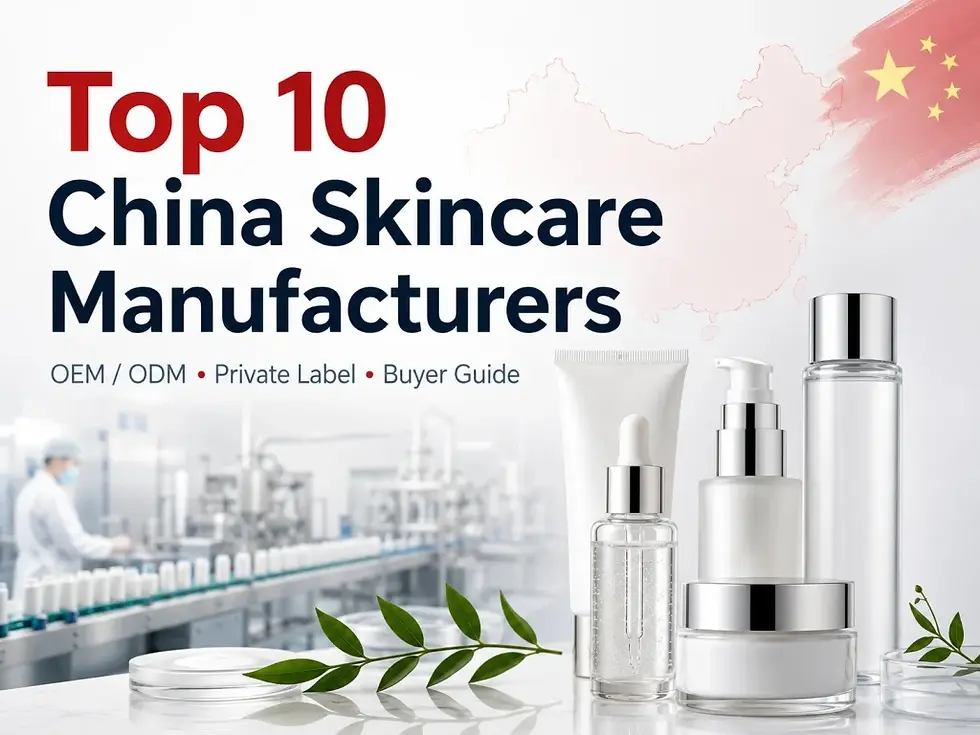
If you've spent any time sourcing a skincare manufacturer, you already know the frustrating part isn't finding a factory — it's finding one that actually fits your brand's stage, budget, and formula ambitions. ZICAIL, a Guangzhou-based private label and OEM/ODM skincare manufacturer, has built its entire pitch around solving that exact mismatch. We took a close look at what ZICAIL actually offers, how its process compares to the broader China manufacturing landscape, and where it makes sense — and doesn't — for brands evaluating a supplier in 2026.
What Is ZICAIL and What Does It Do?
ZICAIL is a Guangzhou-based skincare manufacturer that provides custom formulation, packaging sourcing, sampling, scalable production, and quality control for private label and OEM/ODM beauty brands. It positions itself as a flexible partner for brands ranging from early-stage private label launches to larger, formula-led development projects.
Its category focus sits squarely in face care, sunscreen, eye and lip care, and body skincare, with formulation directions built around hydration, acne management, brightening, sensitive-skin barrier repair, and sun protection. What separates a manufacturer like this from a generic "we make cosmetics" factory is the coordination layer — someone managing formulation direction, sample revisions, packaging selection, MOQ negotiation, and production scheduling as one connected process rather than five separate vendor conversations.
Why the Private Label Skincare Market Is Booming Right Now
Private label skincare isn't a side trend anymore — it's the segment carrying the private label beauty industry. Skincare accounted for 42.23% of the global private label cosmetics market in 2025, and that market itself was valued at roughly $11.17 billion in 2025, projected to reach $11.65 billion in 2026 and climb toward $15.19 billion by 2031 at a 5.45% CAGR, according to Mordor Intelligence.
Zoom out further and the broader skincare category is even larger: Grand View Research puts the global skincare products market at $163.2 billion in 2026, growing toward $202.8 billion by 2033. Statista-sourced figures cited by industry trackers put skincare at roughly 42% of the entire $677 billion global beauty and personal care market in 2026 — meaning skincare alone now represents a $180 billion-plus slice of global beauty spend.
That growth is exactly why demand for flexible OEM/ODM partners has surged. Retailers and independent brands both want in, but very few have the capital or timeline to build their own labs, filling lines, and regulatory teams. Manufacturing partners fill that gap — and Guangzhou has become the default address for it.
Why Guangzhou Specifically
Guangzhou isn't just "a" cosmetics manufacturing city in China — it's the center of gravity for the entire industry. The Baiyun district alone hosts more than 1,200 manufacturers and contributes roughly 40% of Guangdong province's cosmetics output, while Guangzhou as a whole has secured the title of top global export city for skincare and haircare in recent years. Guangzhou Customs data shows the city's cosmetics exports reached approximately 6.43 billion yuan in just the first seven months of 2025, a 45% year-on-year jump, with sunscreen sprays and skincare products among the fastest-growing export categories.
That density matters practically. When hundreds of ingredient suppliers, packaging vendors, and filling facilities operate within the same few districts, sample turnaround and production flexibility improve simply because everyone involved is geographically close. It's one reason brands comparing options in our China Skincare Manufacturers roundup keep landing on Guangzhou-based suppliers rather than factories scattered across other provinces.
ZICAIL's Core Services, Broken Down
ZICAIL structures its offering around four connected services rather than a single production step, and understanding how they link together is the difference between a smooth launch and a stalled one.
Custom Formulation
Formulation work is where most private label projects either take shape or fall apart. ZICAIL supports brands through formula direction planning — deciding whether a product should lean toward a lightweight gel-cream, a rich barrier balm, or a fluid sunscreen texture — followed by sample adjustment rounds based on sensory feedback (how it feels on skin, how it absorbs, how it smells).
This matters because a "ready" base formula rarely launches unchanged. Brands typically go through two to four sample rounds tweaking viscosity, fragrance load, or active ingredient concentration before a formula is production-ready. A manufacturer that treats formulation as a collaborative back-and-forth, rather than a take-it-or-leave-it catalog pick, tends to produce a more differentiated final product.
Packaging Sourcing and Coordination
Packaging decisions affect cost, shelf appeal, and shipping logistics simultaneously, which is why they're rarely simple. ZICAIL coordinates packaging selection alongside formulation — airless pumps for actives sensitive to oxidation, tinted glass for light-sensitive serums, tubes for higher-viscosity creams — so the container and the formula are chosen together rather than as an afterthought.
This sequencing avoids a common and costly mistake: finalizing a formula, then discovering the desired packaging isn't compatible with the product's viscosity or preservation needs, forcing a reformulation late in the timeline.
Private Label and OEM/ODM Production Paths
Buyers usually choose between three starting points: a ready private label formula (fastest, lowest cost, least differentiation), a modified base formula (moderate speed, some customization), or a fully custom ODM formula (slowest, most differentiation, typically higher MOQ). ZICAIL supports all three paths, which lets a brand start with a private label product to test market response, then move toward custom formulation once the product line proves demand.
Scalable Production and Quality Control
Once a formula and packaging are locked, production scheduling and quality control take over. This stage covers batch consistency testing, stability testing (checking whether a formula holds its texture, color, and efficacy over time and under different storage conditions), and microbiology testing for preservation adequacy — particularly important for water-based creams and lotions, which are more vulnerable to contamination than anhydrous products like balms or oils.
How the Process Actually Runs, Step by Step
A typical project timeline with a Guangzhou-based manufacturer like ZICAIL follows a fairly consistent sequence, even though the details vary by product complexity.
Briefing and formula direction. The brand shares target texture, active ingredients, price point, and any claims (SPF, "fragrance-free," "non-comedogenic") it wants to make.
Initial sampling. The manufacturer proposes a base formula or starts custom development, typically delivering first samples within one to three weeks depending on complexity.
Sample revision rounds. The brand tests texture, scent, and performance, then requests adjustments — this is usually the longest phase of the process.
Packaging selection and compatibility testing. Chosen packaging is tested against the finalized formula to confirm no reaction, leakage, or degradation occurs.
Pilot or bulk production. Depending on MOQ, the manufacturer runs either a small pilot batch or moves directly to bulk production with quality checks at each stage.
Quality control and documentation. Batch testing, certificates of analysis, and export documentation are prepared before shipment.
Brands that skip steps — particularly compatibility testing between formula and packaging — are the ones who end up with leaking pumps or discolored serums three months after launch. It's a slower process than it looks from the outside, and any manufacturer promising to compress it dramatically is usually cutting a corner somewhere.
Illustrative Scenarios: How This Plays Out for Real Brands
To make this concrete, here's how two common buyer situations typically unfold when working with a full-service Guangzhou manufacturer offering this kind of custom formulation and packaging support.
Scenario 1 — The first-time private label founder. An independent skincare founder wants to launch a three-product hydration line (cleanser, serum, moisturizer) without holding inventory risk. Starting from a modified base formula rather than a fully custom one keeps MOQ manageable and sample timelines short — often six to eight weeks from brief to finished samples — letting the brand test the line with a small retail or DTC batch before committing to a larger custom formulation run later.
Scenario 2 — An established brand adding a sunscreen SKU. A brand with an existing skincare line wants to expand into SPF products, which carry stricter testing requirements (SPF verification, water-resistance claims, UV filter compliance for the target market). This project moves slower — often ten to fourteen weeks — because SPF testing and target-market regulatory checks happen before bulk production, not after. Brands that rush this step risk having to relabel or re-test products after they've already shipped, which is far more expensive than building the time in upfront.
Neither scenario is unusual — they're close to the default path most brands take when working with a Guangzhou OEM/ODM partner, and they illustrate why timeline expectations should be set by product complexity, not by the fastest quote you receive.
In Our View: Where ZICAIL Fits in the Sourcing Landscape
In our view, ZICAIL's real value isn't that it's the cheapest or largest option in Guangzhou — it almost certainly isn't, and it doesn't claim to be. Its value is in occupying the middle ground that a lot of brands actually need: more formulation flexibility and hands-on coordination than a rigid, high-MOQ ODM group, but more structure and category depth in face care and sunscreen than a factory that treats skincare as one of many unrelated product lines it happens to produce.
That said, "flexible partner for overseas brands" is also the exact language nearly every mid-sized Guangzhou manufacturer uses to describe itself, which is precisely why we don't think any brand should shortlist a supplier — ZICAIL included — based on website positioning alone. The verification checklist below matters more than the marketing copy.
How to Evaluate ZICAIL — or Any Manufacturer — Before You Commit
This is the step buyers skip most often, usually because sample quality looks good and momentum feels important. Slow down here anyway.
What should you verify before sending a deposit?
Confirm the legal company name and factory address independently, not just the name on the quote. Ask for current production licenses and product-specific certificates, request MOQ broken down by product type rather than a single blanket number, and clarify whether you're buying a ready private label formula, a modified base, or a fully custom formula — because that distinction changes both cost and how differentiated your final product actually is.
Beyond that, four questions consistently separate a smooth partnership from a painful one:
Who owns the final formula and packaging design files once development is complete?
What stability, compatibility, and microbiology testing is included, and is it documented with actual reports?
What's the realistic sample lead time versus bulk production lead time — get both numbers, not just the faster one?
What export documentation and labeling support does the manufacturer provide for your specific target market?
For sunscreen or other regulated claims specifically, add SPF testing support and UV filter compliance to that list before you sample anything.
Conclusion
ZICAIL represents a fairly typical — and in the current market, increasingly necessary — model for skincare manufacturing: a Guangzhou-based partner combining custom formulation, packaging coordination, sampling, and scalable production under one process rather than leaving a brand to stitch these pieces together across separate vendors. With the global private label skincare segment approaching $12 billion in 2026 and the broader skincare market pushing past $160 billion, that kind of coordinated manufacturing support is becoming less of a nice-to-have and more of a baseline expectation for brands trying to launch quickly without sacrificing formula quality.
The manufacturer itself, though, is only half the equation. MOQ fit, formula ownership terms, and testing transparency will determine whether a project goes smoothly far more than any single service listed on a factory's homepage — ZICAIL's included. Treat this article as a starting point for the right questions, not a substitute for asking them directly.
Author's Note:
I write about skincare sourcing and manufacturing from the buyer's side of the table — the questions I'd want answered before wiring a deposit to a factory I'd never visited. This piece is based on publicly available information about ZICAIL alongside broader industry data on China's cosmetics manufacturing sector; it isn't a paid endorsement, and I'd encourage any brand to verify certificates, MOQ, and formula ownership terms directly with the manufacturer before starting a project.


