
5 Certified E-Bike and Smart Helmets That Balance Safety and Urban Style
- Aug 12
- 7 min read

The urban commute has changed considerably in recent years.
As Class 3 e-bikes, speed pedelecs and other forms of electric micromobility allow riders to travel farther and faster, helmet design is evolving with them. In the U.S., Class 3 e-bikes can assist riders at speeds of up to 28 mph, while European speed pedelecs can reach 45 km/h.
For some commuters, that has created demand for helmets that go beyond conventional bicycle-helmet requirements.
One of the most relevant benchmarks is NTA 8776, a standard developed specifically for higher-speed e-bike and speed-pedelec use. Some newer helmets also combine impact protection with visibility technology, rotational-impact management, crash detection, NFC identification and other safety features.
Not every premium helmet needs to be fully connected to qualify as advanced, however. Some prioritize active lighting, while others focus on increased coverage, rescue technology or refined urban design.
Here are five standout helmets that balance modern safety features with aesthetics suited to the contemporary commute.
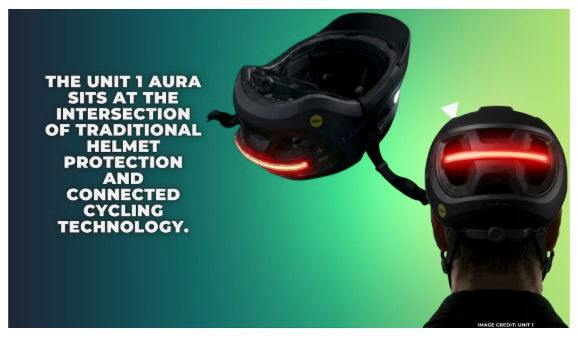
1. UNIT 1 AURA
Safety certifications: NTA 8776, CPSC and EN 1078
Rotational protection: Mips
Lighting: Integrated front and rear lighting with 350-lumen output
Battery: 1,350 mAh
Smart features: Crash Detection, automatic brake light functionality and turn-signal compatibility
Weight: Approximately 440 g in Medium
Ventilation: 10 fixed vents
Key highlight: NTA 8776 certification combined with integrated lighting and connected safety features.
Unlike a conventional urban helmet with an aftermarket light attached to the rear, AURA incorporates its lighting directly into the helmet. UNIT 1 currently rates the system at 350 lumens, with lighting positioned at the front and rear to increase a rider's visibility in traffic. This smart helmet is also IP67 rated for resistance to dust and water.
AURA is certified to NTA 8776, in addition to CPSC and EN 1078 standards. NTA 8776 was created specifically with higher-speed e-bike use in mind, making the helmet particularly relevant to commuters using Class 3 e-bikes or speed pedelecs.
The connected features are where AURA stands apart. With the UNIT 1 ecosystem, riders can use automatic brake-light functionality and compatible handlebar turn signals, allowing important riding intentions to be communicated without relying solely on hand gestures.
Crash Detection adds another layer. If the system detects a significant crash, the associated app can initiate a safety check.
If the rider does not respond, an SOS message containing their location can be sent to a designated emergency contact.
Battery life varies considerably according to brightness and lighting mode.
UNIT 1 lists up to three hours in Solid Mode at full brightness, up to 15 hours in Beacon Mode at full brightness and up to 30 hours in Beacon Mode at 50% brightness.
Style profile: Minimalist, technical and highly contemporary, with enough visual restraint to work as an everyday urban electric bike helmet rather than obvious cycling equipment.
2. UNIT 1 FARO Mips

Safety certifications: CPSC and EN 1078
Rotational protection: Mips
Lighting: More than 500 lumens of integrated illumination
Battery: 1,500 mAh
Weight: Approximately 640 g in Medium
Ventilation: 5 fixed vents
Weather resistance: IP67
Smart features: Crash Detection, brake-light functionality, turn-signal compatibility and app-based lighting controls
Key highlight: A distinctive hidden-light design that integrates high-output illumination into the helmet shell.
For commuters who want technology without the visual language of a traditional gadget, the UNIT 1 FARO takes a particularly design-conscious approach.
Rather than relying entirely on exposed LED strips, FARO incorporates what UNIT 1 describes as a hidden light beneath a fabric section of the helmet. Together with its other lighting elements, the system produces more than 500 lumens and creates a large illuminated surface intended to make the rider easier to notice in traffic.
The helmet uses an ABS outer shell with an EPS impact-absorbing layer, while the FARO Mips version adds Mips rotational-impact management. It meets CPSC and EN 1078 helmet standards and carries an IP67 rating for dust and water resistance.
FARO also connects to UNIT 1's broader smart ecosystem. Riders can configure lighting through the companion app, use automatic braking functionality and pair compatible handlebar controls for turn signaling.
Crash Detection follows a similar principle to AURA: when active through the app, the system can identify a significant impact and initiate an emergency sequence if the rider fails to respond.
The trade-off is weight.
At approximately 640 grams in Medium, FARO is substantially heavier than lightweight road or mountain-bike helmets. That extra mass comes with the integrated electronics, lighting system and distinctive hard-shell construction.
Style profile: Architectural and understated, combining a hard shell, textile detailing and concealed lighting for riders who want technology without an overtly sporty appearance.
3. POC Kortal Race Mips

Safety certifications: EN 1078 and NTA 8776
Rotational protection: Mips Integra
Safety technology: Twiceme NFC Medical ID and RECCO reflector
Design: Extended protection zones and patented breakaway peak
Weight: Approximately 410 g in M-L
Key highlight: NTA 8776-certified protection combined with passive rescue and medical-information technology.
Not every technologically advanced helmet needs batteries or an app.
Swedish brand POC takes a different approach with the Kortal Race Mips, incorporating safety technology that can remain useful even when the rider has no phone connection or battery power.
The helmet carries both EN 1078 and NTA 8776 certification, making it suitable for riders looking for a helmet specifically tested to the Dutch e-bike helmet standard. POC lists a weight of 410 grams for the M-L size.
Inside, the Kortal Race uses Mips Integra for rotational-impact management. It also includes an integrated Twiceme NFC Medical ID, which can store medical information and emergency contact details that may be accessed from a compatible smartphone following an accident.
A built-in RECCO reflector offers another type of passive safety technology. RECCO equipment can help equipped rescue services locate a rider in certain search-and-rescue situations.
POC has also designed the helmet around more aggressive riding. Protection extends farther around the temples and back of the head, while the patented breakaway peak is intended to detach in a crash rather than transfer unnecessary force to the rider's neck.
That makes the Kortal Race particularly appealing to commuters whose routes extend beyond smooth city streets into gravel paths, trails or mixed-surface riding.
Style profile: Geometric Scandinavian performance design with the more substantial coverage expected from an enduro-oriented helmet.
4. MET Urbex Mips

Safety certification: NTA 8776
Rotational protection: MIPS-C2
Lighting: Removable magnetic USB-C rear LED
Light runtime: Up to 6 hours
Fit: MET Safe-T Heta adjustment system and Fidlock magnetic buckle
Weight: Approximately 400 g in Medium
Key highlight: Purpose-built urban e-bike protection with NTA 8776 certification and a neatly integrated rechargeable rear light.
The MET Urbex Mips approaches higher-speed commuting without trying to become a fully connected wearable.
Designed around urban e-bike use, the Urbex carries NTA 8776 certification and incorporates additional coverage around the back and temples of the head. MET pairs that construction with its MIPS-C2 rotational-management system.
Visibility is handled by a removable magnetic USB LED light positioned high on the back of the helmet.
The light includes 25 LEDs and five operating modes, including steady, pulsing, blinking and strobe settings. MET lists battery life of up to six hours, with a full recharge taking approximately one hour via USB-C.
Unlike AURA or FARO, the Urbex does not attempt to provide connected crash alerts, app-controlled light patterns or handlebar turn indicators. That simplicity may actually appeal to riders who want an e-bike-specific helmet with active visibility but fewer electronics to manage.
A Fidlock magnetic buckle and MET's adjustable Safe-T Heta fit system further reinforce its commuter-focused positioning.
Style profile: Clean European urban styling with deeper head coverage and a relatively restrained silhouette.
5. KASK Urban R
Safety certifications: EN 1078 and CPSC
Rotational-impact testing: KASK WG11 protocol
Ventilation: Adjustable Active Ventilation System
Design features: Integrated visor system and premium chinstrap detailing
Weight: Approximately 410 g
Key highlight: Italian design and adjustable ventilation for commuters who prioritize refinement over connected electronics.
The KASK Urban R occupies a different corner of the urban helmet market.
There is no crash-detection app, integrated turn signal or NTA 8776 certification. Instead, KASK focuses on materials, comfort, ventilation and its own approach to rotational-impact testing.
KASK tests its helmets using the company's WG11 rotational-impact protocol. It is important to distinguish this from a formal helmet certification: KASK itself notes that WG11 is not an official standard, but rather its proprietary testing methodology for evaluating rotational-impact performance.
That distinction makes the Urban R better suited to conventional city cycling than to shoppers specifically seeking an NTA 8776-certified speed-pedelec helmet.
One of its most useful urban features is the Active Ventilation System. A movable upper section lets the rider control airflow through the helmet, providing greater ventilation in warm weather while offering the ability to close the openings when conditions change.
The interchangeable integrated visor also gives the Urban R the polished, almost scooter-inspired profile that distinguishes it from performance road helmets.
Style profile: Refined Italian urban design intended to work naturally alongside tailored jackets, commuter coats and business-casual clothing.
What does NTA 8776 mean?
NTA 8776 deserves particular attention when comparing helmets for faster e-bike use.
It should not be interpreted as a guarantee that a rider will avoid injury in a crash at 28 mph or 45 km/h. Helmet standards cannot make that promise.
Instead, NTA 8776 was created specifically for faster electric bicycles and requires different protective performance from a conventional cycling helmet. MET notes that an NTA-certified helmet is designed to dissipate more impact energy and includes additional tested coverage around areas such as the back of the head and temples.
That makes certification one useful factor when choosing a helmet for a faster e-bike, but it is not the only consideration.
Fit remains fundamental.
A highly certified helmet that moves excessively on the head or is worn incorrectly cannot perform as intended. Visibility, comfort, ventilation and whether a rider will actually wear the helmet consistently matter as well.
The modern helmet: more than shell
The most interesting development in urban helmet design is not simply the addition of electronics.
It is the emergence of several different approaches to managing real-world cycling risk.
UNIT 1 uses integrated lighting, signaling and connected crash alerts.
POC combines higher-speed certification with medical identification and search-and-rescue technology.
MET pairs NTA 8776 protection with a simple rechargeable visibility light. KASK focuses on premium urban ergonomics and its own rotational-impact testing methodology.
For riders travelling regularly on faster e-bikes, models carrying NTA 8776 certification deserve particular consideration. For conventional urban commuters, smart lighting, rotational-impact technology and emergency features may be equally valuable depending on where, when and how they ride.
The result is a new generation of helmets that treats safety, visibility and design as parts of the same problem rather than competing priorities.


