
Aasif Mandvi
Aasif Mandvi has built a career at the intersection of sharp comedy and thoughtful storytelling, moving fluidly between stage, screen, and late‑night satire. Known for blending humor with incisive commentary on culture, politics, and identity, he has become a distinctive voice in contemporary entertainment. In this conversation, he opens up about the craft behind his work, the stories that matter to him now, and how he navigates a landscape that is constantly shifting.

Elevated Magazines: You’ve moved fluidly between The Daily Show, prestige drama like Evil, British comedy, Broadway, film, and now The Miniature Wife on Peacock. Most actors find a lane and stay in it — what drives your instinct to keep crossing genres?
Aasif Mandvi: I don’t think of it as crossing genres. I’ve always done comedy and drama and they are just different aspects of the same skill set for me. I do believe if you’re trained in the theatre then on camera acting is an easier transition to make. Also to be quite honest as a brown actor in Hollywood coming up at the time I came up, staying in one lane would have been a death knell for my career. I had to diversify in order to keep working because the roles were limited to begin with so I had to move between comedy and drama, stage and screen and write my own stuff etc… it was the way I managed to survive.
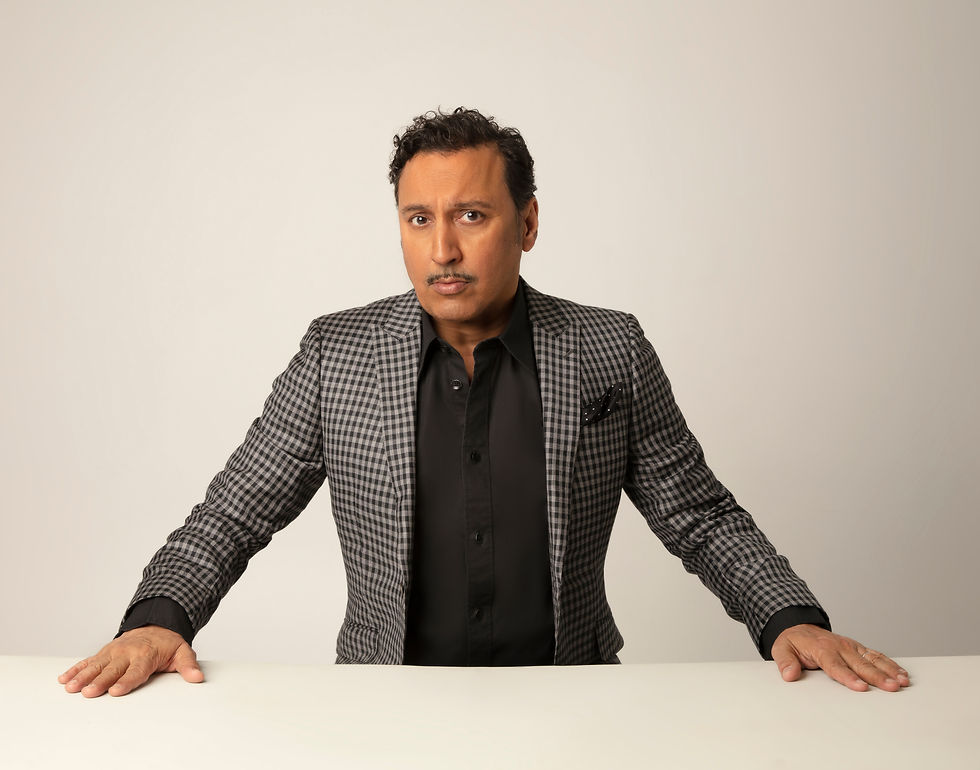
The Miniature Wife is described as a sharp surreal relationship comedy. Working opposite Elizabeth Banks and Matthew Macfadyen — two performers with very different comedic energies — how did that dynamic shape your performance and the tone of the show?
Nearly all of my scenes are with Matthew and even though we had never worked together before, he and I got along great and both collaborated on our scenes and he’s an amazing scene partner. He’s also English and since I grew up in England we watched the same TV shows growing up and so that was nice ice breaker. Ha. Elizabeth I’ve known since our days at Williamstown Theatre Festival and so we just get along and she’s a friend. We all got to work together in the wedding episode (Ep 9) and so it was nice to get to play with everyone and they brought together so many great actors- it was almost like shooting a play.
Returning to Broadway in Noël Coward’s Fallen Angels alongside Kelli O’Hara, Rose Byrne, and Mark Consuelos is a remarkable ensemble. What does live theater give you that camera work simply can’t?
Well it’s the live experience. Every night you tell a story to a group of strangers and the symbiotic interplay and energy between audience and actors is what makes it so electric. Also in film or TV, once it’s shot and in the can, as they say, it’s done and that’s what it is forever. In theatre you find a character, but you keep discovering things, you keep playing, you keep perfecting or trying new things every night. That’s what makes it exciting.
You were raised in Bradford, England, then transplanted to Florida as a teenager — two completely different worlds. How much does that specific cultural collision still inform who you are as a performer and a writer?
Hugely. I draw on my multi immigrant multi-faceted childhood in all of my writing and in my general world view. It’s also why I think I was able to move so easily between genres in this business. I wrote a book a few years ago entitled NO LAND’s MAN because I’m always living that experience of multiplicity.

Halal in the Family earned you a Peabody Award for addressing anti-Muslim bigotry through comedy. That’s a delicate needle to thread. What did you learn about the power of humor as a vehicle for something that serious?
Well from my years on The Daily Show I became acutely aware of the power of comedy and satire to deal with controversial and difficult topics. Humor is an access point. Once you’re laughing you’re open, and when you’re open, ideas can penetrate, different ways of looking at things can become apparent, you perhaps start to see the absurdity and the ridiculousness of things as soon as the lens through which you are looking at it is slightly altered.
That what satire does. When someone tells you how to feel about something, immediately defenses go up, but when you’re invited in to laugh, you’re not being lectured to, you’re being entertained.
Evil ran for Paramount+ and then found a whole new audience on Netflix — that second life phenomenon is fascinating. Did the show feel different to you once it reached that wider audience?
Absolutely. The reality is, whether one likes it or not, that once the show was on Netflix it reached an audience that was ten times that of Paramount plus and we could feel it from the conversations that happened online and also from people who just stopped us in airports and restaurants, most of them had seen it on Netflix. We always knew that the show was really really good, (and after having worked in this business for a long time I can say that with a certain level of objectivity, because I’ve done shows that are not objectively good) and when you do a show that’s good but nobody is watching it for whatever reason, it’s naturally frustrating so when it Evil reached a significant audience for the first time on Netflix we were thrilled to share our hard work with so many more people.

The New Yorker piece about you was titled “Aasif Mandvi Contains Multitudes” — which is both a compliment and a kind of challenge. Do you ever feel pressure to consolidate your identity as an artist or does the range feel like the point?
The range was a conflation of a survival mechanism, my own particular nature and the timing of when I came up in the business when there were very few brown actors working in Hollywood or NY, so you had to be a shape shifter to stay employed. There is a legitimate argument to be made that if you can be identified with one thing then that becomes your brand identity and Hollywood has an easier time marketing you and then you can break out into other things as you become more successful, but for me, I believe if I had just stuck to one thing I would never have kept working and would never have been able to climb whatever ladder I was able to climb. It was also my nature, so perhaps I couldn’t have ever done it differently. There may have been a downside but I feel I was rewarded with experiences that I would have never had. I got to be in a Broadway musical and be a correspondent on The Daily Show, do standup and work with folks like Merchant Ivory, M.Night Shyamalan and Robert and Michelle King, so I think that’s been worth it.
You’re a published author, a stage actor, a television star, a comedian, and a Peabody Award winner. When you’re not performing or writing — how do you actually decompress? What does your version of a quiet day look like?
Hahaha. I can say that I’ve been a workaholic for most of my life and I will always just need to be performing somewhere at some time but these days as I’ve gotten older and now am a father, decompressing honestly is just spending time with my wife and son. Just having movie and pizza night, or just dinner with good friends. Spending time with my kid is the biggest decompressor of all, even though a six year old can be exhausting its soul filling in a way that I could have never conceived when I was younger and single. Also writing is another great decompressor for me. I like to write and it helps me process and so that’s another way.
Noël Coward wrote Fallen Angels in 1925 — a century ago. What feels surprisingly modern about the material and what required the most recontextualization for a 2025 audience?
This is a piece that could have fallen flat very easily under the guidance of a less talented director, so I give a lot of credit to the vision that Scott Ellis had for this. Also our cast is top notch and some of the most talented people in the business. I’m so lucky to get to be onstage with them every night. For the fact that it was written a century ago it is a feminist play. The themes are not as scandalous today as they were then but the idea of women taking ownership of their own sexuality and desire still resonates today. Some of the language here and there needed recontextualizing for a modern audience but Cowards language is also so witty and fun and vibrant that it will never feel arcane and then when you pair that with the kind of physical comedy that we are bringing you get a slam dunk.

You’ve built a career that consistently defies easy categorization at a moment when the industry tends to reward the opposite. What advice would you give to a young performer — particularly one navigating questions of identity and representation — who’s trying to find their place in this landscape?
I hate giving advice because the world today is so different then when I came up in the business. I didn’t have to contend with AI creating synthetic actors but just as it was true when I was coming up we always need stories and we always need story tellers so keep telling your stories. There will never be enough stories and the more fucked up the world is the more stories we need in order to understand ourselves. Also don’t pay much attention to those who sit at the intersection of commerce and art and will tell you what the business wants, because this business is fickle and what’s hot on Monday is yesterday’s news by the end of the week and so no one has their finger on the pulse except that artist who has his finger on his own pulse.
Devil in Silver arrives on AMC+ on May 7th, with new episodes running through the summer — and the timing puts you in a remarkable position of having a Peacock series, a Broadway production, and now a prestige AMC+ drama all in the cultural conversation simultaneously. Devil in Silver is adapted from Victor LaValle’s celebrated novel, which lives at this specific intersection of horror, social commentary, and dark humor that feels very much in your wheelhouse. What drew you to this particular story, and what does the AMC+ platform and this moment in prestige television mean for a project like this?
The timing of all three of these projects coming out at the same time could never have been planned but I’m incredibly grateful for this moment. Truth be told, horror was never a genre that I gravitated towards but I realized during my time on Evil how effective it was and is as a tool for social commentary and The Devil in Silver takes on the world of mental health and the medical system and how bureaucratic and corporate systems operate specifically to keep people in place, keep people addicted and dependent rather than flourish, grow and evolve. We see it today in our world more than ever as we watch how easily the systems of power can subsume weak men into denying their own values and conscience and commit acts of barbarism. It was that commentary that drew me to the project. Prestige television can, in this moment, as we see the silencing of dissent across media platforms, take on stories that of course primarily entertain us, but also challenge us and make us think and even feel uncomfortable. My hope is that this does just that.


