
Beyond the Logo: Why Rare Jewelry Is Becoming the Most Personal Form of Luxury
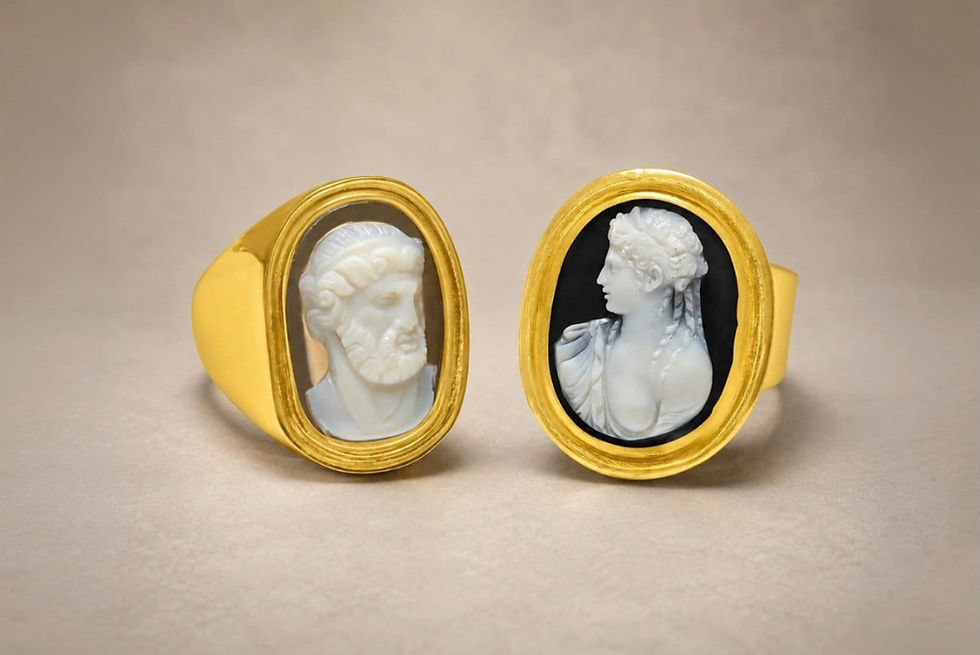
As luxury becomes increasingly personal, collectors are looking beyond recognizable names toward jewels distinguished by craftsmanship, rarity, history and individuality.
There was a time when luxury was expected to announce itself. A recognizable logo, an unmistakable silhouette or an impressive carat weight offered an immediate signal of status. Today, many experienced buyers are moving in a quieter and more individual direction.
The most compelling jewel in the room may not be the largest or the most familiar. It may be an antique ring with a beautifully worn surface, a signed bracelet whose construction reveals the hand of a remarkable workshop, or a carved gemstone that combines natural rarity with miniature-scale artistry.
This changing idea of luxury is encouraging buyers to look beyond immediate recognition and consider qualities that reveal themselves more gradually: provenance, design, condition, materials, craftsmanship and historical context.
For collectors, that process of discovery is becoming part of the pleasure.
From Luxury Purchase to Personal Collection
Jewelry has always carried meaning beyond its materials. It can commemorate a marriage, preserve a family connection, express personal style or represent an important chapter in someone’s life.
What distinguishes a collection from an assortment of beautiful possessions is intention. A collector begins to notice relationships between objects: a preference for a particular period, a fascination with colored gemstones, an interest in signed houses or an appreciation for techniques that are rarely practiced today.
Some are drawn to the architectural precision of Art Deco jewelry. Others prefer the natural lines and translucent enamel associated with Art Nouveau. Another collector may focus on ancient intaglios, unusual cufflinks, signed 20th-century jewelry or gemstones accompanied by important laboratory documentation.
There is no single formula. The strongest collections often develop slowly, guided by curiosity rather than fashion.
At New York-based DSF Antique Jewelry, this broader view of collecting brings together fine jewelry, signed designer pieces, rare gemstones, vintage and antique jewels, and historically interesting objects. What connects them is not simply age or price, but individuality and the quality of their execution.
Rarity Is More Than Carat Weight
Carat weight can be measured immediately. Rarity is more complex.
Two jewels containing stones of similar size may have entirely different levels of importance. Geographic origin, treatment history, cutting style, period, condition, documentation and artistic character can all influence how a collector understands a gemstone.
A particularly revealing example is a 5.20-carat natural unheated Kashmir sapphire carved as an antique intaglio. Accompanied by an AGL Prestige Report and mounted as a gold stick pin, the jewel brings together several distinct collecting categories.
It can be appreciated as a Kashmir sapphire, as an untreated gemstone, as an antique jewel and as a work of glyptic art. Instead of being conventionally faceted to emphasize brilliance alone, the stone has been engraved with a classical figure, allowing color, depth and imagery to coexist within the same object.
This is the type of jewel that cannot be understood through a specification sheet alone. Its importance lies in the relationship between material and human intervention: an already rare natural gemstone transformed by the hand of an engraver.
Independent documentation becomes especially important when origin and treatment contribute to a gemstone’s significance. The Gemological Institute of America explains that confirmation of no evidence of heat can add to the rarity and value of a fine sapphire. Laboratory findings do not replace connoisseurship, but they can provide essential information that cannot reliably be determined by appearance alone.
When Jewelry Becomes Art
The border between jewelry and art has never been clearly defined.
A jewel may be wearable, but it can also demonstrate sculpture, architecture, painting, engraving and metalwork on an intimate scale. Enamel can behave like color on canvas. Chased gold can create the illusion of fabric or feathers. A carved hardstone may hold a portrait, mythological figure or personal symbol within an area smaller than a fingertip.
Engraved gemstones are among the clearest examples of this intersection. Intaglios are carved beneath the surface of a stone, producing an image in reverse. Historically, they could be used as seals, but they were also collected for their beauty, subject matter and technical sophistication.
The Metropolitan Museum of Art has documented the long history of collecting engraved gems, including the renewed enthusiasm for intaglios and gem cutting that developed among European collectors. Their appeal continues because each object unites natural material, symbolic imagery and the unmistakable trace of a human hand.
Seen in this context, an important jewel does not merely accessorize its wearer. It creates a private encounter with art.
The Importance of Authorship
Signed jewelry occupies another important area of collecting because a maker’s mark connects a jewel to a recognizable creative tradition.
The appeal of a signed piece should never rest on the name alone. The most desirable examples reveal why that name became important in the first place: assured proportions, intelligent construction, exceptional finishing and a clear design identity.
Cartier, Van Cleef & Arpels, Bulgari, Tiffany & Co., Boucheron and Buccellati each developed distinct visual and technical languages. Experienced collectors learn to recognize these qualities beyond the signature itself.
A signed jewel should therefore be considered as a complete object. Is the construction consistent with the maker? Are the marks appropriate? Has the piece been altered? Are the gemstones, clasps and components original to the design? Does the condition preserve the qualities that made the jewel desirable?
Authorship may add historical context and desirability, but craftsmanship must still support the attribution.
Condition Is Part of the Story
Antique and vintage jewelry should not always look newly manufactured. A degree of age can be appropriate and even beautiful.
The important distinction is between honest evidence of use and damage that compromises the jewel. Softened engraving, gentle surface wear or an old repair may be understandable in a piece that has survived for generations. More serious concerns include poorly replaced components, excessive polishing, unstable settings, damaged enamel or alterations that disrupt the original design.
Restoration is not automatically negative. Sensitive restoration can preserve a historically important jewel and allow it to be worn safely. The key is transparency: buyers should understand what remains original, what may have been repaired and whether those interventions affect the character or value of the piece.
This is why detailed photographs, measurements, hallmark information, gemstone reports and clear condition descriptions are essential. DSF’s Jewelry Authenticity and Collector Education guide explains how factors such as signatures, hallmarks, construction, documentation, condition and craftsmanship can be considered together before acquiring a piece.
Buying With Discernment
The most rewarding jewelry purchases often begin with questions rather than conclusions.
Why does the piece look the way it does? What techniques were required to make it? Is the design representative of a particular period or workshop? Has it been altered? Does it retain the details that give it character? Is there documentation supporting important gemstone or maker information?
Buyers should also consider wearability. A jewel can be historically significant and still become part of modern life. Antique brooches can be worn on jackets, scarves or evening bags. Stick pins can be placed on lapels or displayed as miniature works of art. Vintage bracelets and signed earrings can introduce individuality into an otherwise restrained wardrobe.
The goal is not necessarily to preserve jewelry untouched inside a vault. It is to understand it well enough to wear, protect and appreciate it responsibly.
The Most Enduring Luxury Is Individual
True rarity does not need to be immediately recognizable.
It may be found in a forgotten goldsmithing technique, an unusual gemstone origin, a beautifully preserved hallmark or a carving that becomes visible only when light enters the stone from a particular direction.
These details create a form of luxury that is difficult to reproduce because it depends on time, material, craftsmanship and survival. No two antique jewels age in precisely the same way, and no thoughtful collection develops according to an identical plan.
In an era of instant access and mass visibility, the rarest possession may be something that requires a closer look.
That is the enduring appeal of collectible jewelry: it offers beauty to everyone who sees it, but reveals its full story only to those willing to pay attention.


