
Brass Knuckles vs Pepper Spray Which Protects You Better?
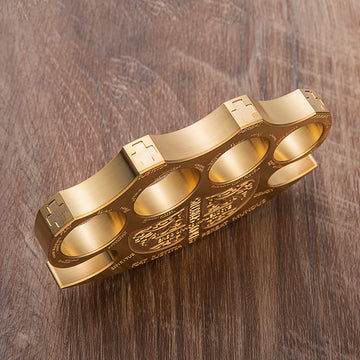
Walking alone through a dimly lit parking garage or heading back to your apartment late at night often sparks a quiet calculation: if someone approached with bad intentions right now, what would you actually rely on to get home safe? When building an everyday carry routine, people almost always run into the classic debate between impact weapons and chemical deterrents. On one side, you have the raw, visceral reassurance of brass knuckles—compact, heavy, and built for close-quarters impact. On the other hand, you have a canister of pepper spray, sitting quietly on a keychain, promising to stop a threat from several feet away. Both tools have dedicated advocates, but they operate on fundamentally different philosophies of self-defense.
The Fundamental Split: Distance Versus Contact
The single most important variable in any violent encounter is distance. Distance buys reaction time, gives you an escape lane, and keeps you out of reaching range of someone who might be bigger, stronger, or carrying an edged weapon.
This is where pepper spray makes its strongest case. A quality pepper spray canister typically offers an effective range of eight to twelve feet, depending on the nozzle type and spray pattern (stream, cone, or gel). By discharging an aerosol or stream of oleoresin capsicum (OC) from ten feet out, you create an immediate barrier between yourself and an advancing aggressor. You do not need to let an attacker enter your personal space to neutralize the threat.
A knuckle duster, by comparison, requires you to be inside extreme grappling distance. To use it, you must be close enough to throw a punch and land it cleanly. That means you are already within the attacker's strike zone, knife range, or tackle radius. If you lack hand-to-hand combat training, stepping into infighting range against an aggressive subject introduces serious physical peril, regardless of how solid the metal across your fingers feels.
How Brass Knuckles Function in a Self-Defense Scenario
To evaluate brass knuckles fairly, it helps to understand what they actually do mechanically. An impact tool slipped over your fingers serves two primary purposes: it concentrates the kinetic energy of a punch into a much smaller, harder surface area, and it distributes the shock of impact across the palm grip instead of crushing the small, fragile bones in your fingers.
In terms of sheer stopping power at zero distance, few handheld pocket tools deliver trauma quite like solid metal. A single well-placed strike can end an encounter immediately by shattering bone or causing profound disorientation. There are no batteries to recharge, no nozzles that can clog, and no mechanical parts that can jam under pressure. If you can make a fist, the tool works.
However, the effectiveness of any knuckle duster relies almost entirely on the user's athletic ability, timing, and willingness to engage in direct physical violence. If an attacker ambushes you, knocks you off balance, or pins your arms, throwing an effective punch becomes immensely difficult. Furthermore, missing a strike at close quarters leaves your balance compromised and your chin exposed.
The Physiology of Pepper Spray: Equalizing the Odds
Pepper spray relies on chemistry rather than muscular force, which makes it one of the most effective equalizers ever engineered for civilians. The active ingredient, oleoresin capsicum, is an inflammatory agent extracted from hot peppers. When it contacts mucous membranes, the reaction is involuntary and nearly instantaneous.
Within seconds, pepper spray causes:
Involuntary eye closure due to acute blepharospasm, effectively blinding the subject temporarily.
Severe burning pain across the skin, eyes, nose, and mouth.
Swelling of the breathing passages, forcing the attacker into coughing fits and shortness of breath.
Immediate psychological distress, disorientation, and sensory overload.
The beauty of this reaction is that it bypasses pain tolerance. Even if an attacker is intoxicated or in an adrenaline-fueled rage where blunt pain might not register, involuntary eyelid spasms and restricted airways take away their ability to see and pursue you. A 110-pound person carrying pepper spray can halt a 220-pound aggressor just as effectively as an experienced martial artist could, without ever taking a hit.
Real-World Drawbacks: Wind, Enclosed Spaces, and Mechanics
Despite its advantages, pepper spray is far from infallible. The most commonly cited risk is environmental blowback. If you discharge a broad fog or cone-mist spray directly into a stiff headwind, there is a legitimate chance that some of that aerosol drifts straight back into your own eyes and lungs. Pepper gel formulas mitigate this risk significantly by firing a heavier, targeted stream, but accuracy then becomes critical under extreme stress.
Enclosed environments—such as elevators, stairwells, or vehicles—also complicate pepper spray deployment. Firing an aerosol mist inside an enclosed vestibule usually contaminates the entire air space, incapacitating both you and your assailant. Additionally, canisters expire over time; the propellant can leak slowly over two to three years, leaving you holding an inert can when you need pressure the most.
With brass knuckles, environmental factors like wind, rain, and confined spaces simply do not apply. A narrow hallway or a car interior actually works to the advantage of a compact contact weapon, assuming you have room to swing or thrust your arm.
Legal Realities and Concealed Carry Complications
You cannot evaluate self-defense gear in a vacuum without looking closely at the legal landscape. The moment you decide to carry a weapon in your pocket, you take on significant legal responsibility, and this is where the comparison becomes stark.
Pepper spray is legal for civilian carry across virtually all fifty states, though some jurisdictions place minor restrictions on canister size, chemical concentration, or purchase age. In most places, carrying a canister on your keys will never cause issues with law enforcement or building security checkpoints.
Conversely, traditional brass knuckles face some of the strictest weapon prohibitions on the books. In numerous states, municipalities, and international jurisdictions, owning, carrying, or concealing a knuckle duster is categorized as a misdemeanor or even a felony. Even in jurisdictions where possession is technically permissible, using one during an altercation can quickly lead prosecutors to argue excessive force or assault with a deadly weapon. The optics in a courtroom rarely favor an individual who utilized heavy metal knuckle guards in an altercation.
Deployability and Fine Motor Skills Under Stress
When sudden violence occurs, your body dumps adrenaline into your bloodstream. Your heart rate spikes, your vision narrows into tunnel vision, and your hands lose fine motor dexterity. Whatever defensive tool you carry must be simple enough to access and deploy with crude, shaking hands.
Most modern defensive spray canisters feature an intuitive, thumb-activated safety flip. You slide your thumb under the spring-loaded flap and press downward—a gross motor action that requires very little dexterity. You do not need precise finger placement to get the spray firing toward a target's face.
Deploying knuckles, on the other hand, requires sliding individual fingers into specific finger loops while under panic. If your fingers catch on the rim or enter the loops backward while digging through a jacket pocket, you risk breaking your own fingers upon impact. Proper orientation and grip are mandatory before you can throw a strike with confidence.
Conclusion: Which Tool Offers Better Protection?
When you strip away cinematic tropes and examine the hard realities of personal defense, pepper spray protects the average person significantly better than brass knuckles. Self-defense is not about winning an honorable brawl; it is about creating an immediate window of safety so you can sprint away and call for help. Pepper spray gives you that opportunity from a safe standoff distance, equalizes dramatic differences in body size, requires minimal physical strength, and remains broadly legal to carry almost everywhere you travel.
Brass knuckles certainly carry destructive power and compact reliability, but their requirement for close-quarters fighting, reliance on physical strength, and severe legal prohibitions make them far less practical for everyday survival. For anyone seeking reliable, everyday peace of mind on the street, keeping an attacker at distance with a dependable canister of spray remains the far smarter strategy.


