
Eye In The Sky is Revolutionizing Private Aviation
Updated: Jun 12
An industry defined by impressive aircraft yet archaic infrastructure, Eye In The Sky introduces something private aviation has never had: an exclusive marketplace with a verified community of private jet owners, operators and flyers where members can seamlessly buy and sell seats or post empty legs all on a single integrated platform.
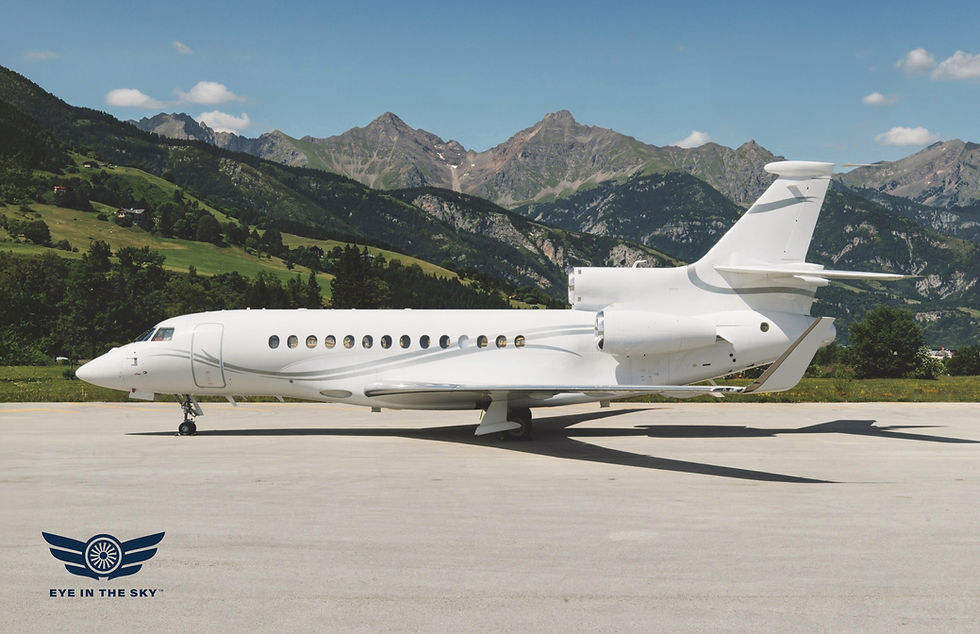
Each month, more than 200,000 private flights take place, just in North America. Over 42% — approximately 84,000 — fly completely empty. These empty aircraft are heading to pick up their first charter, moving toward their next charter, or making their way back to the home hanger after their final drop off.
Meanwhile, luxury travelers are chartering entire aircraft at full price and purchasing commercial first-class seats, often unaware a jet may already be flying the exact route they need. This is not a supply problem, it’s a coordination problem. Eye In The Sky was built to solve that missed connection (pun intended) — and in doing so, pioneer a new way of flying.
By connecting existing supply with real-time demand, Eye In The Sky transforms private aviation from disjointed individual movements into a coordinated ecosystem. The aircraft were always there, now Eye In The Sky puts people on them. Click here for a video on how Eye In The Sky Works!
ELEVATED - In the simplest terms possible, what is Eye In The Sky? How would you explain it to a friend who has never flown private before?
Eye In The Sky is an exclusive marketplace with a verified community (via biometrics and background checks) of private jet owners, operators and flyers where members can seamlessly buy and sell seats or post empty legs all on a single integrated platform.
Eye In The Sky is not an operator or a broker so we don’t “create” flights but are rather a private network open marketplace; our “inventory” of available flights is dependent upon our Members posting available seats and flights for trips they are actively taking.
Hosts set the prices for seats/flights. We don’t collect any % for flights or seats sold, we charge only the one-time $10 verification fee and $65/month membership fee thereafter.
By not taking a % from any flights or seats sold, we are able to remain entirely agnostic and able to benefit everyone in the industry. This is what sets us apart from everyone else in the space. Think Facebook Marketplace, not Amazon. Or, think Uber or Airbnb — but invitation-only and private aviation centric.

How Membership Works:
Eye In The Sky is not available to the public as it is by invitation only to continue to curate a dynamic and professional network. (Unless you are a member of the Elevated Magazines community, and then you are invited to join this exclusive network and bypass the existing waitlist via the special invitation link here!
In order to join, a person must:
Submit an application on our website, to then sit on a waitlist; or alternatively be sent a direct invite from Eye In The Sky or one of our affiliates.
Once an invitation is received each person must first pay a $10 verification fee and complete our biometric verification and background check process. If they pass, then and only then are they allowed the opportunity to become a member of Eye In The Sky (yes, for $65/month). A big part of requiring biometrics verification and a monthly membership fee (albeit nominal) for access, is to continue to promote a dynamic and professional network for the Eye In The Sky community.
Having a verification process and charging a monthly membership fee, helps further that initiative, as Eye In The Sky expects all users to comply with applicable laws and regulations. Once onboard the platform Hosts and Flyers connect directly and transact privately; a seamless experience.
Two types of Members:
Hosts — aircraft owners, operators, charter customers, or brokers; who are posting empty legs or empty seats on already existing flights they are hoping to fill.
Flyers — the members who are looking to purchase a flight or seat, at a fraction of the full charter cost, on those posted flights.
Flight Interest Section:
Our proprietary “Flight Interest” feature on the platform intelligently matches the two. When you can’t find the flight you need, simply post an “Interest”. This creates a post and associated group chat, searchable within the platform and allows other users with similar searches and needs to find it and join. It’s a great way to get together with people of the same interest to charter a plane (and split the cost!) if you aren’t seeing what you need posted on the platform. Let the demand create the supply!
Alternatively, if you’re a Host with a plane looking to fly a route and date that already has an Interest post for the same criteria—create the flight! The interest gets notified of the new flight now available to fulfill their need. In short, we bring both efficiency and visibility to private flights that were already happening, and help Host new ones when real demand is present. Click here for a video on how “Flight Interests” work!

ELEVATED - Give us a Host example. Someone is chartering a private jet from Florida to Colorado for a long weekend and has two open seats. Walk us through exactly how they would use Eye In The Sky from start to finish.
A Host chartering a jet from Florida to Colorado logs into Eye In The Sky and Under the “My Flights” tab simply clicks “+ ADD NEW” and fills out all required fields. The moment the flight is posted, the platform’s algorithm checks for any existing Flight Interests with that route and timeframe. If a matching Interest (or Interests) exist(s), the Interest Group(s), and the Flyers in it, are immediately notified a flight now exists matching their need.
This alert system is core to the platform’s power, and it’s all inside a verified environment. Click here for an in-depth video “tutorial" on how different parts of the platform work!
ELEVATED - Now give us a Flyer example. A luxury traveler wants to fly private from Miami to Aspen for an event weekend but does not want to charter an entire plane. How do they find a flight on Eye In The Sky and what does the booking process look like?
The Flyer logs in and searches Miami to Aspen. All flights within 100 miles of the selected departure and arrival airports will populate. As you know, there are multiple airports in South Florida (MIA, PBI, BCT, etc.) and the Aspen area (ASE, RIL, EGE, etc.), that could interest a Flyer going Miami to Aspen, and we want to be sure all options are captured regardless of the specific airports specified in the search.
If a flight is listed, they review aircraft details, seat pricing, departure windows and any amenities provided. If they decide it’s a fit, they send a message directly to the Host, request a seat, confirm flight details and pay. The Host provides plane and FBO info. The Flyer shows up at the appropriate time and FBO and boards the plane. It’s that easy.
Alternatively, if they do a search and no flight appears, they can now post a “Flight Interest” request specifying route, dates, preferred departure window, flexibility...and as we often say, “Let the demand create the supply!
Instead of waiting for flights to appear that fit your needs, the demand itself can be the catalyst for their creation. This reverse fulfillment has never been done in private aviation before, and the inversion is what makes the Interest system so powerful and unique to Eye In The Sky.

ELEVATED - Step by step, what happens once a Host posts seats? What does the Flyer see on their end?
The Host posts the flight, which lists all flight details and available seats (as previously described). The platform cross-references active Flight Interests. Matching Interests receive instant notifications of the posted flight fulfilling their Interest. (This notification is sent directly to all Flyers in the Interest, not just the Interest itself.)
After either browsing the platform and seeing a flight they want; or getting a notification from an Interest they are in about a newly posted flight satisfying their Interest; Flyers review the posted flight (aircraft and pricing details etc.), and it’s a fit.
Flyer sends a message, communicating directly with the Host. Seats are requested, confirmed and paid for. For Flyer’s, capitalizing on the Interest section is a gimme, as the system is continuously connecting supply and demand.
ELEVATED - How is this experience different from booking a traditional charter or flying first class commercially? Can you explain this through a real-world comparison?
Chartering is fully bespoke and fully private — but it’s priced for one party. That exclusivity comes at a steep cost. Flying first class commercially is comfortable, but it’s not private aviation. You still have burdensome time-consuming security lines and commercial airport protocol, unpredictable delays, cancellations and re-routes, missed connections and lost luggage. While it can be significantly less expensive, it’s a fundamentally different experience. With Eye In The Sky you get none of that, plus access to direct routes otherwise not available, and a greater sense of comfort and safety traveling with less outside factors and a known higher standard of service, cleanliness, dedicated space and mobility.
Both the experience and the price gap between the two are massive. So, let’s use real numbers. A one-way charter from New York to Los Angeles on a quality midsize or heavy jet can easily run $40,000. That aircraft likely has 8–10 seats. A first-class commercial ticket on the same route might be anywhere from $1,500-$4,000/ticket, let’s call it $2,000 per person to be moderate/conservative. So for two people, that’s roughly $4,000 versus $40,000.
Flying private in this example is 10x the cost of flying commercial. But what is the cost of a seat on that same private aircraft if posted on Eye In The Sky? Approximately $4,000 per seat. So now you have two travelers flying private for $8,000 instead of the $40,000 cost of the entire charter.
Or you have two travelers now flying private for $8,000, for only $4,000 more (often times even less of a disparity) trading the nuisance of commercial travel for the private terminal, no TSA lines, personalized service, flexible timing and quiet cabin environment. Meanwhile, back on the Host side who charted and posted these now sold seats on Eye In The Sky, they are now offsetting $8,000 of their cost by sharing unused capacity. Everyone wins. One party no longer has to pay 100% of the cost; the platform optimizes/fills the unused capacity, connects supply with demand and shares the expense of flying private.

ELEVATED -Explain a deadhead leg using a real scenario. Where is the plane going, why would it normally be empty, and how does Eye In The Sky change that outcome?
A jet flies passengers from Miami to Aspen on Friday. After drop-off, it must then (reposition) go to Los Angeles for its next charter on Monday. The Aspen-to-Los Angeles leg flies empty. That is a deadhead/dead leg/empty leg — and it happens tens of thousands of times per month.
If that leg were listed on Eye In The Sky by the Host (Operator, Plane Owner, whoever), Flyers wanting to go from Aspen to Southern California could occupy those seats. The aircraft is flying regardless, so adding passengers improves efficiency and offsets costs without compromising the private flight experience.
Now if all those empty flights were listed on Eye In The Sky, multiply the above across more than 84,000 empty private flights per month, and the potential impact becomes substantial — economically and environmentally (carbon emissions is something we are getting into even greater detail later this year!).
ELEVATED - From a business perspective, how does filling seats on existing flights help aircraft owners and operators recoup costs and reduce overhead? Can you give a simple financial example?
Consider a Jet Owner. Operating cost of $15,000 for a particular flight. On this flight, it’s just the owner and his partner onboard — with six empty seats. If four of those seats are sold at $2,500 each, that’s $10,000 in recovered costs. The net cost of the flight drops from $15,000 to $5,000. That’s nearly 70% of the operating expense offset — on a flight that was happening anyway. Across dozens of flights per year, that can mean six figures recovered for a single aircraft owner.
Consider an Operator. Operators managing fleets think in yield per flight hour (the average revenue generated by an aircraft for every hour it is in the air). If a dead leg is already scheduled, the fixed cost of operating the aircraft has nothing but upside if you offset by filling even one empty seat on the flight. For both, it’s about optimizing flights already in motion.
The 51,000 ft Industry Problem. As mentioned before, roughly 84,000 private flights fly empty every month.
Assume a conservative average operating cost of $9,000 per flight. That equates to $765 million per month, nearly $10 billion per year, in underutilized capacity or lost revenue opportunity. That is not a rounding error. That is structural inefficiency in a capital-intensive industry.
All in all, owners offset operating costs, operators increase yield and improve efficiency, private aviation becomes more accessible to travelers at materially lower entry points. Eye In The Sky was built to provide these solutions, and by remaining agnostic, we’re able to serve everyone in the industry. If using Eye In The Sky becomes habitual — Hosts list capacity and luxury travelers check availability on Eye In The Sky, first, every time —consumer behavior shifts; the industry shifts; Eye In The Sky becomes ubiquitous with private aviation ridesharing.
ELEVATED - Why was direct communication between Hosts and Flyers important to build into the platform? How does that change the experience compared to broker-led models?
Broker-led models come with “sticker shock” when providing or receiving a quote for an entire plane (making Broker’s quote to trip ratio about 50-1) as well as additional economics (commissions). Direct communication between verified Hosts and Flyers, allow the users to communicate directly through a secure environment, rather than an intermediary, and only about specific seats (or flights) they already know the price of and are still interested in. All without commissions. But, if you’re a broker, use Eye In The Sky as a tool! Remember those Flight Interest sections we talked about. Those are pools of demand, waiting to be supplied; each one able to improve those quote to trip ratios! Click here for a video on how Eye In The Sky works for Operators and Brokers alike!

ELEVATED - How does Eye In The Sky maintain a private aviation caliber experience while offering access at a lower cost point? Can you give an example of what stays the same and what changes?
Nothing about the experience changes. Same jet. Same crew. Same FBO. Same safety standards. What changes is filling the empty seats of a flight already flying. The “lower cost” is derived from the efficiency in sharing the space and increasing capacity on a flight that already exists — not from downgrading the experience, aircraft or standards. Eye In The Sky simply provides the closed to the public, vetted environment for that to be able to happen.
ELEVATED - Sustainability is often discussed in broad terms. Using a real flight example, explain how filling empty seats or legs reduces waste or unnecessary emissions.
In today’s world, a single example of what might happen when flying from Scottsdale to Los Angeles might look like the following. A plane owner is leaving tomorrow at 2pm by himself to visit his grandkids, and has 7 empty seats. A charter customer charters a plane, leaving tomorrow at noon for a business meeting, with only 1 additional colleague on the plane. An operator based in LA, just dropped off a group of passengers in Scottsdale and is returning home to LA empty in the morning. Three different planes flying the exact same route, on the exact same day—2 essentially empty and 1 completely empty!
Now enter Eye In The Sky. One plane flys instead of three. The Operator posts the empty leg on the platform. The plane owner checks Eye In The Sky, sees the empty leg and jumps on it; keeping his plane on the ground. The charter customer and her colleague check Eye In The Sky, see the empty leg and also jump on it; spending significantly less to fly private, and no longer chartering a plane. The operator fills its empty leg. Everyone wins. Including the environment, as there is now one plane serving three groups, versus three planes serving three groups on the same exact route and day. Now, scaling the above across 84,000 empty legs monthly… that not only generates significant efficiency gains but also significantly reduces carbon emissions.
ELEVATED - What is the biggest misconception people have when they hear “shared private flight,” and how does Eye In The Sky solve that concern in practice?
The biggest misconception is that travelers do not want to share planes. Private aviation is extraordinarily expensive. Whether someone is worth $5 million or $500 million, when given the opportunity to offset cost without compromising experience — people make the choice, we see it every day. Technology driven ridesharing is a proven business model, just see Uber and Lyft. It’s just finally made its way to Private Aviation, thanks to Eye In The Sky.
The second biggest misconception, really more so piggybacking on the above, is that sharing diminishes privacy or quality. On Eye In The Sky, shared private flights typically involve two to four highly vetted individuals in a cabin designed for eight to twelve. It remains quiet, spacious, and elevated. But remember, the Host decides how many empty seats he/she wants to fill. So if they want a more empty cabin, they can offer less seats. If they are looking for a fuller cabin, they can offer more. It’s entirely in the hands of the Host. There is also a surprising upside, if you choose to take it: meeting someone inside the cabin of a private aircraft often becomes a valuable experience — socially and professionally. We have heard numerous stories from members who formed business relationships or lasting friendships after sharing a flight. When the environment is curated and intentional, shared travel can enhance the experience, rather than diminish it.
ELEVATED - If a reader remembers only one example from this story, what scenario best illustrates why Eye In The Sky works.
Eye In The Sky works because we are able to remain entirely agnostic (by not taking a % from any flights or seats sold) and provide a benefit to everyone in the industry. Whether it’s offsetting costs for plane owners and charter customers; reducing over head for operators; providing brokers a new pool of demand to supply; or providing access to private air travel at a lower entry point for travelers; Eye In The Sky benefits everyone by providing a private (invitation only), vetted (required biometrics verification and background checks prior to entry), and living ecosystem to the private aviation industry.
All of this is what sets us apart from everyone else in the space, and why Eye In The Sky is, should, and will be ubiquitous with private aviation ridesharing. There’s a piece of the pie for everyone here; but more than that, Eye In The Sky helps expand the pie, not just serve it. Our best advice; embrace the ridesharing revolution of private aviation.

ELEVATED - Looking ahead, can you give an example of how Eye In The Sky might change behavior in private aviation over the next several years, especially in high-activity markets like Texas?
In high-activity markets like Texas, Flight Interests will increasingly guide aircraft positioning. Operators will begin to move aircraft toward visible demand they see in the Interests, rather than speculate. Flights will thus originate where real interest already exists. Over time, the industry will become proactive rather than reactive; and when infrastructure changes, behavior follows. If using Eye In The Sky becomes habitual — Hosts list capacity and luxury travelers check availability on Eye In The Sky, first, every time —consumer behavior shifts; the industry shifts; Eye In The Sky becomes ubiquitous with private aviation ridesharing.
Every time you think about flying — anywhere — Eye In The Sky should be your first stop. Whether you’re a Host (looking to fly) or a regular Flyer; check for a flight, or matching interest. If a flight already exists, take it. If one doesn’t, you have options. Fly your own aircraft, or charter, and list the seats you don’t need. Or as a passenger create a “Flight Interest” and allow demand to grow and create supply.
But without Eye In The Sky, you only have the below, limited, choices. Fly your own aircraft at full cost or fly commercial. Neither of the above scenarios compare to what you are able to now do on Eye In The Sky instead. With Eye In The Sky, the possible scenarios multiply. Seats that were invisible become visible. Flights that were empty become full. Demand that was silent becomes seen. As mentioned earlier, if using Eye In The Sky becomes habitual — Hosts list capacity and luxury travelers check availability on Eye In The Sky, first, every time —consumer behavior shifts; the industry shifts; Eye In The Sky becomes ubiquitous with private aviation ridesharing, and the economics of the entire private aviation industry change.
Empty seats get filled. Owners offset operating costs. Operators/Brokers improve yield and efficiency. More travelers gain access to private aviation. Everyone wins. Eye In The Sky didn’t reinvent the aircraft. It reinvented the behavior around them; and behavior, once harnessed, reshapes industries.
Private aviation has always been remarkable because it gives you the one thing you can never manufacture: time. From any human perspective, it can feel like a time machine. Leave Denver at 9:00 a.m. for a 10:00 a.m. meeting in Los Angeles and land almost at the same time you departed. Make multiple stops on the way back. Be home for dinner. Commercial travel simply cannot compete. But it’s personal, too. Bring your dog. Travel with your friends or family. Move without lines or friction. Eye In The Sky not only unlocks access to aircraft — but also the time advantage that come with it. Because time is the only asset that never replenishes. The aircraft were always there. Now with Eye In The Sky, the access is too.


