
How to Make Family Game Night More Than a Quiz
Family Game Night With Shared Puzzles and Drawing
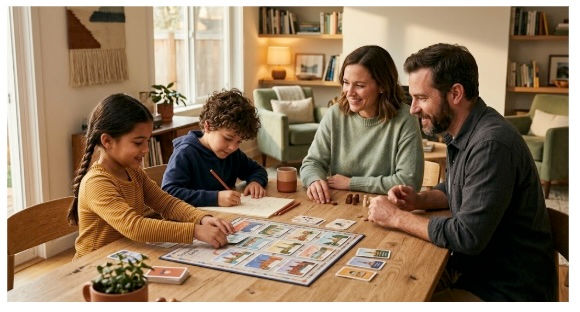
Simple ways to bring curiosity, conversation, and shared problem-solving to the table.
A family game night can make room for learning without becoming another homework session. Start with something everyone can try, mix questions with drawing or building, and give the family a challenge to solve together. A few well-chosen activities can fill half an hour without an elaborate setup or a new subscription.
The harder part is finding a format that works when one child reads quickly, another wants to move, and the adults already know most of the trivia answers. Planning around those differences makes the evening easier to share.
Think of the table as a place to try things, explain a surprising answer, and occasionally let the children write the rules.
Start with a shared interest, not a subject list
Choose a theme the family already talks about. A recent museum visit, an upcoming trip, a favorite animal, or something spotted on a walk gives you a starting point that feels connected to everyday life.
Then vary what players do with it. A travel-themed evening could include finding a destination on a map, drawing a landmark from a description, and choosing what to pack for its weather. Nobody needs to sit through three rounds of geography questions.
Keep factual answers separate from questions that invite judgment. “Which country is Lisbon in?” has one answer. “Which three things would you pack for a rainy city walk?” calls for reasons, and several combinations could work.
For families looking through quiz-based options, Wayground Guide is an independent education site covering learning games and teaching tools. Its classroom focus can help with choosing a format, but the home version can be much simpler: fewer questions, shared materials, and no need to keep a report afterward.
Make the table easy to join
Set out only what the first activity needs. A clear patch of table, pencils, and a small stack of cards are more useful than an impressive spread that leaves no room to play.
Place materials where children can reach them and read cards aloud when needed. Use large, clear writing and avoid instructions that depend only on color; a card can have both a blue border and a triangle symbol.
Keep extra supplies in a tray beside the table. That lets you switch from drawing to a puzzle without clearing the whole room, and it makes putting everything away straightforward.
The setting can still feel special. A favorite snack, comfortable seats, and a small invitation made by a child are enough to mark the evening as something chosen together.
Give everyone a piece of the solution
A shared challenge changes who gets to contribute. Instead of asking one question and rewarding the quickest answer, distribute information so the group needs to listen to each person.
Try this simple destination puzzle. Put four places on the table: a park, a library, a café, and a swimming pool. Give different players these clues:
We are going somewhere indoors.
We can borrow something there.
We need to return what we borrow.
The group combines the clues to identify the library. A younger player can point to a picture, while an older player explains why the other destinations do not fit all three clues.
On the next round, ask the children to choose a destination and write the clues for the adults. Check that the clues narrow the choices to one answer; discovering an ambiguous clue can become part of the game.
For more formats to adapt, these cooperative classroom games include shared puzzles and communication challenges. At home, use the shared goal and rotating roles while leaving out the classroom assessment steps.
Change the task before adding more questions
If the first activity involves reading, make the next one visual or hands-on. Changing the task creates another way to participate without requiring a new topic.
One option is a drawing challenge with a deliberately precise instruction. Ask everyone to draw a square, add a circle inside it, and place a triangle above the square without touching it.
Compare the pictures. If they differ, talk about which instruction needed more detail: how large should the circle be, and how far above the square should the triangle sit? Let a child revise the directions and run another round.
For a building activity, offer equal sets of blocks and ask pairs to make a bridge across the same gap. Agree on a simple test before building, such as whether a toy car can cross without the bridge falling.
Neither activity needs a winner. The interesting moment may be a changed design or an instruction that suddenly makes sense.
Use a screen for one clear job
A screen can display a photograph, play a short sound, or show a question that everyone discusses. Decide what it adds before opening an app.
For a shared-screen quiz, prepare a handful of questions and check the answers beforehand. Give each person paper to write or draw a response, then reveal answers together so the first voice does not settle the whole round.
If you use a quiz platform, preview the full activity before inviting everyone over. Check whether it expects individual devices, uses a timer, or introduces a sign-in step that interrupts play.
You can also skip the platform entirely. A photograph of an unfamiliar object makes a useful prompt: what might it be for, and what details support that guess? Reveal its purpose after everyone has had a chance to contribute.
Adjust the role, not just the difficulty
Mixed-age play works better when younger children have something meaningful to do beyond watching an older sibling answer. Give them a choice, a material to arrange, or a clue that the group needs.
In the destination puzzle, a younger child might match pictures to place names. An older child can check whether the clues eliminate every alternative, while an adult reads instructions without announcing the answer.
Rotate those responsibilities. The same person should not always read, explain, or make the final decision.
Avoid a scoreboard that simply records who already knows more. If the family wants a goal, try completing three different challenges together or improving a design after its first test.
Finish with a reason to play again
Plan a stopping point before starting another round. For a short evening, one opening puzzle, one drawing or building activity, and a child-led final challenge may be plenty.
Ask one useful question before putting the materials away: “Which part should we keep next time?” A request to write harder clues, swap roles, or rebuild the bridge gives you a better starting point than planning a completely new evening.
Save the favorite activity in a small envelope or box with its instructions. Next time, change the theme or one rule rather than preparing everything again.
Learning does not need to become the evening’s score. A child explaining a clue, an adult reconsidering a guess, and a family improving something together are worthwhile reasons to gather around the table.


