
Illuminating the Resort: Landscape Lighting Design Behind Five-Star Outdoor Spaces
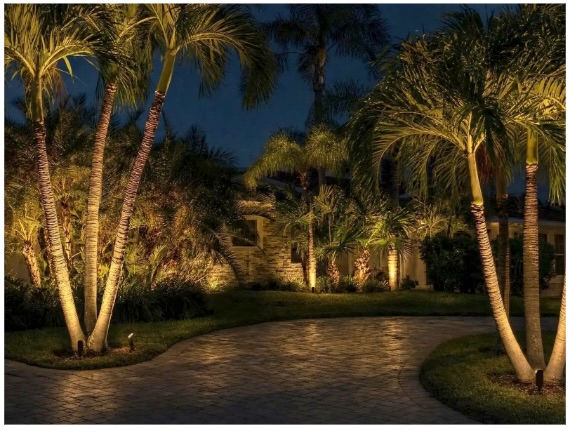
There is a moment every traveler knows: you arrive at a resort at dusk, and somewhere between the porte-cochère and the lobby, the atmosphere shifts. The palms are softly lit, the path leads with warm light, and a sense of care is already present before you reach the lobby.
That impression is deliberate. In five-star hospitality, outdoor lighting is rarely about brightness alone; it is about hierarchy, mood, and the controlled reveal of architecture after dark. Here is how the best resorts approach it.
The Arrival Sequence: First Light Impressions
A guest forms an opinion of a resort within the first thirty seconds, and much of that judgment comes from the lighting — before any greeting is spoken.
Warmth over wattage. The drop-off area relies on low path lights, a few uplit specimen trees, and a color temperature held between 2700K and 3000K. Cooler tones risk making the entrance feel institutional. Warm light is what defines the evening atmosphere.
The handoff. The entrance is kept slightly brighter than the path beyond it, drawing the eye forward before the light levels ease into a more intimate scale. Too bright and the space reads as a parking area; too dim and the guest hesitates.
One focal point. One element should carry the scene — a sculptural tree, a water wall, or a statement planter. Ambient and wayfinding light remain secondary. Consistency matters: the entire run of fixtures must share the same CCT, finish, and beam. A single mismatched unit can break the overall effect.
Pathway Choreography: Guiding Without Glare
Beyond arrival, the priority shifts from atmosphere to function. The path’s primary role is to guide guests safely to their rooms without drawing attention to the lighting itself.
Rhythm, not runway. Path lights are staggered on alternating sides with varied spacing, creating a sense of cadence rather than a continuous strip of light. Beams are tight and fully shielded so that only the ground is illuminated. Step lights are recessed into risers, low bollards cover open stretches, and in-ground linear fixtures handle transitions. The consistent rule is simple: light the ground, conceal the source.
Keeping the night. Many premium properties now require Dark Sky compliance — shielded, warm-toned fixtures that preserve the night sky, allowing the Milky Way to remain visible from the pool deck. The infinity edge may attract the photographs; the intact night sky often leaves the stronger memory.
Unobtrusive safety. Effective wayfinding is noticed only when it fails — a missed step or glare from an unshielded source. When done well, guests simply arrive at their destination without thinking about the light.
Water Features: Light as Liquid Architecture
Water interacts with light in distinctive ways: it reflects, refracts, and multiplies it. At a resort, this quality is used deliberately.
The mirror. A reflecting pond is lit from the far edge rather than the viewing side, allowing the architecture to double in the surface. Lighting from the guest’s position introduces glare and destroys the reflection.
The splash. Submersible uplights transform a fountain into a three-dimensional form that appears only after dark, with each droplet catching the beam.
The fall. A single fixture at the base of a waterfall allows light to travel upward through the falling water; additional fixtures at the top are usually unnecessary.
The pool. Color temperature is typically held between 3000K and 4000K. Warmer light can appear muddy against stone and tile, while cooler light reads cleaner. Underwater lighting fixtures must meet true IP68 standards and withstand chlorine, salt, and repeated thermal cycling without fogging. A non-functional pool at a five-star property is more than a maintenance issue — it becomes a visible brand problem.
Facade and Architectural Illumination: Revealing Form
Once the landscape is addressed, attention turns to the buildings. Facade lighting is less about illuminating a structure and more about clarifying its form — the layering of stone, the grain of timber, the rhythm of a colonnade.
Grazing. Light directed along a textured surface (stone, brick, or timber) deepens shadows and brings the material to life.
Wall-washing. Even illumination flattens the surface. It is most appropriate where the wall itself is smooth, and texture is not the primary interest.
Silhouette. Placing light behind a feature — a palm, sculpture, or column — creates a dark form against a luminous background, producing a more graphic effect.
Concealed fixtures. Across all approaches, the principle remains the same: the light should be seen, not the luminaire. Fixtures are recessed, buried, or set within planting. Housing materials are chosen to weather into the landscape — a bronze finish typically disappears within a season, while polished metal remains conspicuous. The finish of an unseen fixture is one of the more carefully considered decisions in the program.
The Craft Behind the Glow: Where Design Meets Manufacturing
Guests rarely notice this layer; specifiers deal with it constantly. It is the distance between a lighting concept and the fixtures that are actually delivered — and the point at which many design intentions are compromised.
The specification that exceeds the catalog. A resort may require a path light with a precise beam spread, 2700K, a bronze finish matched to local stone, IP65 rating for coastal conditions, and the appropriate UL listing. Standard catalog products often fall short. The practical question becomes who can manufacture it.
From sample to consistent installation. A fixture that performs well on a sample board must do so uniformly across the entire property years later — whether 200 matching bollards along a driveway, a custom uplight with a proprietary shroud, or a coordinated family of path and step lights. This requires a partner capable of moving from concept through prototyping to certified production while preserving design intent: rapid prototyping, in-house photometric testing (integrating spheres, goniophotometers, IP and salt-spray chambers), and rigorous control of color and finish across volume.
The control layer. Most contemporary fixtures incorporate electronic modules for dimming, scene setting, or integration with building automation. Ensuring these components remain reliable outdoors, maintain certification, and continue communicating with the system over time is a separate engineering challenge.
For brands and specifiers seeking this capability, an established custom landscape lighting OEM/ODM partner with dual-factory capacity, full UL/ETL/RoHS compliance, and integrated smart modules can translate a design concept into a consistent, long-term installation — one that performs as intended from opening night through subsequent years.
The Resort That Glows
The most memorable resorts are rarely the brightest. They are the ones that, after dark, feel exactly as intended.
Among the many layers of luxury hospitality, outdoor lighting is the one least often named and most consistently felt. The next time a path between palms leads you forward at dusk, and the space feels quietly resolved, the underlying design decisions — and the manufacturing discipline behind them — are what made that impression possible.


