
Inside Canada’s Quiet Peptide Research Boom
- Aug 13
- 3 min read
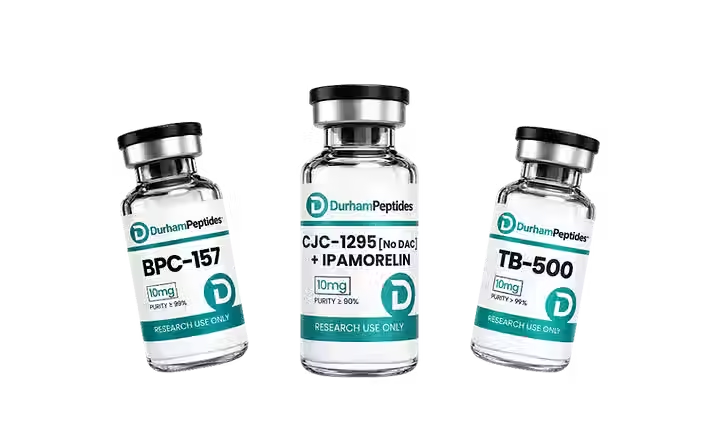
A surge of longevity science has turned a once-obscure corner of biochemistry into one of the country’s fastest-moving research markets. Here’s what’s driving it — and how serious buyers are separating the credible from the questionable.
For most of the past decade, peptides lived in the footnotes of pharmacology — short chains of amino acids studied quietly in university labs and pharmaceutical pipelines. Then the GLP-1 era arrived. As metabolic peptides became household names and longevity medicine moved from the fringe to the boardroom, attention spread to the wider class: hundreds of research compounds under investigation for everything from tissue repair to skin science to cellular energy metabolism.
Canada has felt the shift acutely. The country produces world-class biomedical research, yet for years its research-supply ecosystem lagged behind the United States. Labs and independent researchers sourcing peptides often faced a choice between slow international shipping, customs uncertainty and — more troubling — a gray market of unverified product. That gap is now closing, and a domestic industry is forming around a single organizing principle: verification.
A class of molecules having a moment
Peptides occupy a middle ground between small-molecule drugs and large biologics, and the research interest around them spans an unusually wide territory. BPC-157 is studied in preclinical models for tissue repair. GHK-Cu, a copper peptide, has decades of literature behind it in skin and regenerative research. CJC-1295 and ipamorelin are investigated for their roles in growth-hormone signaling, while newer metabolic candidates such as retatrutide and cagrilintide sit adjacent to some of the most-watched pharmaceutical trials in the world.
To be clear, these are research materials — sold for laboratory use, not approved therapies. But the volume of academic and preclinical work surrounding them has grown dramatically, and with it, demand for reliable research-grade supply.
The trust problem
The research-chemical market has always had a provenance problem. A lyophilized peptide vial reveals nothing to the naked eye: not purity, not identity, not whether the milligram count on the label matches what is actually inside. Independent analyses of gray-market product have repeatedly turned up underdosed or misidentified vials. For a working lab, that is not an inconvenience — it invalidates results and wastes months.
The suppliers now winning in Canada are the ones treating analytical transparency as the product itself. Independent third-party testing, published certificates of analysis with verifiable report numbers, batch-level traceability and HPLC purity data have become the table stakes of a credible operation — and the fastest way to tell a serious supplier from a reseller with a logo.
The Canadian answer
A new generation of domestic suppliers has built its model around exactly that. Durham Peptides, an Ontario-based supplier, is representative of the approach: every batch is independently tested by a third-party analytical laboratory, certificates of analysis carry verification keys that can be checked directly with the lab that issued them, and orders ship domestically — which matters in a category where customs delays and temperature exposure are real variables. For researchers looking to buy peptides in Canada, the emergence of verification-first domestic suppliers has quietly changed the calculus: faster logistics, no border risk, and a paper trail that stands up to scrutiny.
What discerning buyers check
The diligence, it turns out, is simple. Ask where the certificate of analysis comes from — an independent laboratory, not an in-house printout. Confirm the report number can be verified with that laboratory directly. Look for HPLC purity at 99 percent or higher, a batch code on the vial that matches the certificate, and a supplier that answers technical questions quickly and specifically. A supplier confident in its product makes its testing easy to verify. One that is not, will not.
Where it goes from here
The longevity economy is not slowing, and the research activity around peptides is compounding with it. The infrastructure being assembled in Canada right now — analytical partnerships, domestic logistics, transparent documentation — looks less like a trend and more like the foundation of a permanent research-supply industry. The winners will be the suppliers who understood earliest that in a market where the product is invisible, trust is the product.


