
Inside India's Most Exclusive Homes, the Luxury Elevator Has Become the Ultimate Statement of Refined Living
- Apr 29
- 6 min read
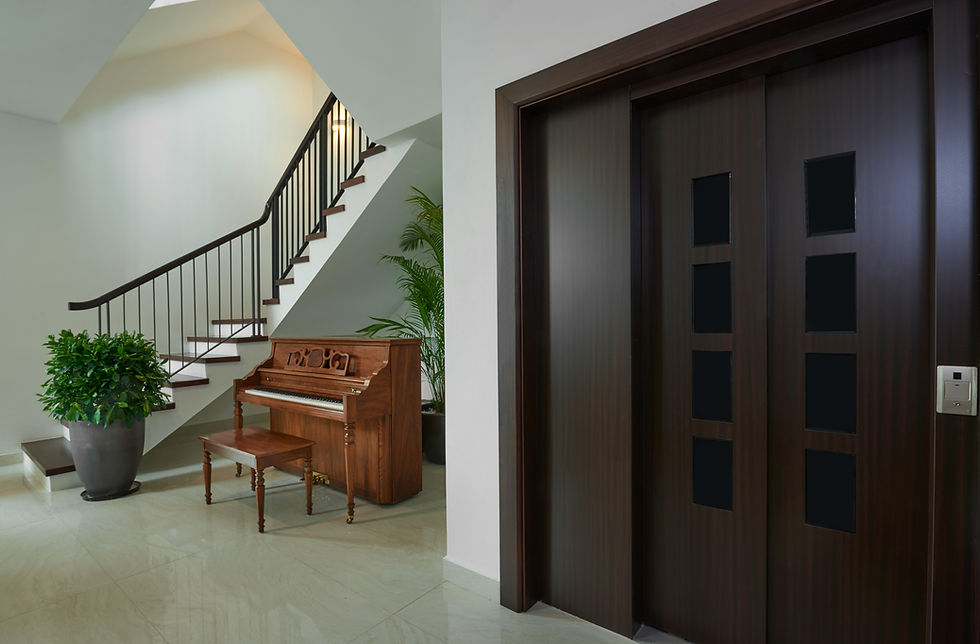
India's relationship with luxury has always been vivid, layered, and entirely its own. From the durbars of the Maharajas to the grand havelis of Rajasthan, from the Art Deco towers of South Bombay to the glass-and-steel mansions rising above Gurugram's Golf Course Road, the Indian appetite for the finest things has never required external validation. It has its own grammar, its own scale, and increasingly, its own language of what a world-class private residence looks and feels like from the inside.
That language is changing again. The most significant shift happening across India's premium residential market in 2026 is not in the kitchens, the swimming pools, or the home theatres, though all of those continue to be specified with increasing ambition and sophistication. It is happening in the vertical dimension of the home. The luxury home elevator has arrived in India's finest private residences not as an accessibility feature and not as a status symbol borrowed from Western residential culture. It has arrived as a logical and inevitable expression of how seriously India's most discerning homeowners now take the totality of their living environment.
Walk through a recently completed independent kothi in Delhi's Golf Links, a sprawling villa in Hyderabad's Jubilee Hills, or a penthouse tower residence in Mumbai's Worli, and the conversation about what defines the finest level of specification has shifted. The luxury home elevator in India has joined the modular kitchen, the automated lighting system, and the climate-controlled wine cellar as a feature that the most considered properties now include as a matter of course rather than as an extraordinary addition.
Why India's Finest Homes Have Reached This Point
The trajectory that has brought the premium home elevator into the Indian luxury residential mainstream is worth understanding because it reflects something genuine about how the category of buyers involved thinks about property.
India's most affluent homeowners are increasingly building or acquiring multi-storey independent homes across the country's great metros and their premium peripheries. In Delhi NCR, the established corridors of South Delhi, the golf community developments of Gurugram, and the villa enclaves spreading toward Noida all share a common characteristic: they are vertical homes, frequently spanning three and four floors, where daily life involves significant movement between levels. The same pattern holds in Mumbai's premium suburbs, in Hyderabad's Banjara Hills and Jubilee Hills, and in Bengaluru's Whitefield and Koramangala.
Living superbly in a multi-storey home means that vertical movement is not a background condition. It is a primary experience that occurs dozens of times daily and that shapes, in ways both obvious and subtle, the quality of life within the home. The most sophisticated buyers have recognised this, and their conclusion is straightforward: if the quality of horizontal experience within the home is addressed with meticulous attention to every detail, the quality of vertical experience deserves the same.
India's multigenerational household tradition reinforces this thinking in the most practical terms. A home where grandparents occupy one floor, parents another, and children yet another requires that every floor be equally accessible and equally comfortable for every generation simultaneously. The luxury home elevator resolves this in a single design decision that no combination of careful staircase design and thoughtful planning can replicate with the same completeness.
The Technology That Has Made This Possible at Scale
The home elevator that India's premium buyers are specifying in 2026 bears almost no relationship to the commercial elevator technology that many would have associated with residential installation even five years ago. The transformation has been driven by Scandinavian engineering innovation, most notably from Sweden, that has compressed the infrastructure requirements to the point where installation in an existing home is a matter of days rather than months of structural disruption.
Modern screw-and-nut drive systems, battery-driven rather than dependent on conventional electrical infrastructure, operate within a footprint comparable to a built-in wardrobe, require no deep pit excavation in most configurations, and run on a standard single-phase power connection rather than the three-phase supply that traditional elevator technology demands. For the Indian homeowner for whom power reliability remains a practical daily consideration, the battery backup capability of these systems, which continues to function during mains power failures by drawing on a battery that recharges dynamically with every descent, is not a marginal benefit. It is a fundamental requirement.
The energy efficiency is equally relevant to the Indian market specifically. Running costs for a family making thirty or more vertical journeys daily amount to less than the monthly electricity consumption of a standard microwave oven. For homes that have invested in solar generation and battery storage, the integration with the broader home energy ecosystem is seamless. These are not abstract performance claims. They are specifications that align precisely with how the most environmentally conscious of India's luxury homeowners are thinking about their residences.
The SWIFT Pro: The Reference Specification for India's Finest Homes
When the Indian luxury residential market discusses the premium home elevator, the conversation consistently returns to one product as its reference point. The SWIFT Pro home lift from Swift Lifts represents the benchmark for what the category delivers at its highest level of specification, and the reasons for its position in that conversation are grounded in design, engineering, and a genuine understanding of what India's most demanding homeowners require.
The 15.4-inch dynamic touch display is the product's most immediately arresting feature for anyone encountering it for the first time. It functions simultaneously as the primary control interface and as a designed object that contributes to the visual character of the cabin, displaying ArtWall content developed in collaboration with Scandinavian design studios whose visual sensibility is as far from functional elevator aesthetics as a Sabyasachi saree is from a uniform. The ArtWall panel system allows each installation to be specified with a distinct visual identity, with imagery themes ranging from natural landscapes to architectural abstractions, and with the capacity to change panel themes as the surrounding interior evolves over time.
Five exterior colour options, six cabin size configurations accommodating everything from intimate single-occupant travel to spacious family use with a capacity of up to 400 kilograms, dual safety brakes, child lock and floor access controls, and smart home integration with Amazon Alexa and Google Home complete a specification that performs at the level that a fine home demands without asking for compromise in any dimension. The Thor Engineering control software, which responds to user commands twenty percent faster than conventional elevator control systems, ensures that the operational experience is as refined as the aesthetic one.
For homes in Delhi, Mumbai, Bengaluru, and Hyderabad where the ambient environment can be demanding on mechanical systems, the build quality and climate-specific engineering behind the SWIFT Pro provide the reliability and longevity that luxury ownership requires. The five-year lift warranty and ten-year drive system warranty are not mere commercial assurances. They reflect the confidence of a manufacturer who understands that the product being placed inside a fine home is expected to perform at the finest level for the lifetime of that home.
What India's Property Market Is Now Telling Buyers
The investment case for the luxury home elevator in India has been made clearly and consistently by the premium residential property market itself. Properties in the established luxury corridors of Delhi's South Delhi, Mumbai's Bandra and Worli, Hyderabad's Jubilee Hills, and Bengaluru's premium suburbs that include a well-specified home elevator are consistently outperforming comparable properties that do not when assessed on buyer interest, time on market, and achieved price in comparable conditions.
The buyer profile driving this premium is instructive. India's most active luxury residential buyers are increasingly in the 45 to 65 age bracket, building or acquiring homes with explicit long-term intentions, designing for the full arc of the family's life in the property rather than for a short ownership horizon. For this buyer, a home elevator is not an indulgence. It is a fundamental component of a property that will serve the family's needs at the highest level across the next several decades, through changing physical circumstances, changing family configurations, and the natural evolution of how a home is used over a long life lived within it.
The home that does not address this dimension of long-term liveability is making a compromise that the most discerning buyers will recognise immediately, whether or not they articulate it explicitly. The home that addresses it completely, with a product specified at the level of the SWIFT Pro, is making a statement about the thoroughness and the ambition of its design that every subsequent detail in the property is positioned to reinforce.
India's luxury residential market has always rewarded that quality of thinking. It continues to do so, and the luxury home elevator has taken its place among the features through which the finest Indian homes express it most completely.


