
Kids’ Electric Bike Guide 2026: Safety, Speed, Age, and Gear
- 4 days ago
- 7 min read
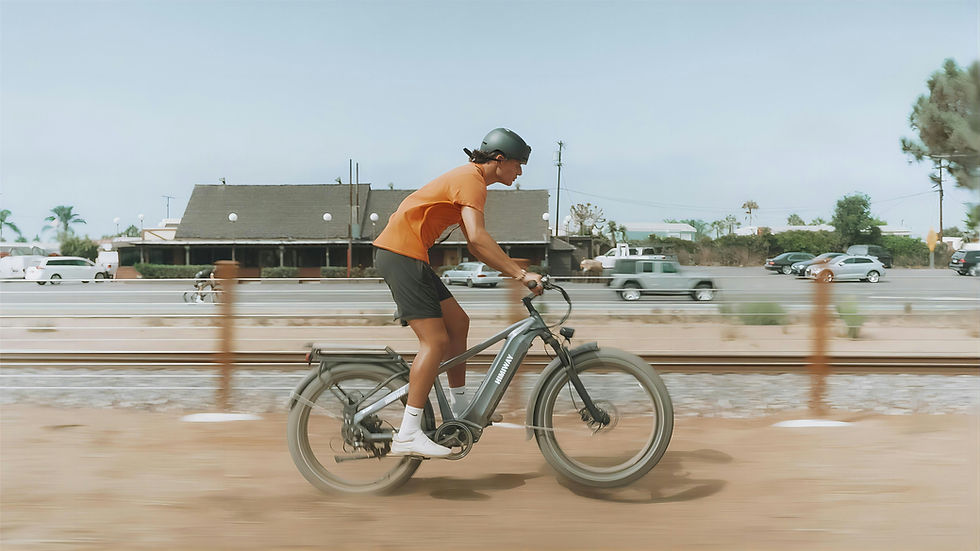
What is the legal age for a child to ride an e-bike
The legal age for a child to ride an e-bike depends on the class of the e-bike and the specific state or country's laws, as there is no uniform national or global standard.
U.S. E-Bike Age Requirements
In the United States, regulations typically follow the 3-class system:
E-Bike Classification | Specs & Speed Limit | Typical Minimum Legal Age |
Class 1 | Pedal-assist only, up to 20 mph | No statewide minimum in most states (a few states set it at 14 or 16) |
Class 2 | Throttle & pedal-assist, up to 20 mph | No statewide minimum in most states (some states set it at 14 or 16) |
Class 3 | Pedal-assist up to 28 mph | 16 years old in most states (14 or 15 in select states) |
Common State Differences (U.S.)
California & Texas: No minimum age requirement for Class 1 and Class 2 e-bikes, but riders must be at least 16 (California) or 15 (Texas) for Class 3.
New York & Oregon: Enforce a strict minimum age of 16 for all e-bike classes on public roads.
Utah: Riders must be at least 14 to operate any e-bike unless directly supervised by an adult.
International Standards
United Kingdom & European Union: Riders must be at least 14 years old (UK) or 14–16 years old (most EU member states) to ride an electrically assisted pedal cycle (EAPC) with pedal assist up to 15.5 mph (25 km/h).
Safety & Pediatric Guidelines
Helmet Laws: Nearly all jurisdictions legally require riders under 18 to wear a certified helmet, regardless of the e-bike class.
CPSC / AAP Guidance: The U.S. Consumer Product Safety Commission and pediatric safety experts recommend that children under 12 should not operate electric rideables capable of speeds over 10 mph.
What Safety Certifications (Like UL 2849) Should I Look For?
When evaluating electric bikes (e-bikes) and light electric mobility devices, electrical and fire safety certifications are critical to ensure the battery and electrical drivetrain are tested against thermal runaway, short circuits, and mechanical faults.
1. North American Electrical & Fire Safety Standards
UL 2849 (Gold Standard for E-Bikes)
What it covers: The entire electrical powertrain system as an integrated unit—including the battery pack, motor, controller, wiring, and charger.
Why it matters: Evaluates system-level safety to prevent electrical shock, overcharging, thermal runaway, and fire hazards during operation and charging.
UL 2271 (Battery Pack Safety)
What it covers: Specifically evaluates the lithium-ion battery pack for light electric vehicles (LEVs).
Why it matters: Tests the battery's resistance to impact, vibration, thermal abuse, crushing, and overcharging.
Note: A UL 2271 battery alone does not mean the entire bike is UL 2849 certified.
UL 2272 (Personal E-Mobility Devices)
What it covers: Electrical systems for devices like e-scooters, hoverboards, and self-balancing boards.
UL 1310 / UL 62368-1 (Charger Safety)
What it covers: Class 2 power units and AC/DC power adapters/chargers to protect against electrical fire and shock during wall-outlet charging.
2. European & International Standards
EN 15194 (European Standard for EPAC / Pedelecs)
What it covers: The primary standard across the EU and UK for electrically power-assisted cycles. Covers mechanical safety, motor cut-off thresholds (25 km/h / 250W limits), electrical safety, and electromagnetic compatibility (EMC).
ISO 4210
What it covers: Frame, fork, braking, and overall mechanical integrity and fatigue testing for standard and electric bicycles.
UN 38.3 (Lithium Battery Transport Safety)
What it covers: International testing protocol for altitude simulation, thermal tests, vibration, shock, external short circuit, and impact required for shipping lithium-ion batteries safely.
3. Recognized Testing Laboratory Marks (NRTLs)
A standard like UL 2849 or UL 2271 does not have to be tested directly by UL Solutions; it can be tested and certified by any OSHA-accredited Nationally Recognized Testing Laboratory (NRTL). Common valid marks alongside the standard number include:
UL (Underwriters Laboratories)
TÜV Rheinland / TÜV SÜD
ETL / Intertek
SGS
CSA Group
How to Verify Legitimate Certification
Look for the Physical Label: Ensure the NRTL mark (e.g., UL, TÜV, ETL) and the exact standard (e.g., “Certified to UL 2849”) are printed directly on the bike frame, battery casing, and charger.
Watch the Wording: Be cautious of phrases like “Built with UL-certified cells” or “Designed to meet UL standards.” True safety compliance requires third-party testing and an official certification listing.
Check Certification Databases: You can verify certificates on official portals such as the UL Product iQ directory, Intertek Directory of Listed Products, or TÜV Certipedia.
The Best eBikes for Kids: Himiway C1 Kids eBike
Finding the right electric bike for your child can feel overwhelming — but if you want safety, durability, and a bike that grows with your kid, the Himiway C1 is in a class of its own.
Electric bikes aren't just for adults anymore. More families are turning to kids' eBikes as a way to get children outdoors, build confidence, and make neighborhood adventures more exciting. But not all kids' eBikes are created equal — speed controls, weight, and safety features vary wildly. That's where the Himiway C1 Kids eBike stands out.
The Himiway C1 Kids eBike ($999) was engineered with one goal: give kids the thrill of riding while giving parents total peace of mind. Here's what makes it the best kids' eBike on the market.
3 Smart Speed Modes That Grow With Your Child
The C1 features three progressive speed modes:
7 mph — perfect for beginners and training-wheel graduates
13 mph — for confident young riders ready for more
15 mph — for experienced kids who've earned the upgrade
You control when they level up. No guesswork, no risk.
Fits Riders Ages 4–12 (3'3" to 4'9")
Adjustable seat and handlebars mean the C1 adapts as your child grows — no buying a new bike every season. It's designed for riders aged 4 to 12 years old, making it one of the most versatile kids' eBikes available.
Ultra-Safe Braking System
Dual disc brakes combined with a motor cutoff bring the bike to a stop quickly and reliably. Whether your child is cruising the sidewalk or navigating a gravel path, stopping power is never a concern.
Lightweight at Just 33 lbs
At only 33 lbs, the C1 is lighter than most kids' eBikes on the market. That means easier handling for small riders and less struggle for parents lifting it in and out of the car.
Puncture-Proof 16" Fat Tires
The C1's 16-inch fat tires are built to handle sidewalk cracks, gravel, grass, and everything in between — without flats. Kids can ride freely; you won't be patching tubes on a Sunday afternoon.
Parental Remote Control
One of the C1's standout features: a parental remote control that lets you limit speed or cut the motor instantly — from a distance. It's the ultimate safety net for new riders.
Can a Child's E-Bike Be Ridden Manually If the Battery Dies?
Yes, in most cases a child's e-bike can still be ridden when the battery dies, but how it rides depends entirely on the design of the bike.
Kids' E-Bikes with Pedals
How it rides: Works just like a regular bicycle. The drivetrain remains mechanically functional even when the electronics are off.
The challenge: E-bikes are significantly heavier, typically an extra 5–15 lbs from the battery and motor. For a smaller child, pedaling uphill or from a dead stop without motor assist can take noticeable effort.
Electric Balance Bikes (e.g., Stacyc)
How it rides: These models feature freewheeling wheels without pedals or chains. When powered off, kids can use them as traditional, non-electric balance bikes by pushing off the ground with their feet.
The challenge: The added weight of the hub motor and battery makes it slightly more fatiguing to push compared to an ultra-light wooden or aluminum balance bike.
Electric Mini-Motos / Dirt Bikes (Foot Pegs Only)
How it rides: These do not have pedals or a low enough profile for foot-striding. If the battery dies, the bike cannot be ridden manually and will have to be pushed home or picked up.
What to Keep in Mind
Motor Resistance: Most modern kids' e-bikes use geared hub motors with internal freewheels, meaning the motor will not drag or resist when the wheel spins unpowered.
Gearing: Many smaller children's e-bikes are single-speed. Without multiple gears to downshift, pedaling a dead battery on an incline can quickly tire out a young rider.
What Type of Helmet and Protective Gear Does a Child Need for an E-Bike?
Because e-bikes travel faster and have greater mass than standard bicycles, children—whether riding as passengers or operating youth-specific models—require higher-grade protective equipment.
Helmet Requirements
E-Bike Specific Certification (NTA 8776): Look for helmets certified under the Dutch NTA 8776 standard. These are specifically tested for higher impact speeds (up to 28 mph / 45 km/h) and provide more extensive coverage at the back of the head and temples compared to standard CPSC or EN 1078 bike helmets.
Rotational Impact Protection: Choose a helmet equipped with MIPS (Multi-directional Impact Protection System) or equivalent technology to reduce rotational forces on the brain during angled impacts.
Full-Face Helmets (For Youth Riders): If the child is actively operating a throttle or higher-speed youth e-bike, a lightweight full-face or downhill-certified helmet (ASTM F1952) provides critical jaw and facial protection.
Fit Check: The helmet must sit level (about two finger-widths above the eyebrows), with straps forming a clean "V" under each ear and a snug chinstrap.
Essential Protective Gear
Full-Finger Cycling Gloves: Protects palms from severe road rash if the child extends their hands during a fall, while improving handlebar grip and brake lever control.
Knee and Elbow Pads: Hard-shell (ABS) or high-density D3O/EVA foam pads prevent joint fractures, deep abrasions, and bruising.
Eye Protection: Shatterproof polycarbonate sunglasses or clear riding goggles protect against wind, dust, road debris, and insects at higher speeds.
Closed-Toe Footwear: Sturdy shoes with non-slip soles protect feet and toes, preventing them from catching in spokes or slipping off pedals/footpegs.
High-Visibility Outerwear: Bright, neon-colored clothing or reflective vests ensure the child is clearly visible to drivers, especially in low-light conditions.
Additional Passenger Safety (For Child Seats/Cargo Racks)
Ensure the child is secured with a 5-point harness.
Always verify that the bike or seat includes integrated wheel spoke guards and footrests to eliminate the risk of feet getting pulled into the rotating wheel.


