
Lighting Ideas That Make Small Rooms Feel Bigger
- Jul 27
- 8 min read
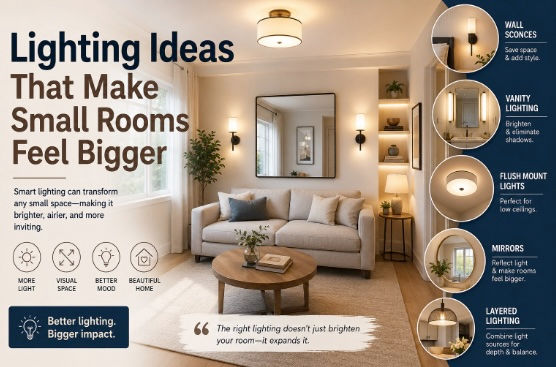
Most people blame furniture when a small room feels cramped. They swap out the couch, remove a side table, rearrange things for the third time that month—and the room still feels tight. The real problem is usually overhead, not underfoot. Lighting shapes how big or small a space reads to your eyes long before furniture placement ever does.
A single overhead bulb creates flat, uneven light that flattens a room and makes corners disappear into shadow. That's what makes a small bedroom or bathroom feel like a box. Layered lighting does the opposite — it adds depth, pulls attention toward walls and ceilings, and tricks the eye into seeing more square footage than actually exists.
This guide walks through the lighting choices that make the biggest visual difference in small rooms: layering, wall-mounted fixtures, color temperature, mirror placement, and the mistakes that quietly work against you. Everything here works whether you're lighting a studio apartment, a small bathroom, or a narrow hallway.
Why Lighting Makes a Room Feel Larger
Light and space are processed by the brain together, not separately. Before you touch a single fixture, it helps to understand why that's true — it explains almost every recommendation in this article.
The Psychology of Light and Space
Your brain uses light and shadow to judge distance and depth, the same way it reads perspective in a photograph. A room lit evenly, with light reaching into corners and up walls, reads as open. A room lit unevenly — bright in the center, dark at the edges — reads as boxed in, because your eyes stop tracking space where the shadow starts. That's why two rooms with identical square footage can feel completely different depending on how they're lit. Brightness alone isn't the goal; distribution is.
The Importance of Layered Lighting
A single ceiling fixture can only do one job at a time, and in a small room, that's rarely enough. Layered lighting means combining ambient, task, and accent light sources so the room is illuminated from multiple angles instead of one flat source overhead. This eliminates harsh shadows, adds dimension to walls and furniture, and gives you control over mood without sacrificing brightness. It's the single biggest shift between a room that feels small and one that doesn't — and it costs less than most people expect.
Maximize Natural Light
Before adding a single fixture, get the most out of the daylight you already have. Small rooms lose square footage fast when windows are blocked or curtains are heavy — daylight is the cheapest way to open up a space, and it costs nothing to adjust.
Start with the window itself. Keep sills clear of furniture, plants, or storage bins that block the light path. Swap heavy drapes for sheer curtains that filter light instead of stopping it, and if privacy is a concern, layer a sheer panel under a functional blackout curtain you only close at night.
Reflective surfaces matter here too. Light-colored walls, glossy trim, and pale furniture all bounce daylight further into a room instead of absorbing it. A mirror placed to catch window light does double duty by amplifying what's already coming in. Small changes, real difference.
Layer Your Lighting Instead of Using One Fixture
One ceiling fixture lighting an entire small room is the most common mistake in this list, and it's the easiest to fix. A single source creates one shadow direction, which flattens the room and makes the edges disappear visually.
The fix is combining three types of light: ambient lighting for overall brightness, task lighting for specific activities like reading or applying makeup, and accent lighting to highlight a wall, shelf, or piece of art. None of these need to be large installations — a flush mount for ambient light, a wall sconce or lamp for task light, and a small picture light or LED strip for accent light is enough in most small rooms.
Layered lighting combines ambient, task, and accent lighting to create a brighter, more spacious-looking room while reducing dark corners.
Install Wall Sconces to Save Floor Space
Floor lamps and table lamps eat up square footage a small room can't spare, and they add visual clutter at eye level. Modern wall sconces solve both problems by moving the light source off the floor and onto the wall, where it does more for the room's perceived size.
Because sconces sit higher and closer to the ceiling line, they pull the eye upward and make ceilings feel taller by association. They also free up floor space and surface area that would otherwise be taken up by lamp bases and cords, which is exactly why this style of fixture works so well in a small space.
The best spots for sconces in small spaces:
Flanking a bed in a small bedroom, replacing nightstand lamps entirely
Along a hallway at regular intervals, instead of one distant ceiling fixture
On either side of a mirror or console table in a small living room
Choose Flush Mount or Semi-Flush Ceiling Lights
Low ceilings and compact rooms don't have the clearance for a hanging pendant light or chandelier without making the room feel more cramped, not less. Flush mount ceiling lights and semi-flush fixtures solve that by sitting close to the ceiling instead of hanging down into the room.
Flush mounts work best in rooms with 8-foot ceilings or lower, where anything hanging lower would be at head height. Semi-flush fixtures give a little more visual interest with a small drop, without eating into vertical space the way a pendant would.
Both distribute light evenly across the room rather than pooling it in one spot, which matters more in a small space than a large one — even distribution is what keeps corners from going dark and making the room feel boxed in.
Brighten Bathrooms with Vanity Lighting
Small bathrooms suffer more from bad lighting than almost any other room, because a single overhead fixture casts shadows straight down the face — not ideal for shaving, applying makeup, or honestly just seeing yourself clearly.
Vertical bath vanity lights on either side of the mirror solve this by lighting the face from both sides instead of from above. That eliminates the shadows under the eyes, nose, and chin that overhead lighting creates, and it makes the whole bathroom feel brighter and larger by removing dark patches near the mirror.
If vertical fixtures aren't an option, a light bar mounted above the mirror is the next best choice — just make sure it spans close to the mirror's full width for even coverage.
Use Mirrors to Reflect Light
Mirrors don't produce light, but they multiply whatever light already exists in the room — which makes them one of the cheapest ways to make a small space feel bigger. A well-placed mirror bounces both natural and artificial light deeper into a room instead of letting it stop at one wall.
The most effective placement is directly across from a window, where the mirror reflects daylight back into the room throughout the day. A mirror positioned near or behind a lamp or sconce works the same way at night, doubling the light spread without adding another fixture.
Avoid placing mirrors where they'd reflect a cluttered corner or a wall you don't want emphasized — mirrors amplify whatever they're pointed at, good or bad.
Select the Right Color Temperature
Color temperature affects how spacious a room feels just as much as brightness does. Warm light (measured in Kelvin, lower numbers) feels cozy but can make a room look dim if overused, while cooler light feels brighter and more open but can turn sterile if it's the only tone in the room. Matching temperature to room function keeps the balance right.
Room | Recommended Color Temperature |
Living Room | 2700K |
Bedroom | 2700K |
Bathroom | 3000K |
Kitchen | 3500K |
Mixing temperatures within the same room is one of the fastest ways to undercut all of this — a warm lamp next to a cool overhead fixture creates a visual clash that draws attention to the size of the room instead of away from it. Keep every fixture in a space within the same range.
Avoid These Small Room Lighting Mistakes
A few habits undo everything covered above. These are the ones worth checking first.
One Ceiling Light Only
A single central fixture lights the middle of the room and leaves the perimeter dim, which is exactly what makes a small room feel smaller. Add at least one additional light source — a sconce, lamp, or accent light — near a wall or corner.
Dark Lampshades
Dark or heavily patterned shades block more light than they let through, cutting the output of whatever bulb is inside. Light-colored or translucent shades let more light spread into the room instead of concentrating it downward.
Wrong Fixture Size
An oversized fixture overwhelms a small room visually, while an undersized one looks lost and underlit. Measure the room first — fixture size should scale with square footage and ceiling height, not just personal taste.
Ignoring Corners
Corners are where small rooms visually "end." Leaving them dark reinforces the boundary instead of softening it. A small accent light, floor lamp, or even an uplight aimed at the corner keeps the eye moving past it.
Mixing Color Temperatures
Combining warm and cool bulbs in the same room creates visual tension that draws attention to size instead of away from it. Stick to one temperature range per room, as covered above.
Best Lighting Ideas by Room
Every room has different lighting needs, but the same principles apply everywhere: layer your sources, keep temperature consistent, and get fixtures off the floor where possible.
Living Room
Wall sconces flanking a media console or sofa work better than a single overhead light in a small living room. Add a floor lamp only if wall space is limited, and keep everything at 2700K for a warm, cohesive feel.
Bedroom
Sconces beside the bed free up nightstand space and eliminate the need for table lamps entirely. A flush mount overhead handles ambient light, and both should stay in the 2700K range for a room meant for winding down.
Bathroom
Vertical vanity lighting flanking the mirror is the single best upgrade for a small bathroom. Pair it with a flush mount for general lighting at 3000K, which keeps the space feeling clean and bright without going clinical.
Hallway
Narrow hallways benefit from evenly spaced wall sconces more than a single fixture at one end. Spacing them every 6 to 8 feet keeps the whole hallway lit instead of leaving one end dim.
Home Office
Task lighting matters most here — a desk lamp paired with an overhead flush mount prevents eye strain during screen work. Cooler light in the 3500K range keeps focus sharp during the day.
Quick Tips to Make Any Small Room Feel Bigger
Use LED bulbs with higher lumens for brighter, more efficient light.
Add wall lighting instead of floor lamps to free up space.
Install dimmers so you can adjust brightness by time of day.
Stick to one consistent color temperature per room.
Reflect light with mirrors placed across from windows or fixtures.
Keep fixture size proportional to the room, not oversized or undersized.
Eliminate dark corners with a small accent or uplight.
Choose open-frame fixtures that let light spread instead of concentrate.
Frequently Asked Questions
Does lighting really make a room look bigger? Yes. Even, layered lighting removes the shadows that make a room's boundaries feel closer than they are, which changes how spacious it looks without changing the actual square footage.
What type of lighting is best for a small bedroom? Wall sconces beside the bed paired with a flush mount overhead, both at 2700K, give you task and ambient light without taking up nightstand or floor space.
Are wall sconces good for small spaces? Yes — they move the light source off the floor and closer to the ceiling, which frees up space and draws the eye upward, making ceilings feel taller.
What color temperature makes a room feel larger? There's no single "biggest" temperature — the key is consistency. Mixing warm and cool light in the same room creates visual tension that makes the space feel smaller, not larger.
How many light fixtures should a small room have? At least two: one ambient source and one task or accent source. A single overhead fixture almost always leaves corners dim, which works against the room, not for it.
Upgrade Your Small Space with Modern Lights
Good lighting is one of the few upgrades that changes how a room feels without changing its footprint. Whether that means adding a pair of wall sconces to a bedroom, swapping a single overhead bulb for a flush mount, or finally fixing the shadows in a small bathroom, the fixture matters as much as the plan behind it.
Modern Lights carries wall sconces, bathroom vanity fixtures, flush mounts, and other space-conscious lighting built for exactly these situations — worth a look next time a small room feels smaller than it should.


