
10 Costly Retail Pricing Mistakes and How Price Intelligence Can Help
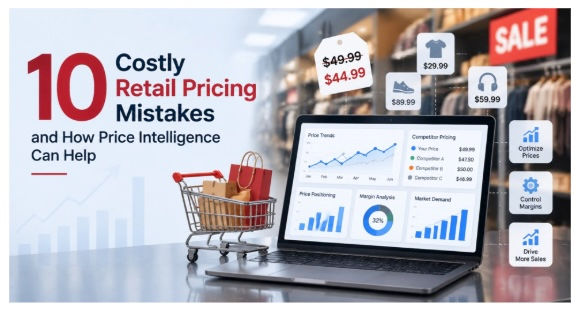
Retail pricing directly affects revenue, margins, inventory turnover, and customer demand. Even a small pricing error can have a significant impact when it is repeated across hundreds or thousands of products. Research from McKinsey has highlighted the strong relationship between pricing improvements and operating profit, making pricing decisions an important lever for retail growth.
Yet retailers often struggle to keep prices aligned with competitors' prices amid changing demand, regional conditions, and customer expectations. Common issues include relying only on cost-plus pricing, overlooking competitor price changes, applying the same price across channels, and delaying markdowns.
This is where Price Intelligence can help. By combining competitor pricing, market trends, and demand signals, retailers can make more informed pricing decisions and identify opportunities to protect margins. In this guide, we examine 10 costly retail pricing mistakes, explain how each can affect performance, and show how price intelligence can help retailers build a more responsive retail pricing strategy.
Why Do Pricing Mistakes Hurt Retailers So Much?
Every wrong price sends a signal to your customer, and it is rarely the signal you intended. Price too high, and shoppers leave for cheaper stores without ever telling you why. Price too low, and you burn margin while training buyers to expect permanent discounts. Retail Price Optimization matters because guessing is expensive and data is far more dependable than instinct. With capable pricing intelligence software, you swap gut feeling for live market signals, competitor benchmarks, and demand trends you can measure.
The 10 Costly Retail Pricing Mistakes
Read each mistake below, then note the fix and check how many apply to your store today.
1. Ignoring competitor prices
Without visibility into what rivals charge, you are effectively pricing in isolation. Sales are lost, and the reasons rarely surface. The solution is price monitoring that reviews competitor listings on a daily basis. Checking once a quarter is not tracking; it is a review conducted long after the opportunity has passed.
2. Relying solely on cost-plus pricing
This is the default at most retailers because it is simple: take the cost, add a set margin, done. The math is clean, which is part of the trap. A 40% markup on a $12 item gives you $16.80 whether or not shoppers would have paid $19, and whether or not three competitors are sitting at $14. Cost tells you your floor. It says nothing about the ceiling. Price elasticity data fills that gap by showing how demand actually reacts when the number moves up or down.
3. Setting a price and leaving it unattended
A price set in January and never revisited is a price making decisions on old information. By March, demand has moved, competitors have repriced, and your figure is quietly either too high or too low. Nobody notices until the numbers slip. Pick a repricing cadence, weekly for most catalogs, daily for fast-moving or high-competition SKUs, and let the system hold the line instead of you checking by hand.
4. Discounting too frequently
There is a hidden cost to the "always on sale" approach. Run enough promotions and customers simply learn to wait for the next one, so a purchase that would have happened at full price gets delayed until the banner goes up again. Full-price sell-through drops. Margin follows. Rule-based pricing keeps a hard margin floor in place, so discounts stay a deliberate tool rather than a reflex.
5. Applying one price across every market
One number for every region and channel assumes every buyer is the same, and they are not. A customer in a low-competition rural market and one browsing a price-comparison site think about the same product very differently. Shipping cost varies. Local demand varies. Build regional and channel pricing rules that reflect those differences instead of flattening them into a single figure.
6. Overlooking high-margin products
Not every product needs to be priced defensively. Some, especially niche or low-visibility items that buyers rarely compare-shop, could carry more without denting sales at all. The problem is that these winners are invisible unless you go looking. SKU-level analysis surfaces them, so you stop underpricing the exact items with the most room to give.
7. Overreacting to competitor moves
A competitor drops their price, and the temptation is to match it before lunch. Resist that. Reflexive matching is how a price war starts, and price wars tend to end with everyone earning less on the same volume they had before. The better setup is a floor rule: let your system respond to competitor changes, but only down to a limit you have decided in advance. Discipline beats reflex here.
8. Neglecting price perception
How a price looks matters almost as much as the price itself. Shoppers form a judgment in a second or two, and a cluttered tier structure or an oddly rounded figure can lose the sale before they have read a single feature. It is worth testing the small things, charm pricing, cleaner tiers, clearer anchors, and watching what each change does to conversion. The numbers usually tell you quickly which version people trust.
9. Mistiming markdowns
Markdown timing is easy to get wrong in both directions. Cut too soon and you hand back margin you could have kept. Hold too long and last season's stock is still sitting there, tying up cash and shelf space. Sell-through and demand data take most of the guesswork out of the call, showing you when an item has genuinely stalled versus when it is just having a slow week.
10. Operating without pricing data
Everything above assumes you can see your market. A surprising number of retailers cannot. Running a store on instinct alone is like driving at night with no headlights, you might be fine for a while, but the odds are not with you. You do not need a sophisticated setup to start. A basic feed of competitor prices and demand signals is enough to begin, and you can build from there once it proves its worth.
How Does Price Intelligence Actually Work?
Price intelligence takes competitor pricing, market trends and demand signals and turns the raw input into decisions you can act on quickly. The engine behind it usually combines three moving parts:
● Competitor data collection that scrapes and structures pricing from marketplaces and rival sites at a set frequency.
● A pricing rules engine that applies your logic, such as "stay 3% below Competitor A but never drop under a 22% margin."
● Elasticity and demand modeling that estimates how sales volume reacts to each price change before you commit to it.
A strong competitive pricing strategy depends on this fresh data, because manual tracking cannot keep pace with hundreds of SKUs. Here is what smart price monitoring delivers in practice:
● Real-time competitor tracking so you always know your position in the market.
● Automated repricing that adjusts prices within rules you fully control.
● Demand insights that reveal which products can hold a premium.
● Margin protected markdowns that move stock without eating into profit.
● Regional and channel pricing tuned to each customer group.
When these parts work together, your retail pricing strategy stops being a monthly guess and becomes a repeatable system.
What Should Retailers Do Next?
Audit your current prices against real competitors this week, not next quarter. Use Price Scraping to pull accurate, real-time competitor data efficiently. Flag any SKU where you sit clearly too high or dangerously too low. Then choose pricing intelligence software that fits your catalog size and margin goals. The target is not to be the cheapest seller, since that road rarely ends well. The target is to be the smartest, using dynamic pricing and real data to defend both revenue and margin at once.
Conclusion
Pricing is one of the fastest levers you can pull to grow profit, yet it stays neglected in far too many retail businesses. The ten mistakes above are common, and every one of them is fixable the moment you can see your market clearly. Backed by reliable price intelligence and a disciplined competitive pricing strategy, you stop leaving money behind and start pricing with real confidence. Review your prices, trust your data, and let retail price optimization guide your store toward stronger, healthier growth.


