
The $200,000 Camper Van: Why the Ultra-Wealthy Are Trading the Second Range Rover for a Sprinter
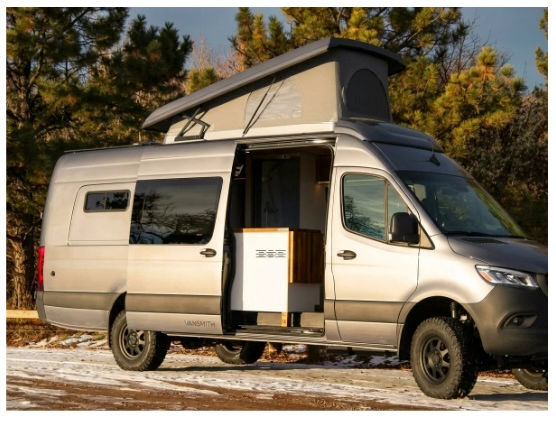
There is a particular kind of vehicle showing up in the driveways of Aspen, Jackson Hole, Montecito and the better streets of Boulder, and it is not what you would expect. It is tall, white or graphite, has no badge that means anything to a valet, and costs about as much as a Range Rover SV. It is a Mercedes Sprinter, hand converted into a rolling apartment, and the people buying it are the same people who already own the Range Rover.
The numbers behind this are stranger than the anecdote. The recreational vehicle industry is contracting. Through August of this year, total RV shipments in the United States were down 14 percent from 2025, with the drop concentrated in travel trailers and the large Class A motorhomes that dominate Florida interstates. One category moved the other direction. Van campers, the industry's term for a cargo van converted into a self-contained motorhome, were up nearly 9 percent year to date, according to the RV Industry Association. The fastest growing segment of the RV market is the one that looks least like an RV, and the top of that segment is now priced like a luxury car.
So what is a $200,000 van, exactly, and why would someone with a garage full of alternatives want one?
The price list is almost identical, which is the point
Start with the comparison in the headline, because it holds up better than it should. The 2026 Range Rover opens at $113,300 for the SE, climbs to $159,200 for the Autobiography, $219,500 for the SV, and $238,900 for the SV Black, according to Land Rover's own configurator.
Now look at a premium custom van builder's price sheet. A complete, hand built Sprinter with a full galley, lithium power and off grid water starts around $115,000. The long wheelbase version with an enclosed hot water shower runs $150,000 to $180,000. The top of the line, with a 15 kilowatt hour battery bank, a second alternator, air conditioning that runs all night on batteries and a full wet bath, lists around $227,000. The tiers line up almost dollar for dollar with the Range Rover trims, and that is not a coincidence. The custom van industry priced itself against the vehicles its customers already own.
What differs is what you get for the money, and how the two objects age.
What $200,000 actually buys
A luxury van is not a luxury car with a bed in it. The interior is closer to a small yacht than to anything automotive, and the components are borrowed from marine and residential suppliers rather than the auto industry.
The electrical system is the single most expensive thing inside. A premium build carries 10 to 15 kilowatt hours of lithium iron phosphate batteries, roughly the capacity of a Tesla Powerwall, mounted under the bed. It charges from 400 to 600 watts of roof solar, from a second high output alternator bolted to the engine that can push 3,000 watts while driving, and from shore power when available. The result is a vehicle that can run a refrigerator, an induction cooktop, a Starlink terminal, two laptops and a rooftop air conditioner for a night in the desert without a generator and without a sound. The electrical package alone, installed, runs $18,000 to $25,000 in a top tier build. It is the reason a $115,000 van and a $227,000 van can share the same chassis and the same cabinets.
The cabinetry is furniture grade. Mass produced Class B motorhomes from Winnebago or Thor use laminated particle board because it is light and cheap. The custom shops use Baltic birch plywood, solid bamboo, and increasingly cedar plank ceilings and upholstered wall panels, all cut on CNC machines and assembled by hand. The better builders offer a lifetime warranty on the cabinetry to the original owner, which tells you something about how much of the value is in the woodwork.
The plumbing is real. Twenty to thirty gallons of fresh water, an on demand electric or diesel water heater, an enclosed shower with a teak floor grate, and a dry flush toilet that requires no hookups and no black tank. That last item matters more than it sounds. It is the difference between a vehicle you can park in a friend's driveway in Malibu and one that needs a campground.
The chassis is modified. Almost every premium build starts with an all wheel drive Sprinter, then adds a two inch suspension lift, upgraded shocks, 33 inch all terrain tires, a roof rack, and often a pop top that adds a second bedroom. A van in this spec will go places a Range Rover will not, which brings us to the real reason people are buying them.
The Range Rover problem
Ask an owner why they bought the van and you get a version of the same answer: the Range Rover goes everywhere and can't stay anywhere.
The people buying $200,000 vans are not first time campers. They are the same demographic that has been buying second and third homes in mountain towns for twenty years, and they have run into the limits of that model. The Jackson Hole house is spectacular for nine weeks a year and sits empty for the rest. The Aspen condo is in Aspen, which is wonderful if you want to be in Aspen and irrelevant if the snow is better in Alta that week. Hotels in the places worth going are either full, mediocre, or forty minutes from the trailhead.
A van solves all three problems at once. It sleeps two in a real bed with a real mattress. It is warm at 10 below in a Colorado ski area parking lot, cool at 105 in Moab, and it is wherever the snow, the surf or the fishing happens to be that week. And it does this with the interior finish and the quiet of a luxury vehicle, which is the part the earlier generation of vanlife never managed.
There is a status element too, and it works in reverse of the usual logic. A Range Rover SV in the Whole Foods parking lot in Aspen says what you'd expect. A graphite Sprinter with a roof rack, a Yeti on the back and no badge says you have somewhere better to be. Among a certain crowd, that has become the more expensive signal.
Why the depreciation math favors the van
This is where it gets interesting for people who think about money, which is everyone who has enough of it to spend $200,000 on a vehicle.
Full size luxury SUVs are among the fastest depreciating assets you can buy. Industry resale data consistently puts the Range Rover among the models that lose the most value over five years, typically around half of the purchase price, and often more for the highest trims, where options that cost $30,000 new are worth close to nothing on the secondary market.
Custom vans behave differently, for three reasons. The chassis underneath is a commercial vehicle with a deep used market. Contractors, delivery fleets and other converters buy used Sprinters regardless of what happened to the interior. The conversion itself is not treated as an option package; it is treated as a product from a named builder, and as those builders develop reputations their vans trade on the builder's name the way a boat trades on its yard. And supply is constrained. The good shops build a few hundred vans a year at most and are booked months in advance, so the used market is thin and prices hold.
The result is that a well built van from a recognized shop typically retains 60 to 70 percent of its value at five years, according to the builders and the secondary dealers who move them. That is roughly double the retention of the SUV it sits next to. Nobody is buying a van as an investment, but at this price point the difference between losing $60,000 and losing $120,000 over five years is real, and it is one of the quiet reasons the category is growing while the rest of the RV industry shrinks.
Who is building them
The premium van market is small and geographically concentrated, mostly in the Mountain West and the Pacific Northwest, where the founders were building vans for themselves before anyone was paying them to.
Outside Van in Portland has been the reference point for the high end since the 2010s, with fully bespoke builds that regularly clear $250,000. Storyteller Overland, out of Alabama, took the opposite approach and productized the category with standardized models sold through dealers, which is how a lot of buyers first encounter a $200,000 van. Airstream, the only legacy RV brand with real cachet, sells the Interstate on the Sprinter chassis between roughly $235,000 and $307,000, with the build quality of a factory product and the interior character of one too.
Between the bespoke shops and the factory brands sits a middle tier of builders producing semi custom vans with genuinely luxury interiors at the $150,000 to $230,000 level. Boulder's Vansmith is a good example of the type. The company has built more than 300 vans since 2016, ships nationwide by enclosed carrier, and its top luxury camper van builds combine a Sprinter 170 all wheel drive chassis with a full enclosed shower, a 15 kilowatt hour battery bank, a second alternator, cedar ceilings and bamboo countertops at a list price of $227,570. Prebuilt vans ship in eight to ten weeks; tailored builds take twelve to sixteen. Buyers in this tier are choosing between a few dozen shops of similar size, and the differentiators are lead time, warranty, and whether the builder will let you sit in one before you order.
The bespoke end has no upper limit. Builders in Southern California and Utah will do a Sprinter with a marine grade lithium system, hydronic heated floors, a Miele induction range, a carbon fiber pop top and a paint match to your Aston Martin, and the invoice will exceed $350,000. At that level the van is not competing with a Range Rover. It is competing with a Sunseeker tender.
The details that separate a serious build from an expensive one
If you are considering one, a few things distinguish a van that will still be good in ten years from one that was merely expensive.
Battery placement and thermal management. Lithium batteries stop accepting a charge below freezing and throttle above about 130 degrees Fahrenheit. In a van meant for Jackson in January and Scottsdale in July, the batteries need to be inside the insulated envelope with a heating pad, not bolted under the floor. Many cheaper builds get this wrong and the owner finds out on the first cold morning.
Insulation in the floor, not just the walls. A surprising share of summer heat comes up through the floor when the van is parked on asphalt. Builders that skip it save a day of labor and cost you every August.
Payload. A Sprinter 2500 carries roughly 4,000 pounds. A premium conversion uses 2,000 to 2,500 of that before you add two people, water, skis and a dog. Ask for the finished curb weight in writing and prefer the 3500 chassis if the build is heavy.
The second alternator. Solar is lovely and nearly useless in a ski area parking lot in December. The second alternator is what actually keeps a 15 kilowatt hour bank charged in winter, and it is the single feature that separates a van you can live in year round from one that works in June.
Who does the warranty work. The chassis is a Mercedes and any dealer will service it. The conversion is another matter. If the builder is in Portland and you are in Palm Beach, find out who fixes the water heater before you sign.
What comes next
The category is maturing quickly. Mercedes now offers factory upfitter packages and has quietly made the Sprinter's electrical architecture friendlier to converters. Ford's Transit Trail is a factory built starting point for the same market. Rivian, Canoo and a handful of startups have shown electric vans that would suit this application perfectly and none of them has shipped one that is available to buy at the moment, though that is likely to change within a few years, at which point the battery in the floor becomes both the power system and the drivetrain.
In the meantime, the people who used to buy a third home in a ski town are increasingly buying a van and a lift ticket instead, and the builders who understand that customer are booked into next spring. The second Range Rover is still in the garage. It just doesn't leave it as often.


