
The Best Tech Gift for Your Kids This Year Might Surprise You: A Parent's Guide to Minecraft Multiplayer
- Jun 30
- 5 min read
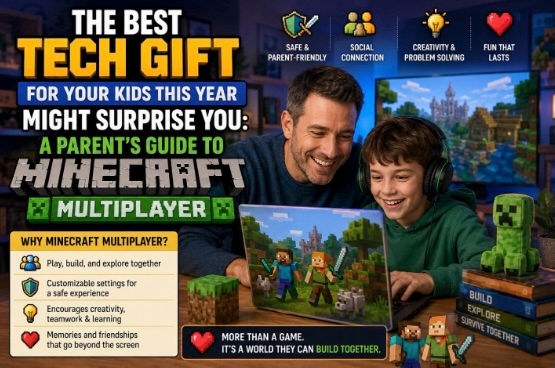
Every gift-giving season brings the same challenge for parents of school-age children: what actually holds their attention beyond the first week? Tablets get abandoned. Subscriptions go unused. The latest console game becomes old news before the next one arrives. What parents rarely expect is that the answer might already be sitting inside a game their child has played for years.
Minecraft is not a new discovery. Most children between the ages of seven and fourteen have encountered it in some form. But the vast majority of them have only experienced the solo version, building quietly in their own world without much connection to anyone else. What most parents do not realize is that behind the single-player surface lies one of the richest and most enduring multiplayer communities in online gaming, and giving your child access to it is a genuinely meaningful gift.
The key is knowing where to start. Browsing an updated Minecraft server list is the practical first step most parents overlook entirely, and it changes the experience considerably. Rather than letting a child wander into whatever server they stumble across, a curated list ranked by community votes and active player counts makes it easy to find well-run, age-appropriate communities worth joining.
Why Multiplayer Changes Everything
Solo Minecraft has genuine value. It develops spatial reasoning, resource management, and creative problem-solving in ways that few games manage so naturally. But multiplayer Minecraft takes those skills and adds an entirely different layer: real human collaboration, negotiation, and community.
On a quality Survival Multiplayer server, your child is not just building a house. They are joining an existing community, learning its unwritten rules, trading with other players, and contributing to something shared. The social dynamics are surprisingly sophisticated. Children learn to communicate clearly, resolve disagreements, and earn the trust of other players through consistent behavior. These are skills that matter well beyond any screen.
For parents who worry about passive screen time, multiplayer Minecraft offers a meaningful contrast. The engagement is active, goal-oriented, and social. There is a reason educators and child development researchers have paid close attention to how children learn within Minecraft environments — the cognitive and social outcomes are genuinely impressive.
Understanding the Different Server Types
One of the most useful things a parent can do before gifting the multiplayer experience is to understand what options actually exist. The Minecraft server landscape is far more varied than most people expect, and different game modes suit different children.
The main types worth knowing:
Survival Multiplayer (SMP): Open-world shared survival where children gather resources, build communities, and develop relationships with other players. Best for older children who enjoy long-term projects and social connection.
SkyBlock: Players start on a tiny floating island with minimal resources and must build outward through clever problem-solving. Excellent for children who enjoy puzzle-style challenges and incremental progress.
BedWars: Short, structured competitive matches where teams defend a bed while trying to eliminate opponents. Well-suited for children who prefer quicker sessions and enjoy strategy under pressure.
Creative Servers: Unlimited resources, no combat, and a focus entirely on building. Ideal for artistic children who want to create without the demands of survival mechanics.
Knowing your child's natural play style makes the decision considerably easier. A child who loves collaborative building will thrive on SMP. A more competitive child will gravitate toward BedWars almost immediately. The variety available means there is genuinely something suited to most personalities.
What Makes a Server Worth Joining
Not all servers are equal, and quality varies considerably. For parents, the markers of a well-run server are worth understanding before your child logs in for the first time. The best servers share several characteristics: active staff moderation, clear community rules, stable uptime, and player counts high enough to ensure there is always someone to interact with.
Community votes are one of the most reliable indicators of quality. Servers that consistently rank highly in player voting tend to be the ones where the experience is genuinely well-managed. A healthy player count is another useful signal — it suggests the community is active and that your child will not be navigating an empty world.
Think of it in the same way you might evaluate any gift that depends on the quality of its community or ecosystem to deliver real value. The product itself matters less than the environment surrounding it. A good server is that environment.
The Practical Gift: What You Are Actually Giving
Framed as a gift, access to quality Minecraft multiplayer involves a few simple components. The base game on Java Edition is a one-time purchase. A reliable internet connection and a decent computer or console are the only hardware requirements, both of which most families already have. The real investment is time spent helping your child find the right server and get settled in.
That initial setup session, ideally done together, is genuinely worthwhile. Browsing server options, reading about different game modes, and helping your child create an account on a server they are excited about is the kind of engaged parenting around technology that tends to set the tone for healthier digital habits overall.
Much like the considered approach to finding a hobby that genuinely enriches your child's life rather than just occupying their time, the value of this gift comes from the quality of the experience it unlocks rather than its price tag. Most of what makes Minecraft multiplayer special costs nothing beyond the initial game purchase.
Why This Gift Has Lasting Value
The single most important quality of a gift for a child is how long it continues to hold their interest. By that measure, Minecraft multiplayer is nearly unmatched. The game has sustained genuinely engaged communities for over a decade, and the server ecosystem continues to grow and diversify. A child who finds a server they love at ten may still be part of that community at fifteen, having developed friendships, skills, and a sense of belonging that extends well beyond the screen.
That kind of sustained engagement is rare. Most games peak within weeks or months. Minecraft's multiplayer ecosystem, built and maintained by communities rather than corporate update cycles, creates something more durable: a living social world that evolves with the players inside it.
For parents looking for a gift that delivers genuine, long-term value rather than a few weeks of novelty, this is one of the more underrated options available. The surprise, for most parents who try it, is not that their child loves it. It is that they wish someone had pointed them toward it sooner.
Where to Begin
If you are ready to explore the option, start with the game itself if your child does not already own it. Then spend twenty minutes together looking at server options, filtering by game mode, and reading through community descriptions. The conversations that come out of that process, about what kind of experience your child wants and what kind of community appeals to them, are often the most valuable part of the gift.
The right server is out there. Finding it together is half the fun.


