
The Cold Edge: Inside the Science (and Celebrity Obsession) of Cryotherapy
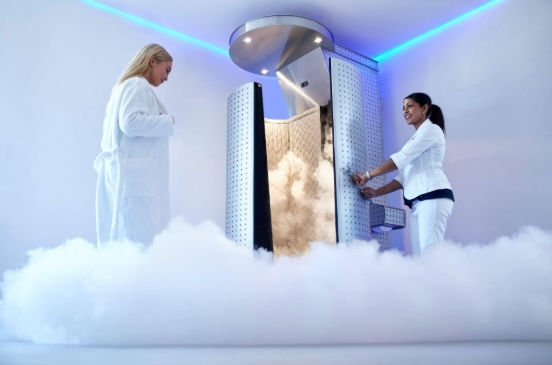
From LeBron and Ronaldo to Jennifer Aniston and Demi Moore, the world's highest performers have built recovery rituals around a three-minute blast of liquid nitrogen vapor. Here is what the cold actually does, and why Texas has quietly become one of the most active cryotherapy markets in America.
Step into a whole-body cryotherapy chamber and the first thing you feel is silence. The door seals. The vapor rises around your shoulders. Within seconds the temperature inside the chamber drops to somewhere between -160 and -240 degrees Fahrenheit, which is, by a comfortable margin, colder than anywhere on Earth has ever naturally been recorded. You stand there for two to three minutes wearing very little and very specific socks and gloves. Then you step out, the blood that fled your skin during the freeze rushes back, and for the next several hours you feel, depending on who you ask, like a new person.
This is the protocol that has quietly become the recovery ritual of choice for an unusually star-studded list of people. Cristiano Ronaldo has reportedly installed a chamber at home and uses it twice a week. LeBron James and Stephen Curry are documented regulars. So are Floyd Mayweather, Usain Bolt, Novak Djokovic, Michael Phelps, and Conor McGregor. On the entertainment side, Jennifer Aniston has spoken openly about using cryotherapy to recover from injuries, calling the three minutes inside the chamber a feeling that, in her words, lasts about four years. Daniel Craig used it to prepare for Skyfall. Demi Moore has described it as one of her anti-aging secrets. Jessica Alba called it one of her biggest beauty secrets. Hugh Jackman, Tony Robbins, Mark Wahlberg, Joe Rogan, and a long roster of Victoria's Secret models have all become public advocates.
All of which raises a reasonable question. Is there anything actually going on here, or is this the most expensively dressed placebo in modern wellness?
The answer, like most things in performance science, sits somewhere in the interesting middle.
What the Cold Actually Does
The basic physiology of whole-body cryotherapy is well understood. When skin temperature falls rapidly, the peripheral blood vessels constrict and blood is pulled away from the limbs and skin and concentrated in the body's core, where it picks up oxygen and nutrients. When you exit the chamber and the body warms back up, that nutrient-rich blood floods back out into the muscles and skin. The mechanism is similar to what an ice bath does, only faster, drier, and considerably more dramatic.
The downstream effects on the body are what the research has been trying to pin down. A 2020 study published in the Scandinavian Journal of Medicine & Science in Sports found measurable improvements in muscle oxygenation and reduced cardiovascular strain in endurance athletes following whole-body cryotherapy sessions. A 2017 review in Frontiers in Physiology found that whole-body cryotherapy showed real benefit for athletes recovering from intense training, with multi-session protocols producing stronger effects than one-off treatments. A randomized trial published in 2020 examined twenty elite athletes given two daily sessions for seven days. The cryotherapy group showed significantly lower levels of inflammatory markers (interleukin 1-beta and C-reactive protein) and reactive oxygen species compared to controls.
In simple language: the cold appears to dampen the inflammatory response after hard training. It does not magically rebuild damaged muscle, and it does not replace the foundational work of sleep, nutrition, and well-programmed exercise. What it appears to do, when used consistently, is shorten the window of soreness and inflammation between sessions. For an athlete training six or seven days a week, that compressed recovery window can be the difference between hitting full intensity on day three and limping into the gym.
A separate 2025 study in Biology found that twenty sessions of whole-body cryotherapy produced significant increases in antioxidant enzyme activity, specifically catalase in men and superoxide dismutase in women. The pathway is interesting. Brief, controlled exposure to extreme cold appears to activate the body's own anti-inflammatory and antioxidant systems, somewhat similarly to the way exercise itself does. The cold is a stressor, the body responds by becoming more resilient.
There are honest caveats worth naming. The U.S. Food and Drug Administration has not approved whole-body cryotherapy devices for any medical condition. Mayo Clinic describes the research as still in early stages. A Cochrane review found limited evidence on the prevention of delayed-onset muscle soreness specifically, though more recent research has been more favourable, particularly for multi-session protocols. People with cardiovascular conditions, certain neuropathies, open wounds, or a cold allergy should avoid the treatment entirely. Sessions should be timed, supervised, and conducted at properly maintained facilities. The cold is a real medical input, and a chamber that is poorly monitored is genuinely dangerous.
Cryotherapy chambers operate at temperatures roughly five times colder than a household freezer. The cold itself is a real medical stimulus, and it has to be controlled with real precision.
The Gases Behind the Cold
There are two distinct ways a cryotherapy chamber generates its cold.
The first method is the original, and the one that gave the treatment its first wave of celebrity recognition. It uses liquid nitrogen. In a nitrogen-vapor cryosauna, liquid nitrogen at -321°F (-196°C) is released into the cabin and the cold vapor surrounds the user from the shoulders down. The user's head stays outside the chamber, breathing room air. This is the format used in many of the original chambers and still operates in a significant portion of cryotherapy studios in the United States.
The second method is the electric or nitrogen-cooled cryochamber, where liquid nitrogen circulates through cooling pipes built into the walls of the chamber and cools the air inside without ever entering the chamber itself, or where electric refrigeration handles the cooling entirely. In these systems the user steps fully inside, including the head, and breathes the chamber air. Electric chambers reach about -160°F, while nitrogen-cooled enclosures can reach around -220°F or colder.
Why this matters for the consumer. Nitrogen vapor is heavier than air and tends to settle in the lower part of a cryosauna. In a properly designed and ventilated facility, this is a managed and safe operating condition. In a poorly maintained one, there is a documented risk of oxygen displacement near the floor of the chamber, which is why the user's head stays outside the cabinet and why operator supervision is non-negotiable. The Frontiers in Physiology review explicitly notes the different safety standards required for the two systems.
The industry has been shifting. Newer facilities are increasingly built around nitrogen-cooled chambers or fully electric units, partly for safety, partly for the slightly different physiological response that comes from immersing the entire body including the head. Either way, behind the scenes, the operational reality is the same. A cryotherapy studio that uses nitrogen technology runs on a steady supply of liquid nitrogen delivered by an industrial gas distributor, typically in 160 to 265-liter dewars or larger bulk tanks. A high-traffic facility can go through several thousand litres of liquid nitrogen per month.
Who Is Actually Using It
The patient list reads like a casting call. Among professional athletes, the documented users include LeBron James, Stephen Curry, the late Kobe Bryant, Shaquille O'Neal, Floyd Mayweather, Cristiano Ronaldo, Usain Bolt, Michael Phelps, Conor McGregor, Novak Djokovic, Serena Williams, Andy Murray, Jamie Vardy, and Eddie Hall. Whole teams have institutionalised the practice. The Dallas Mavericks, the Lakers, the Knicks, the Phoenix Suns, the Dallas Cowboys, the Tampa Bay Buccaneers, and several NHL franchises have built cryotherapy into their training facilities or partnered with nearby providers.
On the entertainment side, the list is just as recognisable. Jennifer Aniston, Demi Moore, Jessica Alba, Daniel Craig, Tom Cruise, Hugh Jackman, Mark Wahlberg, Joe Rogan, Will Smith, Alicia Keys, Justin Bieber, Kevin Hart, Lindsay Lohan, Gigi Hadid, Lily Aldridge, and Katy Perry have all been linked to the practice. Tony Robbins owns a personal chamber and uses it daily.
The market data has caught up to the celebrity adoption. Industry analysts at Global Growth Insights value the global cryotherapy market at roughly $6 billion in 2026, projecting growth to around $17.7 billion by 2035, a compound annual growth rate of about 12.7%. Grand View Research places North America at 57% of the global market, with around 3,000 cryotherapy centres operating across the United States alone. Spas and fitness centres are the fastest-growing single segment, expanding at about 9% per year as cryotherapy moves out of elite sports medicine and into mainstream wellness offerings.
The global cryotherapy market is forecast to nearly triple over the next decade, driven by wellness centres, fitness facilities, and at-home installations among ultra-high-net-worth users.
Why Texas Has Become a Cryotherapy Hotspot
If you had to guess which American region would emerge as one of the most active cryotherapy markets in the country, Texas might not be the first place to come to mind. It is not Los Angeles or New York. It does not have the long-established alpine wellness tradition of Aspen or Park City. And yet over the past few years, Dallas, Houston, Austin, and San Antonio have built one of the densest networks of cryotherapy studios anywhere in the United States.
Texas has serious money, a serious sports culture, and a serious climate problem in the summer that has driven enormous interest in any technology that helps the body recover faster and feel better. The Dallas-Fort Worth metroplex alone hosts multiple high-end cryotherapy clinics, many of them serving professional athletes from the Cowboys, Mavericks, Stars, and Rangers, plus a growing population of executives, surgeons, and entrepreneurs who have folded cryotherapy into their weekly routines.
Austin's wellness scene, anchored by the city's outsized concentration of fitness studios, biohackers, and tech founders, has become a particularly aggressive adopter. So has Houston, where the Texas Medical Center has driven adjacent demand for advanced recovery facilities. Wellness resorts and luxury hotels across the state have added cryotherapy chambers to their spa menus, often charging $60 to $90 for a single three-minute session and offering monthly memberships in the hundreds of dollars.
Behind the scenes, all of this rests on a reliable supply of liquid nitrogen. A single nitrogen-cooled studio running ten to fifteen sessions a day needs consistent dewar deliveries on a regular schedule. Texas-based industrial gas distributors such as Southwest Gases, which supplies liquid nitrogen across Dallas, Houston, San Antonio, Austin, and Fort Worth, are quietly the infrastructure underneath one of the fastest-growing corners of the Texas wellness economy. The cryotherapy boom is, in its own quiet way, an industrial gas story too.
The Honest Verdict
Cryotherapy is not a miracle. It will not lengthen your lifespan in any way the published research can currently demonstrate, and the most rigorous reviewers in the field continue to call for more high-quality trials before any of the more aggressive claims (weight loss, depression treatment, longevity) can be considered settled. The fundamentals of human performance remain unchanged. Sleep, exercise, nutrition, stress management, and meaningful connection account for the vast majority of the variance in how you feel, perform, and age. No amount of frozen vapor will compensate for neglecting them.
What cryotherapy does appear to be, used consistently and properly, is a genuinely useful tool for athletes and high performers managing the inflammation and soreness that come from training hard, travelling constantly, and pushing the body to its operational ceiling. The science supports the recovery use case. The growing wellness use case is less rigorously studied, but the worst that can be said about it is that the placebo effect of three minutes alone in a chamber of cold quietly rearranging your nervous system is, for many people, worth the price of admission on its own.
The world's highest performers have made the calculation and concluded that the cold is worth the inconvenience. The science is catching up. And in Texas, with thousands of recovery-minded users walking into chambers every day, the industry behind it is just getting started.
Sources & Further Reading
Lombardi G., et al. (2017). Whole-Body Cryotherapy in Athletes: From Therapy to Stimulation. Frontiers in Physiology. | Ziemann E., et al. (2020). Multiple Cryotherapy Attenuates Oxi-Inflammatory Response Following Skeletal Muscle Injury. | Mass General Brigham Center for Sports Performance and Research. | Grand View Research and Global Growth Insights, Cryotherapy Market reports, 2026.


