
The Rise of Asymmetry: Why Designers Are Embracing Unconventional Forms in Contemporary Diamond Jewelry

For centuries, the standard of beauty in fine jewelry was defined by perfect balance. Mirror-image earrings, solitaire rings centered with mathematical precision, and necklaces that laid with exacting symmetry were the hallmarks of high luxury. However, a seismic shift is occurring in the design world. The era of rigid perfection is giving way to a more dynamic, expressive aesthetic: asymmetry.
This movement is not merely a fleeting trend but a fundamental reimagining of what makes a piece of jewelry valuable. Designers are now championing the "beauty of imperfection," creating pieces that feel organic, individual, and deeply personal. From high-fashion runways to independent ateliers, the rise of unconventional forms is challenging our traditional perceptions of elegance.
Breaking the Rules of Traditional Design

The departure from symmetry represents a rebellion against the mass-produced uniformity that dominated the jewelry market for decades. In the past, a symmetrical design was often a shortcut to visual safety; it was predictable and universally accepted. Today, however, safety is less appealing than distinctiveness. Modern consumers are seeking pieces that stand out in a sea of sameness.
Designers are responding by deliberately breaking the rules of balance. This might manifest as a necklace where the focal point is shifted off-center, or a bracelet that mixes heavy, industrial chains with delicate, scattered diamonds. This intentional imbalance creates visual tension, drawing the eye and inviting the viewer to look closer. It transforms jewelry from a static accessory into a piece of wearable art that demands attention.
The Mismatched Earring Revolution
Perhaps the most visible manifestation of this trend is the popularity of mismatched earrings. The days of identical twin studs are fading. In their place, we see the "curated ear" taking center stage, where the left and right sides tell different chapters of the same story.
This trend ranges from subtle to bold:
Stud and Drop Combinations: A simple diamond stud in one ear paired with a dramatic, shoulder-grazing chandelier earring in the other.
Thematic Pairs: Earrings that share a common motif—such as a star and a moon, or a lock and a key—but differ in shape and size.
Mixed Stones: Utilizing different diamond cuts, such as a pear shape on the left and an emerald cut on the right, to play with light reflection and geometry.
This approach allows for a level of personalization that symmetrical jewelry simply cannot match. It invites the wearer to become a stylist, mixing and matching pieces to reflect their mood or outfit on any given day.
Beyond the Round Brilliant: Fancy and Abstract Cuts
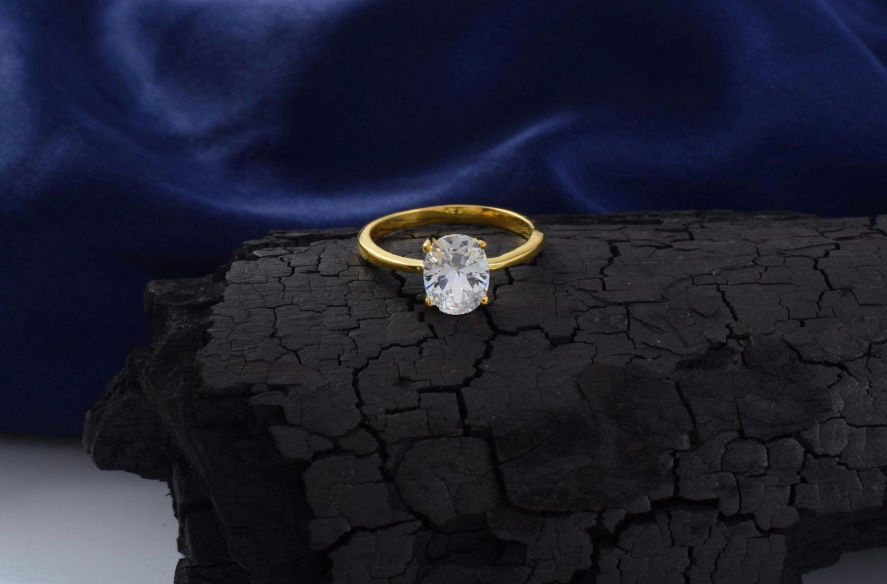
Asymmetry in design is often supported by the use of unconventional diamond cuts. While the round brilliant cut remains a classic, designers are increasingly favoring fancy shapes that lend themselves to irregular arrangements. Elongated cuts like the marquise and pear are being set at jaunty angles, avoiding the traditional north-south or east-west orientation.
Furthermore, there is a surge in the use of geometric and "abstract" diamond shapes. Hexagons, kites, lozenges, and shield cuts are being used to create mosaic-like patterns that refuse to adhere to a grid.
These sharp, angular forms feel modern and edgy, appealing to a generation that values innovation over tradition. Even raw, uncut diamonds are finding their way into high jewelry, celebrated for their natural, irregular silhouettes that ensure no two pieces are ever truly alike.
Redefining Commitment with Asymmetrical Engagement Rings
The bridal sector, historically the most conservative area of jewelry, has also embraced this avant-garde shift. The "Toi et Moi" (You and Me) ring style has seen a massive resurgence. Featuring two gemstones set side-by-side, these rings often pair diamonds of different cuts or sizes, or even mix diamonds with colored gemstones.
Beyond the two-stone look, cluster rings are gaining traction. These designs feature a central stone surrounded by smaller diamonds scattered in a spray or organic grouping, rather than a uniform halo. This "perfectly imperfect" arrangement creates a sense of movement and life, mimicking forms found in nature, such as a blossoming flower or a constellation of stars.
The Psychology of the Imperfect
Why is this trend resonating so deeply right now? Psychologically, asymmetry speaks to the human experience. Life is rarely perfectly balanced; it is full of twists, turns, and unexpected moments. Jewelry that mirrors this reality feels more authentic to the modern wearer. It aligns with the Japanese philosophy of Wabi-sabi, which finds beauty in the imperfect, the impermanent, and the incomplete.
Moreover, as buyers seek out more contemporary diamond jewelry, they are looking for items that serve as conversation starters. An asymmetrical necklace or a ring with an offset stone signals confidence. It suggests that the wearer makes their own rules and is not bound by convention.
In a digital age where everyone can have the same luxury goods, wearing something that looks unique is the ultimate status symbol.
A Lasting Shift in Luxury

The rise of asymmetry in diamond jewelry is more than just a passing fad; it is a reflection of a broader cultural shift towards individualism. By embracing unconventional forms, designers are opening up a new world of creative possibilities, liberating diamonds from the stiff settings of the past.
Whether it is through a pair of mismatched earrings that play with proportion or an engagement ring that defies expectations, this trend proves that beauty does not require symmetry. In fact, it is often in the unexpected, the off-balance, and the unique that we find the most captivating brilliance.


