
Why Architectural CAD Drafting Services Are Crucial for BIM-Ready Project Documentation
- Dec 4, 2025
- 5 min read

In the past decade, the UK construction and architecture landscape has seen a major shift toward digital transformation. From the government’s BIM mandates to the rapid adoption of cloud-based collaboration, the industry is evolving faster than ever. Today, accuracy, coordination, and data transparency are no longer “nice to have”; they're essential for winning tenders, reducing risks, and delivering modern buildings.
At the centre of this transformation lies one foundational element: high-quality Architectural CAD Drafting Services. While BIM and 3D modelling often steal the spotlight, neither can function effectively without clean, precise, and standards-compliant CAD documentation developed at the early stages. Across the UK, architectural firms, contractors, and consultants increasingly rely on professional drafting support to achieve BIM-ready designs, avoid costly rework, and accelerate project approvals.
This article explores why Architectural CAD Drafting Services matter more than ever and why they form the backbone of BIM-ready project documentation.
Why Are Architectural CAD Drafting Services So Important for BIM-Ready Projects?
BIM (Building Information Modelling) is fundamentally about data, coordination, and collaboration. However, the foundation of every BIM workflow still begins with accurate 2D drawings. Whether you’re working in Revit, ArchiCAD, Vectorworks, or Bentley Systems, the BIM model is only as reliable as the CAD inputs used to build it.
This is why Architectural CAD Drafting Services play such a critical role. They ensure documentation is:
Dimensionally accurate
Standardised according to BS and PAS guidelines
Ready for LOD workflows
Compatible with BIM Level 2 and Level 3 environments
Suitable for multi-disciplinary coordination
Without clean and precise CAD data, BIM teams struggle with broken geometry, inaccurate layouts, and inconsistent documentation, all of which slow down design development and increase project risks.
How Does CAD Drafting Support BIM Compliance in the UK?
The UK is a global leader in BIM adoption. With the government’s BIM Level 2 Mandate for public projects, accurate digital documentation is no longer optional; it's a requirement.
Here’s how professional CAD Drafting Services support BIM compliance:
1. Standardised Drawings for Multi-Discipline Coordination
Architectural CAD drafting ensures that plans, elevations, sections, and details follow industry standards such as:
BS 1192
ISO 19650
UK National Annex
PAS 1192-2
This alignment is essential for accurate BIM modelling and clash-free coordination.
2. Clear Layer Management and File Structuring
Drafting teams create drawings with consistent:
Layers
Line weights
Hatch patterns
Annotation styles
This makes it seamless for BIM technicians to build models without cleaning messy files.
3. Accurate Base Plans for BIM Model Setup
Whether the BIM model is for LOD 200 or LOD 500, it always starts with a clean CAD layout. High-quality 2D CAD Drafting Services reduce errors in:
Room sizing
Wall placement
Grid lines
Openings and fixtures
These details are crucial for data-rich BIM environments.
4. Compatibility with BIM Software
Drafted files must be imported into software like Revit, Navisworks, ArchiCAD, or Tekla.Professionally drafted CAD files ensure a smooth import with minimal adjustments.
What Are the Biggest Risks of Poor CAD Drafting in BIM Workflows?
Poor documentation can bottleneck an entire project. Industry reports show how costly design errors can be:
When CAD drafting is rushed or inconsistent, the consequences multiply:
Inaccurate BIM Models
Incorrect measurements lead to flawed geometry and incorrect data.
Clashes in MEP & Structural Coordination
BIM relies on accurate backgrounds. If the architectural data is flawed, the model becomes unreliable.
Slow Design Iterations
Designers waste time cleaning up drawings, fixing line weights, or correcting messy layers.
Delays in Approvals and Planning Applications
Stakeholders need clarity, especially UK planning authorities.
Cost Overruns During Construction
Small errors in CAD drawings often escalate into expensive site changes.
This is why many firms now outsource their CAD Drafting Services to ensure consistency, accuracy, and BIM-ready information.
How Do Architectural CAD Drafting Services Improve Project Efficiency?
Whether you’re an architect, design consultant, contractor, or property developer, drafting plays an essential role in project delivery.
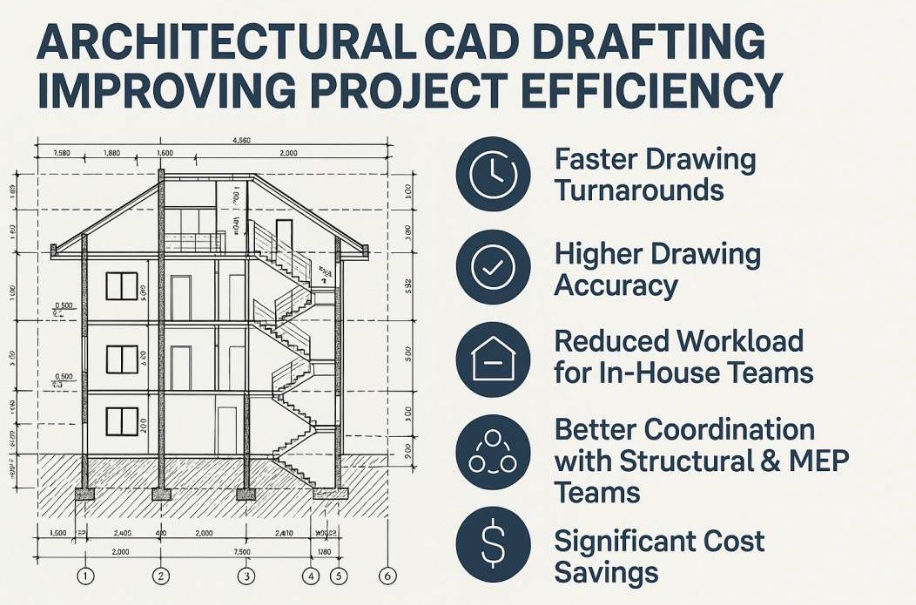
Here’s how it improves efficiency:
1. Faster Drawing Turnarounds
Dedicated drafting teams can produce:
GA drawings
Floor plans
Elevations
Sections
Roof & ceiling plans
Construction details
Much faster than internal teams juggling multiple tasks.
2. Higher Drawing Accuracy
Experts follow strict QA processes and double-checking procedures to minimise errors.
3. Reduced Workload for In-House Teams
Design teams can focus on creativity, concept development, and client management rather than redrawing details.
4. Better Coordination with Structural & MEP Teams
Clean CAD drawings simplify cross-disciplinary coordination and reduce clashes later in BIM.
5. Significant Cost Savings
Outsourcing CAD Drafting Services helps SMEs and larger studios avoid:
Hiring additional staff
Training costs
Software licensing expenses
This is especially important as labour shortages continue to impact the UK construction sector.
How Do 2D CAD Drafting Services Still Play a Role in a BIM-First World?
Many assume 2D CAD is outdated but it remains essential.
Here’s why 2D CAD Drafting Services are still critical:
1. Planning & Building Regulation Drawings
Councils still expect traditional 2D plans, sections, and elevations.
2. Tender Documentation
Contractors rely on clear 2D drawings to understand the scope.
3. Shop Drawings & Fabrication
Fabricators and installers often prefer 2D for clarity and speed.
4. Construction Packages
Site teams use printed 2D drawings daily.
5. Initial Survey & As-Built Documentation
Many surveys begin with 2D inputs before moving into BIM.
In short, BIM starts with CAD, and CAD stays relevant throughout the entire lifecycle of a building.
How Do CAD Drawing Services Support Digital Transformation in Construction?
Digital adoption is accelerating. Research from NBS shows global BIM adoption rising significantly year-over-year. The UK is especially ahead.
CAD drawing services play a major role in this shift:
Enabling Digital Twins
Accurate CAD creates the base geometry for BIM-driven digital twins.
Supporting Offsite & Modular Construction
Prefabrication requires precise, detailed drawings.
Improving Collaboration Across Stakeholders
Architects, engineers, contractors, and planners can work from the same accurate information.
Enhancing Project Predictability
Accurate drawings help reduce RFIs, revisions, and site changes.
What Should You Look for in an Architectural CAD Drafting Partner?
To ensure BIM-ready documentation, look for:
Experience with UK standards (BS / PAS / ISO 19650)
Strong layering and annotation discipline
Ability to deliver drawings at multiple scales (1:20, 1:50, 1:100)
A proven QA/QC drafting workflow
Knowledge of BIM Level 2 requirements
Fast turnaround and revision support
Familiarity with planning and regulatory requirements
Choosing the right partner ensures your BIM models are accurate, compliant, and ready for multi-discipline coordination.
Conclusion
While BIM and 3D technologies shape the future of design and construction, the foundation of every successful project still lies in precise, high-quality Architectural CAD Drafting Services. The shift toward digital workflows, higher regulatory demands, and the need for coordinated project documentation make professional drafting more important than ever.
From architectural drawings to construction packs, from planning submissions to BIM foundations, CAD drafting ensures clarity, accuracy, and compliance.
For companies seeking reliable, consistent, and BIM-ready documentation, partnering with an experienced UK-based CAD drafting company can streamline workflows, reduce errors, and enhance overall project outcomes.


