
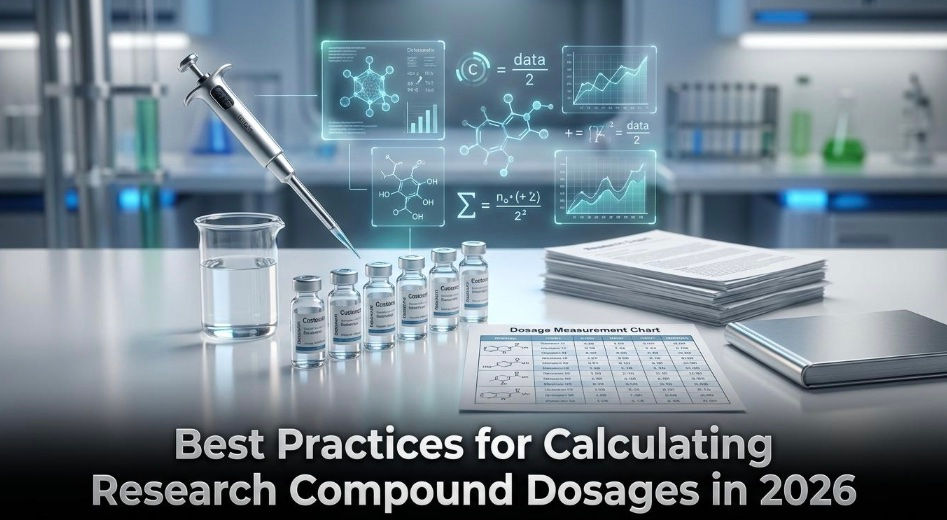
Best Practices for Calculating Research Compound Dosages in 2026
Precision is everything in laboratory research. When working with synthetic peptides and other research-only compounds, accurate dosage calculation is not a minor detail. It is the foundation that every subsequent step of your experiment rests on. Getting it right the first time protects the integrity of your data and prevents costly preparation errors from cascading through your entire protocol.
This guide covers the core practices that research teams should follow when calculating compound dosages in 2026.
Why Dosage Calculation Errors Are So Costly
One Mistake Affects Everything Downstream
In a research setting, a preparation error at the reconstitution stage affects every sample drawn from that stock. If your working solution is twice the intended concentration, every data point collected from it reflects that error. Identifying this kind of mistake after the fact requires repeating work that may have taken days to complete.
The stakes are high enough that building verification steps into your calculation process is not optional. It is a core part of responsible laboratory practice.
Unit Conversions Are a Common Source of Error
Many calculation mistakes come down to unit handling. Moving between milligrams and micrograms, or between milliliters and microliters, introduces multiple opportunities for errors that are easy to make and easy to miss during a quick review. Standardizing how your team records and converts units reduces this risk significantly.
The Core Inputs for Accurate Dosage Calculation
What You Need Before You Start
Every dosage calculation for a lyophilized research compound requires three pieces of information: the total mass of the compound in the vial, the molecular weight of the specific compound as confirmed by its certificate of analysis, and the target concentration you need for your protocol.
With these three values, you can calculate the volume of solvent needed to achieve your desired working concentration. Missing or approximating any of these inputs introduces error from the very start.
Always Use Confirmed Molecular Weight
The molecular weight used in your calculation must come from the certificate of analysis for the specific batch you are working with, not from a general reference or a previous order. Batch-to-batch differences, while typically small, can affect precise calculations. Using confirmed data every time is a simple habit that meaningfully improves accuracy.
Online tools remove much of the manual calculation burden. A well-designed Peptide Calculator handles the unit conversions and concentration math automatically, reducing the chance of arithmetic errors during preparation.
Building a Reliable Calculation Workflow
Standardize Your Process Across the Team
If multiple researchers in your laboratory prepare compounds independently, inconsistencies in method can produce inconsistencies in results. Establish a shared protocol for how calculations are performed and documented. Everyone should use the same input sources, the same unit conventions, and the same verification steps.
Written protocols are more reliable than informal habits, especially when new team members join or when preparation tasks are handed off between researchers.
Verify Before You Prepare
Before drawing any solvent, take sixty seconds to cross-check your calculation. You can do this manually, using a second tool, or by asking a colleague to run the same numbers independently. Two matching results from different sources give you much stronger confidence than one result from a single method.
This cross-verification step adds almost no time to your workflow but catches the kinds of errors that are otherwise invisible until results start looking unusual.
Document Every Calculation
Record the inputs and outputs of every dosage calculation as part of your standard preparation notes. Include the compound name, batch number, molecular weight used, target concentration, calculated solvent volume, actual solvent added, and the date of preparation.
This documentation makes it possible to trace any anomalous result back to a preparation variable and supports the audit trail that most institutional research protocols require.
A Peptide Calculator that clearly displays all inputs alongside the calculated output makes this documentation step faster and more consistent across your team.
Practical Tips for 2026 Research Teams
Keep a dedicated preparation log separate from your experimental data notebook. This makes it easier to review preparation records when troubleshooting results without sorting through unrelated experimental notes.
When working with a compound for the first time, prepare a small test volume before committing your full stock. This gives you a chance to confirm that your calculation produces the expected physical result before using material that may be difficult to replace.
Review your calculation tools periodically to confirm they are still functioning correctly. Online tools can update or change, and a tool that produced reliable results last year should be re-verified before continued use.
The Takeaway
Accurate dosage calculation is a skill that improves with deliberate practice and consistent process. In 2026, the combination of reliable online tools, standardized team protocols, and thorough documentation gives research laboratories every resource they need to get preparation right every time.
Build good habits early and they will serve your research for the long term.
Disclaimer: All peptides and research compounds referenced in this article are intended strictly for laboratory and scientific research purposes only. They are not intended for human or animal consumption, medical treatment, or any therapeutic application. Always follow your institution's established safety protocols and all applicable regulatory requirements when preparing and handling research materials.
A Beginner's Guide to TB-500 and Laboratory Recovery Research
If you follow peptide science at all, you have likely heard the name TB-500 come up. It is one of the more talked-about compounds in recovery research circles, and for good reason. But what exactly is it, and why are researchers so interested in it? Let us break it down in simple terms.

What Is TB-500?
TB-500 is a synthetic version of a naturally occurring protein fragment called Thymosin Beta-4. This protein exists in almost every tissue in the human body and is believed to play a role in how cells respond to damage and stress.
In scientific research, TB-500 is studied for its potential involvement in cellular repair, tissue recovery, and inflammation regulation. It is important to note that it is strictly a research compound, not a supplement or medication.
Why Scientists Study It
Cellular Repair and Recovery
The primary reason TB-500 draws attention in laboratory settings is its possible role in tissue repair. Studies suggest it may support the process of cell migration, which is how cells travel to damaged areas to begin repair work.
Researchers are also looking at its connection to angiogenesis, the formation of new blood vessels. Both of these processes are central to how the body responds to injury at a biological level.
Inflammation Response
Some early laboratory findings suggest TB-500 may interact with inflammatory pathways in tissue samples. This makes it an interesting subject for researchers studying how the body manages swelling and cellular stress after injury.
These findings are still in early stages, and no firm conclusions have been drawn outside of controlled research environments.
How It Is Used in a Lab Setting
TB-500 typically comes as a lyophilized powder, which means it has been freeze-dried for stability. Before use in studies, researchers reconstitute it with bacteriostatic water in precise measurements.
Anyone conducting studies with this compound should source it carefully. Purity and quality directly affect the reliability of research results. If you are a researcher looking to start a study, you can Buy TB 500 Research Peptide from a supplier that offers verified lab-grade quality and third-party testing documentation.
Practical Tips for Beginner Researchers
Always Check for a Certificate of Analysis
A Certificate of Analysis, or CoA, is a document from an independent lab confirming the purity and composition of a peptide. Never skip this step when sourcing any research compound.
Store It Correctly
TB-500 is sensitive to heat and light. Keep it refrigerated when not in use, and avoid repeated temperature changes, as this can affect its stability and your results.
Keep Detailed Records
Good science depends on accurate documentation. Record every measurement, observation, and result throughout your study. This makes your findings more reliable and reproducible.
A Few Questions Beginners Often Ask
Is TB-500 the same thing as Thymosin Beta-4? Not exactly. TB-500 is a specific fragment of the full Thymosin Beta-4 protein. It shares similar characteristics but is not the complete protein.
Is it safe for human use? No. TB-500 is approved only for use in controlled laboratory research. It is not intended for human or animal consumption under any circumstances.
How do I find a trustworthy supplier? Look for companies that provide transparent lab reports and independent testing. Researchers can Buy TB 500 Research Peptide through verified sources that meet scientific-grade standards and follow proper handling protocols.
Final Thoughts
TB-500 is a genuinely interesting compound for anyone exploring peptide science and recovery biology. The research around it is still developing, but its potential in understanding cellular repair and tissue recovery makes it a worthy subject of study.
If you are just getting started, focus on understanding the science first, source carefully, and always follow proper lab protocols. Good research starts with good preparation.
Disclaimer: TB-500 is intended strictly for laboratory and in-vitro research purposes only. It is not approved for human or animal use, consumption, or any therapeutic application. This article is purely educational and does not constitute medical, legal, or professional advice. Always adhere to your local regulations and institutional guidelines when working with research peptides or any scientific compounds.


