
BIG. Building an Inner Architecture. By Maite Nobo.
I have always understood art the way an architect understands space: as something that must be built with intention, integrity, and restraint. My work does not begin with decoration or narrative; it begins with foundation. What supports us? What holds when everything else is removed? These questions have guided both my life and my practice, eventually giving rise to BIG.

I was born in Havana, at the precise moment when political collapse reshaped an entire country. My family fled Cuba during the revolution, leaving behind lineage, land, and certainty. I arrived in New York City as an infant refugee, carrying none of that history consciously, yet shaped by it entirely. Displacement teaches you early that nothing is permanent and that whatever endures must be carefully constructed. This understanding, though unspoken for many years, became the framework through which I view both space and self.

That perspective led me naturally to architecture. I was formally trained in interior design, deeply influenced by the Bauhaus movement and its philosophy of reduction, clarity, and purpose. Less is more was never an aesthetic preference for me; it was a discipline. Reduction reveals truth. When excess is stripped away, what remains must justify its presence. This belief governs not only how I design, but how I live.
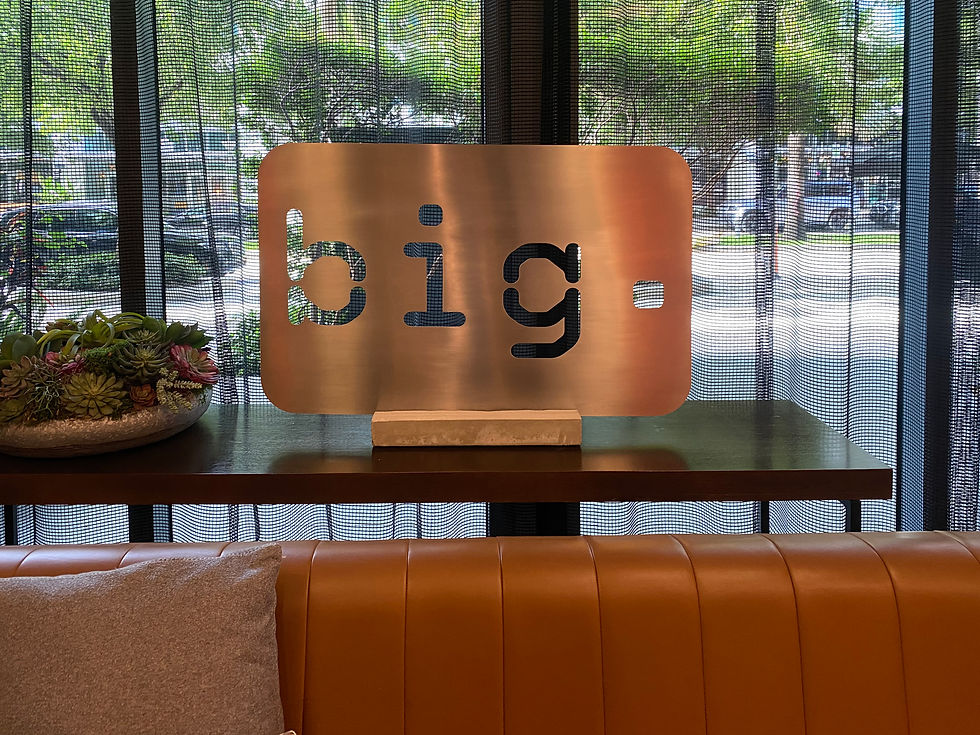
My architectural training taught me to see relationships between proportion and emotion, between material and memory, between structure and spirit. Those lessons carried seamlessly into my art practice. I do not approach a surface as a blank canvas, but as a site. Each work is constructed, layered, and resolved with the same care one would apply to a building meant to last.
Materiality is central to this process. I work across metals, wood, concrete, and architectural substrate, materials traditionally associated with construction rather than fine art. I am drawn to surfaces that carry weight and labor, materials designed to endure weather, time, and use. Architectural substrate, in particular, holds quiet symbolism for me. It exists to protect what lies beneath, unseen yet essential. Working with construction materials represents the necessity of building a strong foundation in life, structurally, emotionally, and spiritually. Just as architecture fails without integrity below the surface, so do people.

There is an honesty in these materials that I trust. They resist ornamentation. They demand respect. Their imperfections are not flaws but records of process. In this way, the work becomes less about surface beauty and more about inner coherence.
My compositions rely on repetition, grids, codes, and proportion. These systems function as stabilizers rather than constraints. Predictability creates rhythm; rhythm creates calm. Within that calm, the body softens and the mind quiets. I am not interested in spectacle or visual noise. I want the work to slow the viewer down, to invite stillness in a culture that rarely allows it. Emotion is present, but it is disciplined. Intuition operates within structure.
For many years, painting was private, a form of therapy, a way to process loss, betrayal, and the fractures of a life lived intensely. Over time, something shifted. The work stopped being about release and became about transmission. I was painting messages. Not literal messages, but encoded ones. Meaning in my work is not delivered; it is discovered. The viewer must remain present long enough for understanding to surface.

This intentional restraint is particularly evident in my smaller works on paper, which I call Big. Celestials. These pieces offer a counterpoint to the architectural solidity of larger BIG. works. Intimate in scale, they invite close looking and quiet engagement. I call the series Celestial because it embraces the full spectrum of color, much like light passing through sacred stained glass. Every hue, from the deepest black to the purest white, and all tonal variations in between holds presence and meaning. Black embodies quiet mystery. White offers gentle radiance. The remaining colors coexist in deliberate harmony, reflecting the subtle beauty of creation.
The Celestials are contemplative rather than expressive. They are not meant to be decoded, but experienced. In their stillness, there is space for breath, for reflection, for a sense of infinite continuity. They offer a moment of pause, a small window into something larger than the self. Even in their quiet, each one carries the subtle rhythm of gesture, a tracing of attention and presence, like calligraphy written by the body itself. In this series I use calligraphy as an extension of the body within my work. Each stroke flows from breath, intention, and the subtle rhythm of the hand, carrying presence and awareness. Movement records tension and release, pressure and pause, making visible what is felt but not always named. Through calligraphy, I honor the full spectrum of human emotion, grief, hope, patience, and love without literal depiction. The body remembers what the mind cannot, and the mark becomes a trace of that memory. Discipline and surrender coexist; structure becomes vessel, and feeling becomes tangible.

A more recent extension of this language appears in a series titled Big. To All Eternity. In contrast to the material restraint and architectural gravity of earlier BIG. works, this series is unapologetically graphic, chromatic, and visually expansive. Organized through grid-based systems, the works operate at the intersection of order and infinity, where repetition becomes a structural and conceptual device rather than a limitation.
The series originates from a dream in which I am endlessly typing the same word (BIG.), without completion or terminal point. The gesture initially recalls childhood punishment, repetition as discipline, obedience enforced through duration. As the dream unfolds, however, the meaning shifts. What appears punitive reveals itself as devotional: a meditation on God’s eternity and humanity’s place within it.
Within this framework, repetition functions as both labor and reverence. The grid becomes a temporal field, a visual architecture through which time is suspended and attention sustained. Each iteration is simultaneously uniform and singular, reflecting the paradox of eternity itself, recurrence without redundancy.
Color is central to Big. To All Eternity. The palette is deliberately open, allowing for infinite chromatic combinations that mirror the boundless variability of creation. While the grid establishes containment and order, color introduces vitality, movement, and difference. Freedom, in this series, does not exist out-side the system but emerges from within it, reinforcing the belief that structure and expansiveness are interdependent conditions.
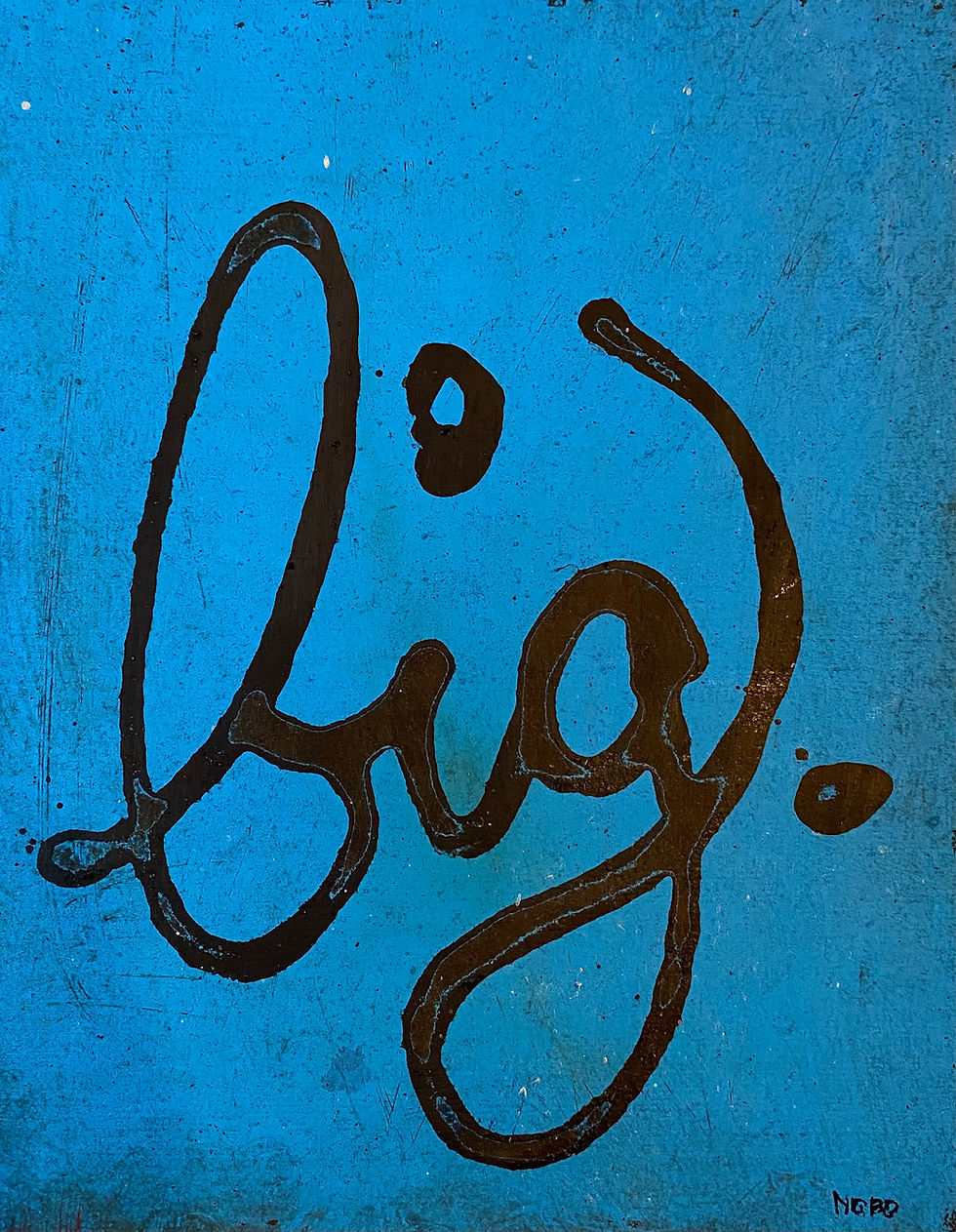
At the conceptual center of my practice is BIG., created in 2019. BIG. operates as a contemporary cultural sign, inheriting the logic of generational images such as the 1960s smiley face while reconfiguring it for a post-digital condition defined by distraction and image saturation. Its formal economy, legibility, repetition, and seriality enables circulation across contexts, yet its restraint redirects these mechanisms toward attention, faith, and interior structure. Positioned at the intersection of post-minimal seriality and conceptual practice, the work enacts reduction as both a critical strategy and a moral framework, privileging presence over consumption. The original image adopts the proportions of a cell phone, the defining object of our era, simultaneously connecting and distracting us. At its center appears a single word: Big. The typography references early forms of lettering legible to both humans and machines, subtly bridging antiquity and digital futurism. BIG. functions as an interruption. It asks the viewer to disengage from constant stimulation and re-enter physical presence.
BIG. is not about scale. It is about courage.
For me, BIG. represents unconditional love, boundless, patient, and non-transactional. Rooted in faith, the work is not symbolic in a traditional sense, nor is it didactic. It does not instruct; it invites. To think Big is to expand consciousness beyond fear. To love Big is to act with openness and generosity. To do good is to translate inner clarity into lived responsibility.
Transformation, in my experience, is not decorative. It is earned. I believe the most profound growth occurs after disintegration, when identity, comfort, and illusion have been stripped away. In that state of human minimalism, we are left with essence. BIG. occupies that space of reduction, asking not what can be added, but what can be trusted.
By Maite Nobo


