
Petah Coyne: How Much a Heart Can Hold
The Lowe Art Museum at the University of Miami proudly presented Petah Coyne: How Much A Heart Can Hold, featuring more than a dozen expansive mixed-media sculptures spanning decades of work by one of America’s most celebrated contemporary sculptors. The sprawling installations and tactile meditations honor the creative power of women through artistic transformation. Several works are on tour for the first time, and some have never been shown in museums.
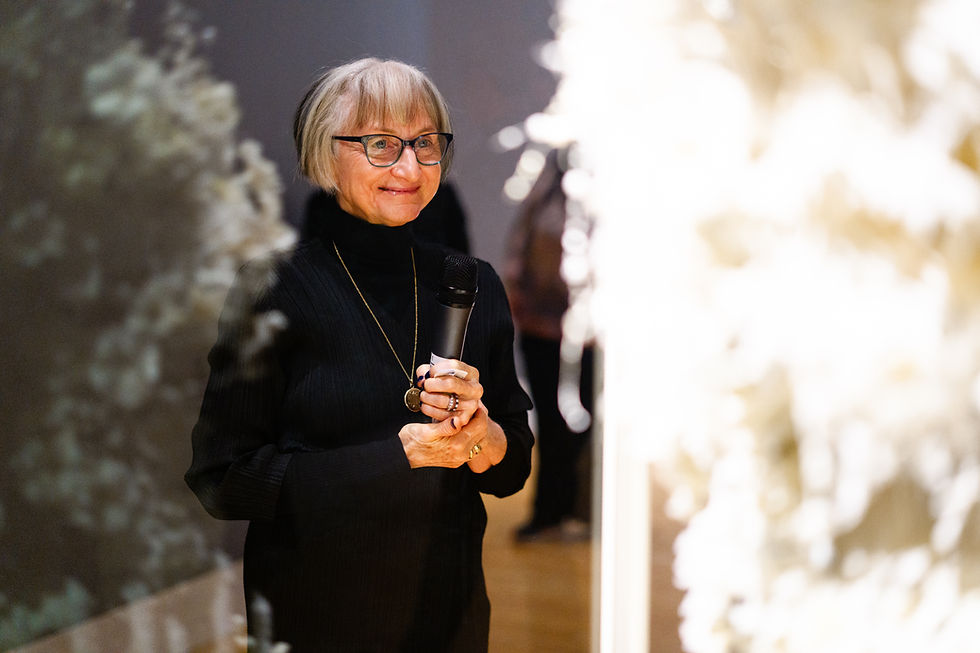
Pulsing at the heart of this museum show is Coyne’s fascination with female identity, and her deep reverence for underrecognized women writers and historical figures, including Zelda Fitzgerald, Joan Didion, Zora Neale Hurston, Jane Austen, and more. The exhibition focuses on the ways her artistic process is inspired by women’s creativity — especially her use of seductive materials to create towering sculptures that bring the viewer in, while confronting the barriers women face. She is best known for the elaborate physicalities of her large-scale hanging sculptures and monumental floor installations, laborious and time-intensive to create. “I think the only way for an artist to know or understand anything is to make work almost from a blind spot, and what you produce speaks to you. Before I begin a sculpture I never know where I am going to go. I think women in particular are given this intuitive instinct. We have this power and we must learn to trust it,” says Petah Coyne. “I am thrilled that this exhibition is traveling to university museums. University students are so open, and they are thinking constantly,” says Coyne.

“Petah Coyne reminds what it is to be human — heart, body, mind, and soul,” says Dr. Jill Deupi, the Lowe Art Museum’s Beaux Arts Executive Director and Chief Curator. “This remarkable exhibition invites us into a wonderland of physical forms whose manifold sources of inspiration are as broad as they are compelling. The viewer leaves the show feeling not only newly inspired, but also newly alive through her work,” adds Dr. Deupi.

A quote by Zelda Fitzgerald inspired the exhibition title: “Nobody has ever measured, even the poets, how much a heart can hold,” said the American writer, dancer and painter. Fittingly, Coyne’s monumental sculpture Zelda is named in Fitzgerald’s honor and anchors the exhibition. Constructed from an astonishing range of materials, the seven-foot-tall work explores Fitzgerald’s legacy, capturing both her brilliance and the professional constraints and obstacles she endured. Zelda ignites the tactile senses, yet a transparent glass box stands between the viewer and the monochromatic work, representing a cage that is a metaphor for Zelda Fitzgerald’s life. Her accomplishments were thwarted by the oppressive time in which she lived, and overshadowed by her marriage to F. Scott Fitzgerald (many lines from her letters appear in her husband’s writings).

Literature, film, art history, and the depths of an individual’s soul are all springboards for Coyne’s incessant and unrelenting imagination. Because she has dyslexia, the stories in the books that inspire her are often processed differently by Coyne. She attributes the resulting artworks that hang from the ceiling (instead of standing from the floor) as a product of her dyslexia. In Coyne’s hands, materials, like our lived experiences, are endlessly re-purposed and reborn into something new.
A lover of objects, she gathers her unorthodox materials from everywhere and wrestles with them until they come together perfectly, pushing them as far as she can. She has received critical acclaim for using intricate, unconventional materials — trees, human hair, dead fish, mud, shackles, scrap metal, wax, silk flowers, black sand, hospital bandages, chandeliers, taxidermy, and more — to create sculptures that are both precise in their attention to detail and baroque in their emotional range.
One of the large-scale sculptures in this exhibition is made of a 1950s Airstream trailer that was totaled in an accident and shredded into thin stainless-steel wire that looks like hair, from a facility that shreds and recycles metals from cars, trains, and trucks. “I spoke to this object and told this Airstream trailer that even though it had been totaled, I would give it new life by sending it to museums for people to enjoy, allowing it to live forever,” says Coyne.
The New York-based artist has been chosen for more than 45 solo museum shows throughout her career. In 2024, Coyne received the Lifetime Achievement Award from the International Sculpture Center. Her national honors include awards from the Guggenheim Memorial Foundation, the Rockefeller Foundation, three awards from the National Endowment for the Arts, the Pollock-Krasner Foundation, the Joan Mitchell Foundation, the New York Foundation for the Arts, two International Association of Art Critics Awards, and more.

While her sculptures are meticulously constructed, Coyne embraces a process rooted in intuition and emotion, often crafting works without preliminary drawings or plans. Pre-planning is not a part of her artistic process. She allows her feelings to guide her work. Although she has her own ideas about her finished works, she wants viewers to experience her art in the same way she approaches creating it — with an open heart. “I hope they open up their hearts and just look at the pieces,” says Coyne. “It doesn’t matter what I feel about the work or what I made it for. If you just open yourself, you’ll feel something and that would be the most wonderful thing if they would do that.”
Petah Coyne: How Much A Heart Can Hold was organized by the Chazen Museum of Art, University of Wisconsin–Madison, and was curated by Amy Gilman, the Director of the Chazen. The exhibition is organized into three thematic sections — Women’s Work, Women Obscured and Transformed, and Women’s Relationships. Visitors will also view a wall featuring the multi-paneled photo project entitled “The Real Guerrillas: The Early Years.” The project is an ongoing collaboration with artist Kathy Grove to photograph the Guerrilla Girls, an anonymous artist-activist group that formed in New York in 1985 to expose gender and ethnic bias in art and culture.
Her work is held in the permanent collections of several leading institutions, including: the Museum of Modern Art, the Metropolitan Museum of Art, the Guggenheim Museum, Whitney Museum of American Art, and many others. Read more about the artist at www.petahcoyne.org.


